A survey of older adults found that those with active hobbies reported better health, more happiness, fewer symptoms of depression, and higher life satisfaction than peers who had none. The finding is worth pausing on, because it cuts against a story most adults have been telling themselves for thirty or forty years: that cooking is a chore, a logistics problem, a thing you survive on Tuesday nights between work and bedtime.
The conventional reading of a sixty-something who suddenly buys a Dutch oven, starts watching pasta videos, or signs up for a knife skills class is that retirement created a vacuum and the kitchen filled it. Empty calendar, new hobby. Time to kill, dough to knead. That framing is tidy, and it is also probably wrong — or at least it misses the more interesting thing happening underneath. The shift is less about filling time and more about reclaiming a daily practice that, for most of adult life, was handed over to obligation, speed, and other people's preferences.
What the kitchen used to mean, and what it became
For most adults between roughly twenty-five and sixty, cooking is a service function inside a larger production schedule. There are children to feed, partners with opinions, meetings that ran long, school pickups, and the quiet math of whether the chicken in the fridge will survive until Thursday. Even people who genuinely like food find that the act of cooking gets compressed into a problem to be solved as efficiently as possible. The meal becomes the output. The process becomes friction.
That compression has a psychological cost that nobody really tracks until it lifts. The kitchen — historically one of the most sensory, tactile, slow-paced rooms in a home — gets converted into a small factory floor. The same hands that could be learning something instead repeat what they already know, because Wednesday at 6:45 is not the time to experiment with a new braise. Decades of this train a person to associate cooking with depletion rather than restoration.
When the obligations recede — kids grown, careers winding down, the weeknight clock no longer ticking — the kitchen is suddenly available again as a space rather than a station. And a surprising number of people in their sixties walk back into it as if meeting an old acquaintance they had been too busy to call.
Why Erikson's framework explains it better than "boredom"
The developmental psychologist Erik Erikson built a model of the lifespan that treats adulthood as a series of active growth stages rather than a slow descent. In Erikson's framework, middle adulthood centers on generativity versus stagnation — the drive to give back, to mentor, to create something durable for the next generation. Late adulthood then moves into ego integrity versus despair, the work of making sense of the life one has lived.
Cooking, viewed through that lens, stops looking like a hobby and starts looking like a near-perfect vehicle for both tasks at once. A pot of soup taught to a grandchild is generativity. A recipe finally mastered after forty years of meaning to learn it is integrity. The kitchen becomes one of the few domestic spaces where you can simultaneously produce something for others, refine a skill for yourself, and sit with the long arc of your own life — your mother's hands, your first apartment, the meals you fed your kids when you were too tired to taste them.
This is also why the filling-time interpretation is the wrong frame. People who are merely filling time pick activities with low stakes and low meaning. People reclaiming a ritual pick activities saturated with both.
The motivation actually flips
Self-determination theory, developed by psychologists Edward Deci and Richard Ryan, holds that humans experience well-being when activities meet three needs: autonomy (you chose it), competence (you're getting better at it), and relatedness (it connects you to others). External obligation undercuts all three. You did not choose to make dinner; you had to. You are not getting better; you are just getting through. The relatedness piece, ironically, often gets hollowed out too — feeding people you love can feel transactional when the clock is the boss.
Something different happens in the sixties. The same physical act — chopping an onion, deglazing a pan — gets re-staged under all three conditions at once. Nobody is making you cook. You can take ninety minutes for a sauce that used to take fifteen. You are choosing to learn something specific, which means competence is now on the table in a way it wasn't when survival mode dominated. And the people you feed are people you actually want to feed, often fewer of them, often slower meals.
The activity didn't change. The conditions around the activity changed. That is the difference between obligation and ritual.
The brain rewards this more than people expect
There is a neurological dividend that makes the shift stickier than it might otherwise be. Cooking sits at the intersection of several things tied to brain health in older adults: novelty, fine motor work, sensory engagement, planning, and often a social component. Hobbies involving new skill acquisition activate neuroplasticity — the brain's ability to form new neural pathways — and this capacity persists across the lifespan, even if learning takes longer than it once did.
Older adults who pick up new hobbies may show changes in brain structure and cognitive processing. Cooking is unusual among hobbies in that it stacks several brain-positive elements at once: you are reading, sequencing, using your hands, smelling, tasting, often standing, sometimes talking to someone, and producing a tangible result.
There is also the stress angle. A person who spent decades cooking under deadline pressure may, for the first time, be cooking under no pressure at all — and the same kitchen that used to spike their stress now lowers it.
Variety, not virtuosity, is the real driver
One reason late-life cooking curiosity sticks while other hobbies fizzle is that it builds in the kind of weekly variation associated with better aging outcomes. Older adults who mix up their weekly habits report better mental health than those locked into rigid routines, and activity diversity itself appears to be the mechanism — not any single "right" activity.
Cooking is structurally diverse in a way that, say, a daily crossword is not. Monday is a stew. Wednesday is a new bread recipe. Saturday is a dinner for friends. Each requires a different set of decisions, ingredients, techniques, and time horizons. The hobby renews itself, which is part of why it tends to expand rather than plateau in people who fall into it later in life.
It also pairs naturally with the unhurried pleasures many people gravitate toward in this stage — the kind of life rhythm VegOut has explored before in the context of the quietly satisfied people in their seventies. The long walk, the good coffee, the finished book, the slow Sunday lunch. Cooking belongs to that family of activities.
The beginner problem nobody warns you about
The most common reason a sixty-something abandons this curiosity within a few months is the discomfort of being a beginner at something in front of yourself. Stepping into novice territory as an adult comes with self-doubt, fear of judgment, and a sense that one ought to already know how to do this by now.
Cooking is uniquely loaded here because most adults already cook. So the move is not from zero to beginner — it is from competent-but-bored to deliberately bad-on-purpose. You have to be willing to ruin a few loaves of bread, burn a pan of caramel, and serve someone you love a meal that doesn't work. The decades of dinner-on-the-table competence become an obstacle, because the ego knows the difference between feeding people and actually learning.
The people who push through this tend to share a particular reframe: they treat the failed dish as the point, not the obstacle. Which is the same posture, broadly, that happier people in the second half of life tend to take toward most things.
What this looks like from the outside vs. the inside
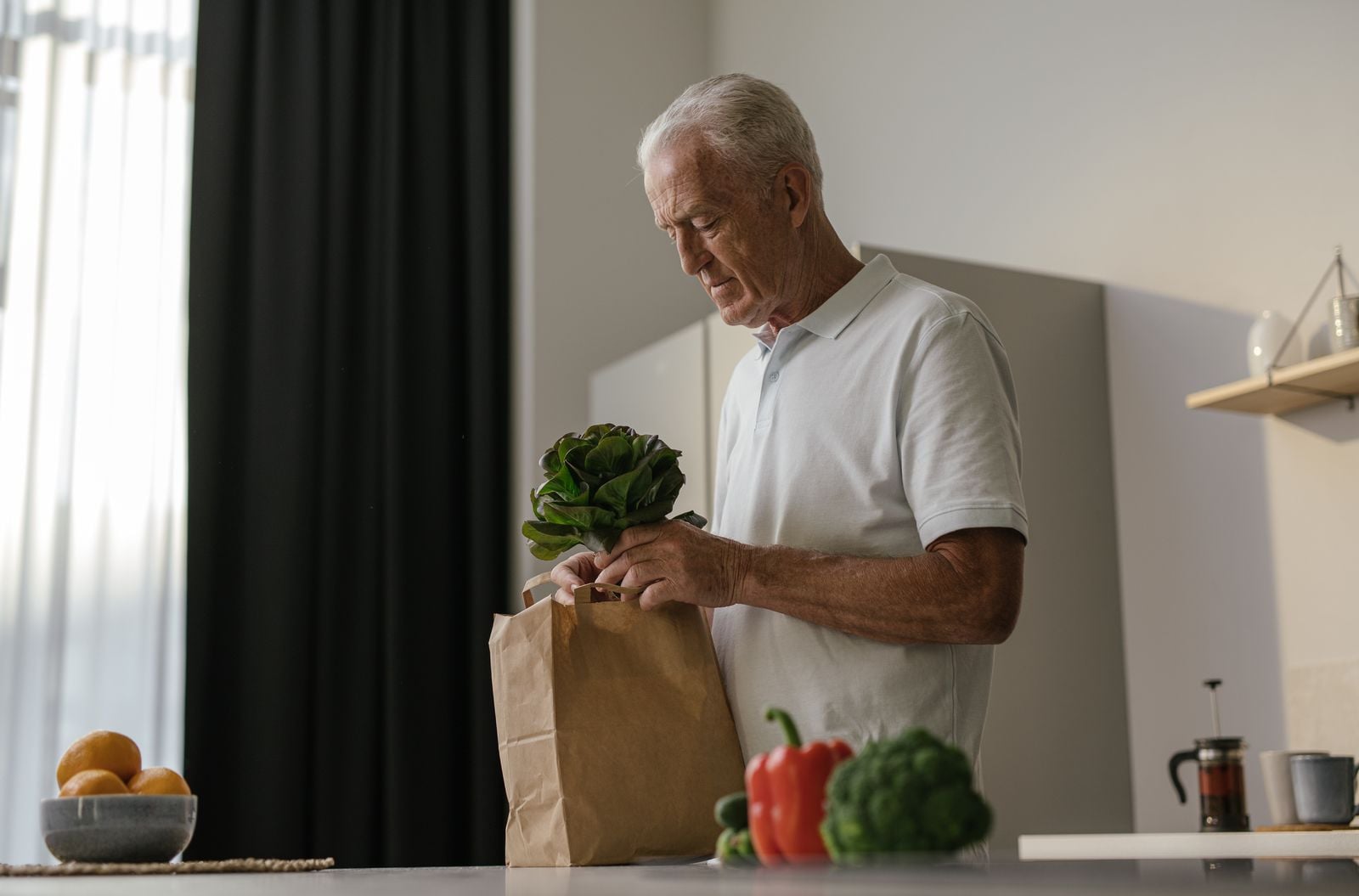
From the outside, the cooking-curious sixty-something looks like someone who has more time. They are buying cookbooks, watching technique videos, wandering around the produce section on a Wednesday morning, asking the fishmonger questions. The interpretation is usually some dismissive version of patronizing encouragement about staying busy.
From the inside, something more specific is happening. A space that was conscripted into duty for thirty or forty years is being reclaimed as a place where attention, autonomy, and pleasure can coexist again. The output — the meal — matters less than the conditions of the making. That is the actual definition of a ritual, as opposed to a task: a ritual is something where the doing is the point.
This also explains why the same activity that felt depleting at forty-two can feel restorative at sixty-four. The act is identical. The relationship to the act has changed completely.
A reasonable caveat
None of this applies uniformly. Plenty of people in their sixties have no interest in cooking and find their generativity and integrity work elsewhere — in gardening, in mentoring, in caring for grandchildren, in volunteer work, in birding, in finally reading the books they were supposed to read in college. The point is not that everyone should cook. The point is that when someone does suddenly drift into the kitchen with new energy, the surface reading of simple boredom usually misses what is actually happening underneath.
What is actually happening is closer to a homecoming. A daily practice that got outsourced to obligation for decades is being repatriated to the person who was doing it all along. The hands are the same hands. The kitchen is the same kitchen. What changed is who the cooking is for.