Precision fermentation startups cracked the science of lab-grown dairy and proteins, attracting billions in funding. But they're hitting an unexpected wall: manufacturers won't touch them at scale.

Add VegOut to your Google News feed. 
What if the future of food already exists in a lab but has nowhere to go? That's the strange bind facing precision fermentation, an industry that promised to remake dairy, eggs, and protein from the molecular level up. Billions flowed in. The science delivered. And then the founders discovered something that no pitch deck had accounted for: there are almost no factories willing or able to produce their products at scale.
The conventional wisdom about alternative proteins has centered on consumer demand. Will people buy it? Does it taste good enough? Can it compete on price? These are fair questions, and they've dominated the conversation for years. But they've also obscured a more fundamental bottleneck. The problem isn't that consumers won't eat fermentation-derived food. The problem is that most of these companies can't physically make enough of it to find out.
The money came fast, then stopped
Between 2020 and 2022, precision fermentation attracted significant attention and investment from venture capital firms convinced that biology was the next platform technology. The numbers were real. So was the optimism.
Then the correction hit. Global agrifoodtech funding declined sharply from its 2021 peak, with few signs of recovery. Precision fermentation startups, many of which had raised Series A or B rounds on the strength of lab-scale proofs of concept, suddenly found themselves in a capital environment that demanded something they didn't have: a clear path to commercial production.
The pullback wasn't unique to fermentation. Foodtech VC activity slowed significantly, with investors shifting decisively toward mature startups with proven business models. Early-stage companies working on novel biology got the message: grow up or go home.
And yet, as vegconomist reported, alternative proteins remained one of the more active subcategories even within a down market. The science still excited people. The gap between excitement and execution just kept widening.
The manufacturing desert
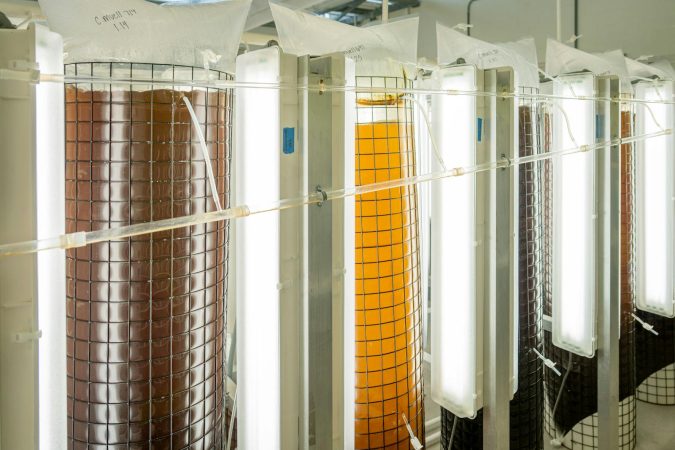
Here's what actually happens when a fermentation startup tries to scale. They've perfected a strain of microorganism in a small bioreactor, maybe 10 or 50 liters. The organism produces a target protein. It works beautifully. The founders raise money, hire a team, and start looking for a contract manufacturer that can run the process at 10,000 or 50,000 liters.
They find almost no one.
The world has enormous fermentation capacity, but most of it is configured for pharmaceuticals, ethanol, or established industrial enzymes. Food-grade precision fermentation requires specific equipment, regulatory clearances, and process expertise that the existing infrastructure simply wasn't designed for. The handful of contract development and manufacturing organizations (CDMOs) that can handle food-grade work are booked, expensive, or both.
The result is a sector full of companies that can make a beautiful sample but can't fill a grocery store shelf. I think about this gap a lot, actually, because I've seen something similar play out in fashion. I spent three years at a sustainable fashion startup in Brooklyn, and our biggest challenge was never the design or the material innovation. It was finding a manufacturer who could produce at a price and volume that made the business viable. We never solved it. The company folded. Watching fermentation startups hit the same wall in food feels uncomfortably familiar.
Who profits from the bottleneck?
The manufacturing shortage isn't an accident of timing. It reflects a structural reality about who controls food production infrastructure. Large incumbent food and ingredient companies own the vast majority of fermentation capacity suitable for food applications. Companies like ADM, Cargill, and DSM-Firmenich have the bioreactors, the regulatory approvals, and the downstream processing equipment. They also have very little incentive to lease that capacity cheaply to startups trying to disrupt their core businesses.
Some incumbents have made strategic moves. ADM partnered with several fermentation startups. Cargill invested in its own precision fermentation capabilities. But these partnerships tend to come with strings: long timelines, volume minimums, and terms that favor the manufacturer. For a startup burning through runway, waiting 18 months for a production slot isn't just inconvenient. It can be fatal.
The dynamic mirrors something we've covered before at VegOut in the agrochemical space, where a small number of corporations control critical supply chains and face accountability only when the pressure becomes impossible to ignore. The food system's infrastructure is concentrated in ways that make disruption genuinely difficult, regardless of how good the science is.
The pivot to "weird ingredients"
Not every fermentation company is stuck. Some have found creative workarounds, partnering with breweries, repurposing pharmaceutical fermenters, or building their own small-scale facilities. Others have pivoted their business models entirely, selling to B2B ingredient buyers rather than trying to launch consumer brands.
Industry analysts have noted startups still finding traction by embedding novel fermentation-derived ingredients into familiar food formats. The approach makes sense: instead of asking consumers to buy a new brand of "animal-free cheese," sell the functional protein to an existing cheese manufacturer who swaps it into their supply chain. The end consumer might never know the difference.
This B2B shift is pragmatic, but it comes with trade-offs. Startups that dreamed of building the next Oatly find themselves becoming invisible ingredient suppliers. The margins are thinner. The brand equity is nonexistent. And the reliance on large food companies to actually adopt the ingredients brings us back to the same power dynamics that created the manufacturing bottleneck in the first place.
There's something worth sitting with here, because it touches on a tension that runs through so much of conscious consumption. We celebrate innovation, then discover the systems that deliver products to our shelves haven't changed at all. It's the same tension behind research linking ultra-processed plant-based foods to health concerns. Good intentions collide with industrial realities.
What would actually fix this?
The honest answer is that manufacturing capacity takes years and hundreds of millions of dollars to build. No amount of clever fundraising copy changes that. But several approaches could accelerate the timeline.
Dedicated food-grade fermentation hubs, funded by a mix of public investment and private capital, could give startups access to production capacity without forcing them into lopsided partnerships with incumbents. The model exists in biotech and pharma, where shared manufacturing facilities helped an entire generation of startups reach commercial scale. Food has been slower to adopt the model, partly because the margins are thinner and partly because governments haven't prioritized it.
Regional manufacturing networks matter too. Most existing fermentation capacity is concentrated in the US, Europe, and parts of Asia. Startups in emerging markets, where fermentation traditions run deep and demand for affordable protein is growing, have even fewer options. Companies in the region are exploring various approaches, including novel feed platforms, a reminder that innovation is happening globally but infrastructure remains stubbornly local.
Regulatory clarity would help too. In the US, the FDA's framework for novel food ingredients produced by precision fermentation requires navigating a process that can be time-consuming. Each new protein requires its own Generally Recognized as Safe (GRAS) determination. Companies report spending months or years navigating the process, which delays their ability to sign manufacturing contracts.
Resourcefulness over resources
I keep returning to a frame that applies well beyond food science. There's a particular kind of resourcefulness that emerges when you don't have access to established systems, a scrappiness that we've written about in the context of household economics. The fermentation startups that survive will likely be the ones that build resourcefulness into their DNA rather than waiting for the infrastructure to catch up.
Some are already doing it. Small companies are forming consortiums to share manufacturing capacity. Others are licensing their strains to established fermentation houses in exchange for guaranteed production runs. A few are taking the riskiest path of all: building their own facilities from scratch, betting that vertical integration will pay off in the long run even if it burns cash in the short term.
The counterargument worth taking seriously is that this is just the normal arc of deep-tech commercialization. Pharmaceuticals took decades to develop reliable contract manufacturing. Solar panels went through a brutal shakeout before manufacturing scaled. Maybe fermentation just needs more time, and the companies that survive the current drought will emerge stronger.
Maybe. But time is the one resource that venture-backed startups don't have in abundance. Every quarter without revenue is a quarter closer to running out of money. The science was supposed to be the hard part. Turns out, making the thing was always the easier challenge. Making enough of it, at a price that works, in a facility that exists? That's where the future of food is actually being decided.
The billions already raised aren't gone. They funded genuine breakthroughs in strain engineering, bioprocess design, and protein functionality. What they didn't fund, because nobody thought they needed to, was the boring, physical, deeply unglamorous work of building places where all that brilliant science can actually become something you eat. Until that changes, precision fermentation will remain one of the most promising technologies in food, perpetually on the verge of transforming everything, and perpetually unable to ship.