Feeding dried red seaweed at half a percent of the diet cut methane yield from beef steers by 68% across 147 days, according to a UC Davis trial published in PLoS ONE on 17 March 2021. On the low-forage finishing ration, the same dose cut methane yield by 80.0%.
The steers on that dose also ate 14% less dry matter than the control group while gaining weight at the same rate. Average daily gain did not differ significantly across groups, at about 1.56 kg a day, so feed conversion efficiency rose 14%.
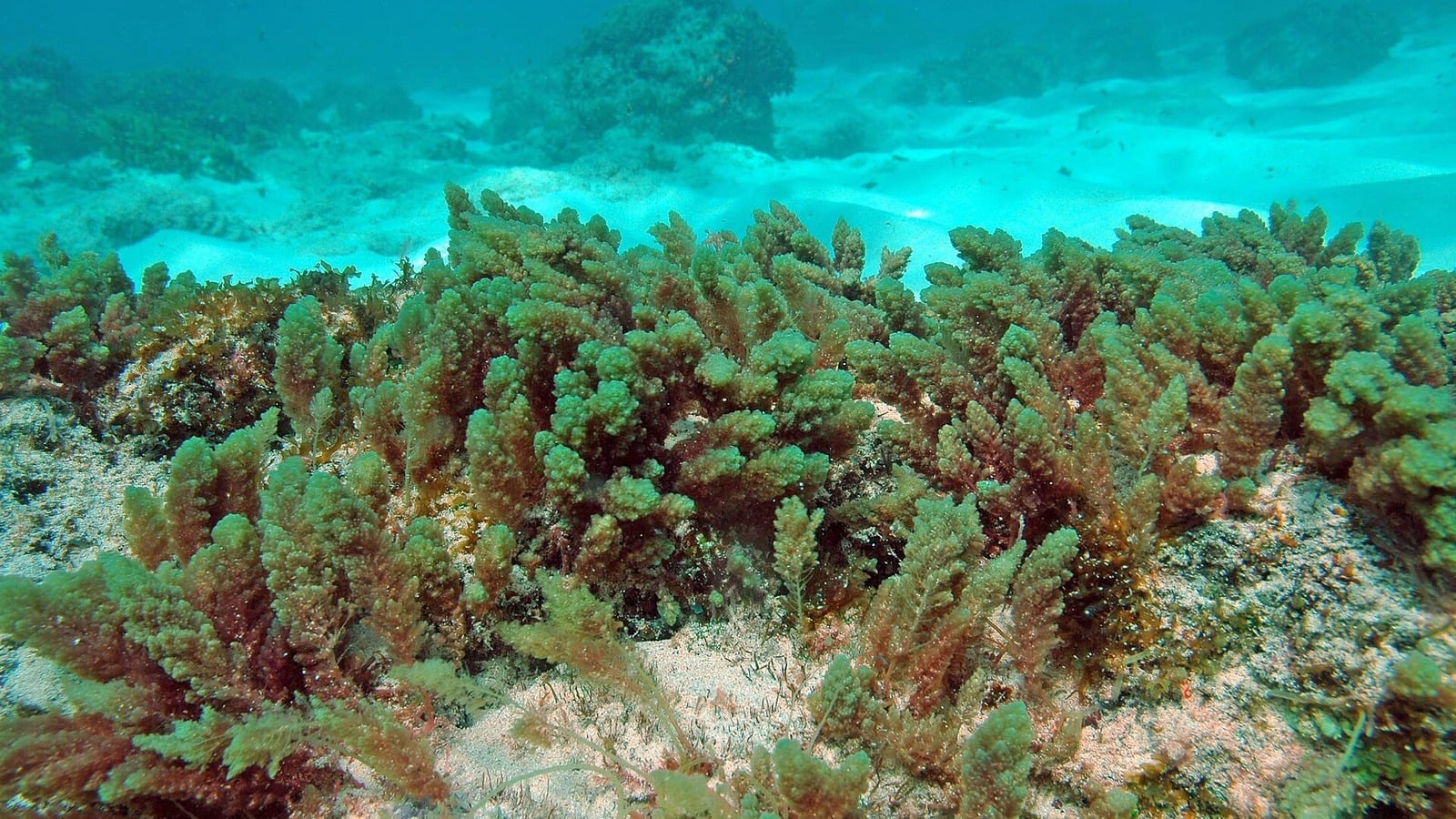
The seaweed was Asparagopsis taxiformis. A widely shared video cites an 82% figure from this work, which is worth checking against what the paper actually reports.
Inside the 147-day feeding trial
Researchers ran 21 Angus-Hereford beef steers on feedlot-style total mixed rations for 147 days, or 21 weeks. Twenty completed the trial through to slaughter at a USDA-inspected commercial packing plant, Cargill Meat Solutions in Fresno, California.
Steers were split into three groups by organic matter intake: a 0% control, a 0.25% low dose and a 0.5% high dose. The seaweed batch contained 7.82 mg/g bromoform and 2.27 mg/g iodine.
The animals moved through three rations in sequence: a high-forage mix at 33.1% NDF, a medium-forage mix at 25.8% NDF, then a low-forage finishing mix at 18.6% NDF. The methane cut got bigger as forage dropped.
For the 0.5% group against the control, methane yield in grams of CH4 per kg of dry matter intake fell by:
- 51.9% on the high-forage ration
- 79.7% on the medium-forage ration
- 80.0% on the low-forage finishing ration
Across all 21 weeks, the 0.5% group cut methane yield 68%, daily methane production 74.9% and methane intensity per kg of gain 73.1%. The 0.25% group cut yield 45%, daily production 50.6% and intensity 50.9%.
Where the video's 82% figure fits
The video says methane is over 80 times more potent than carbon dioxide as a warming agent over a 20-year window, and puts livestock methane at roughly 10% of human-driven greenhouse gas emissions. It says red seaweed added at less than half a percent of the diet dropped methane by 82% in the UC Davis work.
That number maps onto one phase of the trial. On the low-forage finishing ration, the 0.5% group cut daily methane production by 81.9%, which rounds to nearly 82%, and cut methane yield by 80.0%.
Averaged over the full 21 weeks and all three rations, the figure is lower. The 0.5% group cut methane yield 68% and daily production 74.9%. The 0.25% group cut yield 45% and daily production 50.6%. Both framings come from the same paper, but they describe different windows.
The residue and quality checks came back clean. Bromoform was below the 0.06 mg/kg detection limit in strip loin steaks and livers in every group. Iodine in steaks averaged 0.15 µg/g (0.15 ppm) in the 0.5% group, with a range of 0.14 to 0.17 µg/g. The results text prints those figures as mg/g, but Table 6 lists them as ppm and the authors' own intake arithmetic uses µg/g: an adult over 18, whose tolerable upper intake is 1,100 micrograms a day, would have to eat more than 7.3 kg of that meat in a day to reach it.
A consumer taste panel found no significant differences in tenderness, juiciness, flavor or overall acceptability. Carcass quality, rib eye area, proximate composition and Warner-Bratzler shear force tenderness also showed no significant differences. For how different proteins compare on emissions at the plate level, see VegOut's breakdown of Thanksgiving main course emissions data. Related livestock-resource figures sit in the accounts of where the world's soy goes and of beef's water footprint.
What the trial does not settle
These steers ate mixed rations in a feedlot setting, not grass on pasture. The gap shows in the numbers: on the high-forage ration, the 0.5% dose cut methane yield 51.9%, well short of the 80.0% recorded on the finishing ration.
The sample was 21 animals over 21 weeks. The methane cut held for the whole 147 days, but durability past that point was not tested here, and neither was delivering seaweed to grazing herds or growing it at commercial volume.
Hydrogen yield rose 336% in the 0.25% group and 590% in the 0.5% group. CO2 yield rose 13.7% in the 0.5% group, with no significant change in daily CO2 production. Feed cost per kg of gain differed by $0.18 for the low dose and $0.37 for the high dose, differences the authors report as not statistically significant in a sample this size.