Two of the most cited studies on the MIND diet point in different directions, and both reward a close read. In Morris et al. (2015), published in Alzheimer's & Dementia, researchers followed 923 Chicago-area volunteers aged 58 to 98 for an average of 4.5 years. Participants in the top third of MIND diet scores had a 53% lower rate of developing Alzheimer's disease than those in the bottom third, a hazard ratio of 0.47.
Eight years later, Barnes et al. (2023) in the New England Journal of Medicine randomized 604 adults aged 65 or older to either the MIND diet with mild caloric restriction or a control diet with mild caloric restriction for three years. Global cognition improved in both groups, by 0.205 standardized units with MIND and 0.170 in the control group. The mean difference of 0.035 standardized units was not statistically significant (P=0.23).
The two findings are not in direct conflict, because they measured different outcomes. One tracked new Alzheimer's diagnoses in people eating as they chose. The other tracked three-year cognitive test scores in people assigned a diet and given weight-loss support.
Four foods are not the whole MIND diet
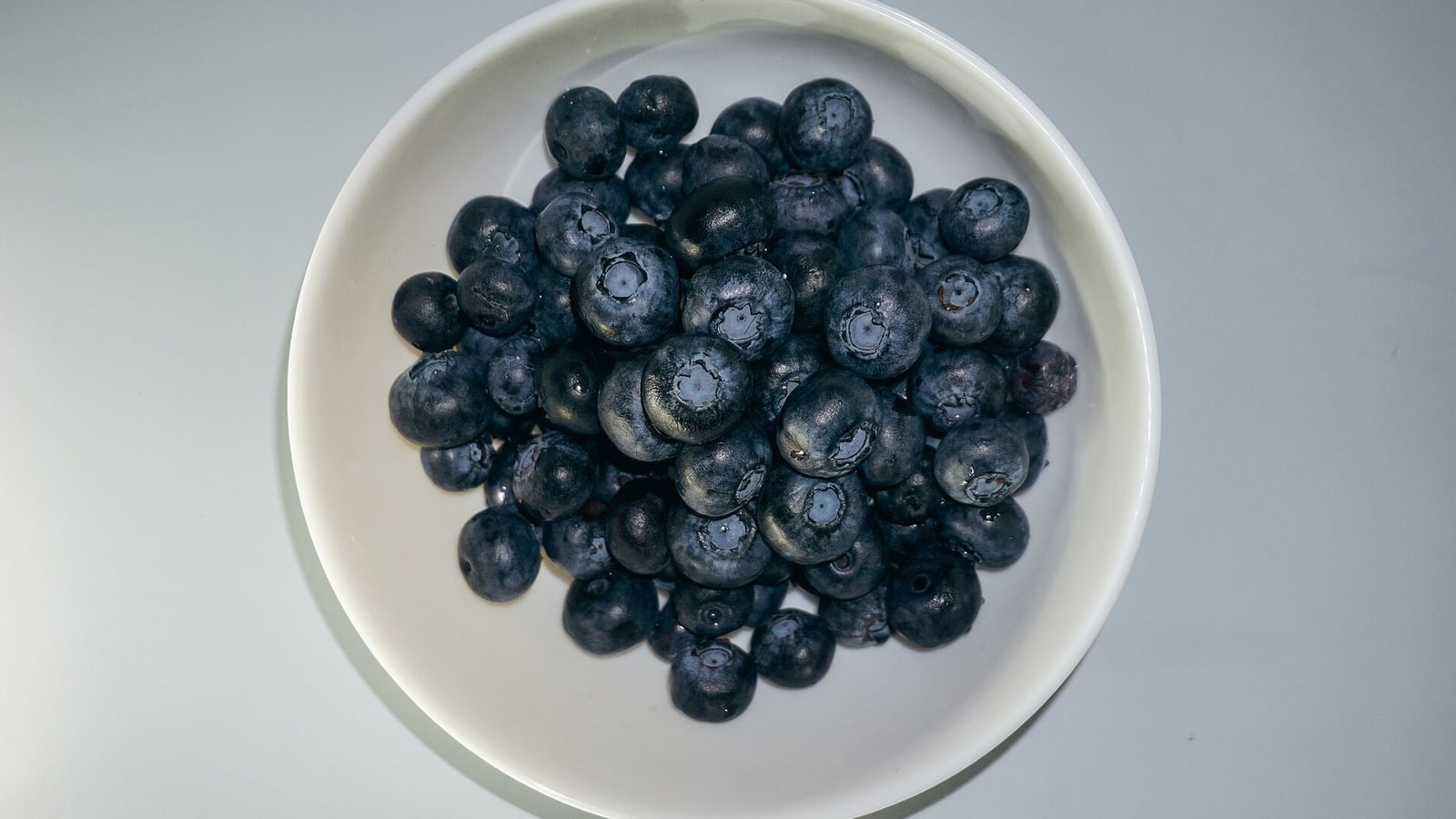
The VegOut video above, The Worst Foods for Your Brain, names spinach, kale and arugula, blueberries, lentils, chickpeas and black beans, and walnuts. Those foods map onto four of the scored groups in the MIND diet. They are not the full pattern.
The MIND score (Mediterranean-DASH Intervention for Neurodegenerative Delay) has 15 components:
- 10 brain-healthy groups: green leafy vegetables, other vegetables, nuts, berries, beans, whole grains, fish, poultry, olive oil and wine
- 5 limited groups: red meats, butter and stick margarine, cheese, pastries and sweets, and fried or fast food
Berries and green leafy vegetables are the items the MIND score specifies that standard Mediterranean and DASH scores do not. The maximum is 15 points. In the Chicago sample, the mean score was 7.4, with a range of 2.5 to 12.5.
The video's other claims, including a 140% rise in Alzheimer's deaths since 2000 and the idea that a single daily serving of greens is tied to a measurably younger brain, do not come from either of these two papers and should not be read as findings from them.
What the Chicago cohort actually found
Morris and colleagues drew their sample from the Rush Memory and Aging Project, made up of volunteers living in retirement communities and senior public housing units around Chicago. Everyone was clinically assessed as free of Alzheimer's disease at the start. Diet was measured with a semi-quantitative food frequency questionnaire.
Over the follow-up period, the results text reports 144 incident Alzheimer's cases. Mean time to diagnosis from the diet assessment was 3.8 years. Fourteen incident cases of non-Alzheimer's dementia were analyzed as non-cases.
In the basic-adjusted model, which accounted for age, sex, education, APOE-ε4 status, total energy intake, physical activity and participation in cognitively stimulating activities, the top tertile scored 8.5 to 12.5 points and the bottom tertile 2.5 to 6.5. The top group's 53% lower rate came from a hazard ratio of 0.47, with a 95% confidence interval of 0.29 to 0.76. The middle tertile also came out ahead, with a 35% lower rate (HR 0.65, 95% CI 0.44 to 0.98).
This is an observational rate comparison between the highest and lowest scorers in one cohort. It cannot show cause and effect, and 53% is not a lifetime risk figure.
What the 2023 trial tested, and what it did not
The Barnes trial screened 1,929 people and enrolled 604. All were cognitively unimpaired, aged 65 or older, had a first-degree family history of dementia, a body-mass index above 25, and a baseline MIND score of 8 or lower on a 14-item screening questionnaire.
Participants were assigned 1:1 to the MIND diet with mild caloric restriction (n=301) or a control diet with mild caloric restriction (n=303). Both arms received counseling on their assigned diet plus support to promote weight loss. The two-site trial was funded by the National Institute on Aging, and 93.4% of participants completed it.
The primary end point was change from baseline to year 3 in a global cognition score built from a 12-test battery, along with four domain scores. MRI measures in a nonrandom subsample covered white-matter hyperintensities, hippocampal volumes, and total gray- and white-matter volumes. Those imaging changes were similar across groups.
So the trial measured three-year cognitive change, not Alzheimer's incidence, and the comparison was against an active control diet carrying the same weight-loss support rather than against usual eating. VegOut has also covered the Physicians' Health Study II multivitamin trial, how Okinawa's lead in green and yellow vegetables disappeared, and Denis Burkitt's 1971 fibre paper.
The 95% confidence interval around the 0.035 difference ran from -0.022 to 0.092. The authors wrote that practice effects from repeated testing, or a three-year window being too short to detect a difference, are possible reasons the groups did not separate.