There’s a flavor to “special” when you grow up lower middle-class.
It’s not white tablecloths. It’s not flights of anything. It’s the foods that appeared when overtime cleared, cousins were in town, or a report card got a magnet on the fridge.
They carried more than taste—they carried signals: we can exhale tonight, we can be a little extra, we can mark this moment.
I’m vegan now, so I read these memories through a gentler lens.
I still name the original dishes because they mattered in my family story, and I offer plant-based ways to keep the feeling.
More importantly, I’ll unpack what each food did for us psychologically—why it felt so rich even when it wasn’t.
1. Rotisserie chicken from the good grocery store
Rotisserie night meant the car smelled like pepper and warm plastic and somebody had “won” the week.
We didn’t do whole birds often—too pricey relative to drumsticks and thighs—so that spinning, lacquered chicken was a parade float.
Mom would pour the “jus” from the tiny cup like she was plating at a bistro. We’d use the “nice” plates, which just meant the ones without cartoon characters.
What it really did: outsourced labor. Buying time is a luxury.
For families counting dollars, it’s also counting decision fatigue. A ready bird deleted the hardest part of dinner: coordinating a protein, two sides, and a mood.
It freed bandwidth for conversation and made the evening feel orchestrated instead of improvised.
Once, the deli ran out, and we “rotisseried” a head of cauliflower at home—brushed with paprika and garlic, basted with pan drippings (olive oil + veg stock). We put it on the cutting board and carved at the table like it had a wishbone.
My little cousin asked where the legs were; my mom said, “It walks on compliments.” Everyone laughed, and I remember realizing the ritual is the feast.
Vegan carry-forward now: whole roasted cabbage or cauliflower with a lemony pan jus; warm rolls; big salad. The show is the carving. The memory is the ease.
2. Sheet cake with names written in frosting
Sheet cake signaled, “Someone made it happen.” The rectangle arrived like a parade float with a first and middle name piped in school-blue.
The frosting to crumb ratio leaned chaotic, and thank goodness. The first slice was messy, the second slice was better, and the forbidden breakfast slice was the secret encore.
What it really did: made achievement legible. For kids in budget-aware homes, recognition can get swallowed by logistics. A sheet cake is a receipt that says, “We see you.” It also democratized celebration—twenty people, one pan, nobody excluded.
Vegan carry-forward: order a plant-based sheet cake or bake one (oil-based cakes stay moist); keep the frosting script. It’s the name that tells the story, not the dairy.
3. Shrimp cocktail on ice
If a shrimp ring appeared, someone had a coupon and a plan. We ate like pirates—cold, peppery, dunk-and-devour—while pretending we knew what horseradish was.
As a kid, I counted the shrimp on “my side” of the ring so I didn’t get hustled by older cousins. The ice bowl, the red sauce, the quiet competition—it was a 20-minute thrill.
What it really did: performed “fancy” affordably. Seafood lived in the adult imagination as luxurious; the ring condensed that into a little spectacle.
The props mattered: the ridged platter, the condensation, the dish of sauce in the center like a target.
You can recreate the theater without the animal: hearts-of-palm or king oyster mushroom “shrimp,” chilled and tossed with lemon, Old Bay, and nori flakes; same cocktail sauce, same ice bowl, same hush-then-chaos energy when you set it down.
4. A “big salad” with things we never bought
Everyday salad was iceberg and one vegetable.
Occasion salad was a heist movie: cherry tomatoes, black olives, pepperoncini, croutons that snapped like commercials, and the “good” ranch. The bowl barely fit in the fridge, and someone wielded tongs like a conductor.
What it really did: smuggled abundance into health food. We didn’t have language for nutrient density. We did have a bowl that told us it was okay to take seconds of something green. It reframed restraint as generosity. Lower middle-class households often learn to economize on “extras.”
The big salad flipped the script by turning greens into a centerpiece.
My vegan carry-forward: a two-bean “big salad” with herbs, crunchy lettuce, and a punchy lemon-garlic vinaigrette; croutons from day-old bread; a comically large bowl to signal “permission.”
5. Spiral ham with a glaze packet
Ham was holiday pageantry. It came pre-sliced like technology and wore a gloss of brown sugar and mustard you warmed in a saucepan. The next day’s sandwiches were where myths were made. You could build one with your eyes closed by age ten.
What it really did: created leftovers you wanted. Scarcity trains you to stretch meals; celebration lets you stretch pleasure. A protein that tastes better on day two means the joy isn’t a one-night stand. It also taught resource planning: how to portion, wrap, and protect the encore from vanishing before school lunches.
Mom once held a secret “ham census,” allocating two sandwiches per adult and hiding a foil packet labeled “Tuesday.” When we found it midweek, it felt like winning the mini-lottery.
Mom laughed and said, “Even joy needs inventory.”
That line still shapes how I host: I plan a small, guaranteed leftover—now it’s maple-mustard glazed tofu or seitan, scored crosshatch to echo the spiral—so that Wednesday carries a trace of Sunday’s glow.
Thin next-day slices on soft rolls with mustard and pickles replicate the ritual without the animal.
6. Frozen lasagna that fed an army
Scratch lasagna smelled like a different tax bracket.
Ours came from the freezer case—heavy pan, long directions, steam like stage fog when the foil came off.
The table fight was for corner pieces where the cheese crisped. We’d add bagged Caesar and garlic bread and call it “Italian night,” fully aware no Italian had sanctioned it.
What it really did: multiplied time.
Big casseroles buy you headspace: one effort, many mouths, tomorrow’s lunch. In households where weeknights were logistical Tetris, a pan that solved three meals felt like wealth.
It also democratized serving—no carving authority needed, just a spatula and enthusiasm.
My vegan carry-forward sticks to the same psychology: spinach-mushroom lasagna with almond ricotta, or a no-boil noodle version layered with roasted veg. Keep the “fight for the corners” as a house sport; it’s part of the folklore.
7. Steak on the grill, even if it snowed
Dad would flip by flashlight in December like a soldier on a mission. Cuts were modest, seasoning was salt and pepper, and resting the meat under foil felt like a ceremony.
“Just a taste” slices circled on the cutting board before plates were made.
What it really did: taught flame as flavor.
Char and patience turn inexpensive into “special.” It also trained our senses—listening for sizzle, smelling doneness, seeing juices.
Sensory literacy is a family heirloom.
I keep the choreography intact with plant mains: marinated portobellos, tempeh, or thick seitan “steaks.” Same salt-pepper baseline, same rest-and-slice ritual, same stained cutting board that tells you something good is happening.
8. Deviled eggs on the good platter
A dozen 99-cent orbs became applause.
We boiled, peeled (unevenly), mashed, piped if we had a zip-top bag, spooned if we didn’t, and dusted paprika like we were breaking rules. Aunties judged texture like fair judges; kids orbited like bees.
What it really did: turned thrift into theater. You took a humble ingredient and transformed it with care. That upgrade reflex is a class superpower—knowing where a little effort makes a big difference.
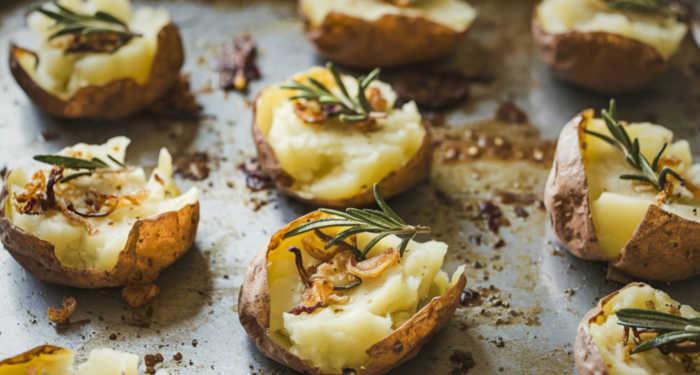
My modern move is deviled baby potatoes: scoop a little “yolk,” mash with chickpea mayo, mustard, and pickle brine, pipe back, finish with paprika. The good platter still comes out, because props are half the flavor.
9. Real butter and the “good bread”
Most days: margarine, standard slices. Occasions: a seeded boule from the bakery, plant butter in a dish with its own tiny knife. Bread stayed in a paper bag folded like origami to “keep it from going stale,” which worked mostly because we ate it fast.
What it really did: proved that tiny quality jumps change the whole meal. Better fat, better crumb, better crust—suddenly soup was a feast and salad was a course.
We learned to respect finishers: a sprinkle of flaky salt, a drizzle of olive oil, a squeeze of lemon. Those are price-efficient luxuries you can keep even when the menu changes.
10. Takeout from a place with heavy boxes
Our splurge takeout wasn’t dainty. It came in foil pans and waxy bags that perfumed the car.
Chinese-American combos, Detroit-ish pizza, barbecue with pickles and cheap white bread.
The living room turned into a picnic. Plates on laps, a game on TV, negotiations over who got the last rangoon like we were at Camp David.
What it really did: redistributed labor and turned dinner into an event without hosts collapsing. In homes where weekends were for chores and recovery, store-bought community mattered.
You got to be relaxed together, not just fed together. It also taught a quiet lesson in fairness—pass the box, share the sauce, trade a slice for a bite.
Dad kept the tiny soy sauce packets like rare stamps.
One drawer was a museum of condiments and “just in case” packets. It was funny, but it was also an archive of small fortunes—evidence of nights we chose ease.
Now when I do a veg-forward takeout spread (veggie chow mein, mapo tofu made plant-based, falafel, or a big pie heavy on veg), I keep a phone-down window for the first twenty minutes and cue up music.
Presence is the luxury, and it’s free.
What these foods really taught us
Under the taste, three deeper lessons were at work:
-
Attention is the actual luxury. The rotisserie, the frosting script, the big bowl—each was a way of saying, “We’re paying attention to each other tonight.” If you’re time-poor or money-tight, design moments that buy attention.
-
Abundance isn’t the price tag; it’s the sense of plenty. A pan that feeds tomorrow, a platter that empties fast and returns refilled, a drawer of condiments—abundance is the felt experience of “enough,” not the cost per ounce.
-
Tradition is a tech stack. These foods were little operating systems: repeatable, resilient, easy to deploy under stress. They solved dinner and delivered belonging. Update the stack to fit your values (for me: plants), but keep the functions.
How I recreate the feeling now (vegan, inexpensive, still “special”)
-
Pick one showpiece (whole roasted veg, big salad, casserole) and one indulgence (cake with a name, fancy bread + plant butter). Two moves, maximum effect.
-
Use props: a huge bowl, the “good” platter, a folded paper bag for bread, a dedicated butter dish. Cues matter.
-
Build in a planned leftover (foil packet, next-day sandwiches). Let celebration echo.
-
Make space for participation: a friend brings the deviled “eggs,” someone else the salad, you handle the roast. Pride scales better than budgets.
-
Institute a phone-down window at the beginning. Music up. Presence tastes like everything good.
Final words
We didn’t need foie gras to feel rich.
We needed a night with fewer decisions, a plate that felt a little extra, a name written in sugar, a board passed around with “just a taste.”
If you grew up lower middle-class, you already know how to convert ordinary ingredients into ceremony. Keep that skill. Update the menu if you want.
The point was never the chicken or the ham or the shrimp ring. The point was the message we kept sending one another:
Tonight, we’re making room for joy.
Just launched: Laughing in the Face of Chaos by Rudá Iandê
Exhausted from trying to hold it all together?
You show up. You smile. You say the right things. But under the surface, something’s tightening. Maybe you don’t want to “stay positive” anymore. Maybe you’re done pretending everything’s fine.
This book is your permission slip to stop performing. To understand chaos at its root and all of your emotional layers.
In Laughing in the Face of Chaos, Brazilian shaman Rudá Iandê brings over 30 years of deep, one-on-one work helping people untangle from the roles they’ve been stuck in—so they can return to something real. He exposes the quiet pressure to be good, be successful, be spiritual—and shows how freedom often lives on the other side of that pressure.
This isn’t a book about becoming your best self. It’s about becoming your real self.