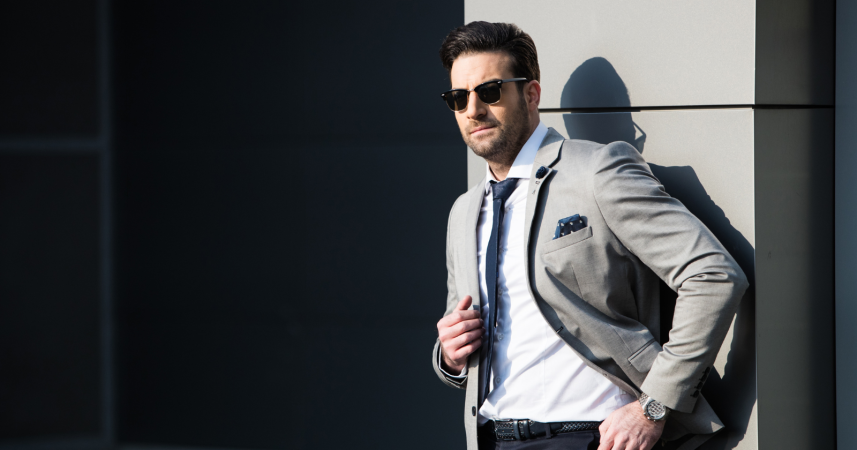
The sharpest men know: the right shades don’t just block the sun—they change the whole story people tell about you.

Add VegOut to your Google News feed. 
There’s something fascinating about style choices that stand the test of time.
Fashion trends come and go, but some accessories stay rooted because they represent more than just aesthetics—they carry history, psychology, and even unspoken status. Sunglasses are one of those things.
When you look closely, the styles preferred by old money men aren’t random. They’re deliberate. They signal restraint, confidence, and a deep understanding that classic always outlasts flashy.
Here are eight timeless sunglasses styles that embody that philosophy—and why they’ll never fade into irrelevance.
1) Wayfarers
Let’s start with the obvious.
Wayfarers are practically a cultural symbol at this point. Originally designed in the 1950s, they hit a sweet spot between practicality and edge. Old money men wear them because they don’t scream for attention—they just sit there quietly doing their job, complementing nearly every outfit.
I remember buying my first pair in college, thinking I was channeling a bit of James Dean. What I didn’t realize then was that they’ve stayed in circulation for decades not because they’re trendy, but because they resist trend cycles entirely.
Psychologically, Wayfarers hit a middle ground: angular enough to signal strength, yet soft enough to not feel aggressive. They’re democratic in that almost anyone can pull them off, but elite in that the right pair (often kept for years, not months) says you know the difference between “classic” and “cheap knockoff.”
Minimal lines, adaptable to suits or t-shirts, and unmistakably timeless. That’s why they keep showing up generation after generation.
2) Aviators
What’s the psychology behind aviators?
They’re associated with authority. Originally built for pilots, aviators carry that same aura of competence and control. Old money men know this. Wearing aviators isn’t about looking tough—it’s about signaling calm confidence, the type that doesn’t need explaining.
I’ve mentioned this before in another post: the human brain links authority and trust to uniforms and professional gear. Aviators borrow from that mental association. That’s why they’ve lasted from Top Gun to today’s quiet luxury crowd.
Sunglasses, in general, function as a kind of “visual mask” that can boost perceived confidence and mystery by concealing eyes and emotional cues.
And unlike oversized, mirrored versions that scream “spring break,” the aviators favored by men with generational wealth are usually subtle—thin frames, muted lenses, and proportions that flatter rather than overwhelm.
They don’t just protect your eyes. They project steadiness.
3) Clubmasters
Clubmasters tell you something about the wearer: he’s into details.
The metal-and-acetate combo gives them a distinguished, intellectual air. They feel academic but not stuffy, stylish but not excessive. Think professors on summer break, or someone leaning on a vintage Mercedes convertible while thumbing through a book.
There’s also a cultural element here. Clubmasters rose during a period when counterculture was merging with respectability. They became the bridge between conservatism and rebellion—a perfect symbol of old money values: modern enough to be relevant, restrained enough to never cross into vulgarity.
I once wore a pair to a music festival, and a friend joked that I looked like I’d just come back from giving a lecture. That’s the thing—Clubmasters make you look considered, like you’ve thought about every detail without trying too hard.
It’s no accident that old money men gravitate toward them. They have a retro feel that nods to tradition while staying versatile enough for modern wardrobes.
4) Round frames
Ever notice how round frames give off an air of introspection?
They’ve been tied to philosophers, writers, and artists for centuries. Old money men who choose round sunglasses aren’t trying to look futuristic. They’re reaching back into history, echoing figures like John Lennon or Mahatma Gandhi—people who shaped culture with thought, not flash.
I picked up a pair in Berlin a few summers ago. They changed how I carried myself. Suddenly, strangers assumed I was deep in thought (even if I was just choosing between falafel or currywurst). That’s the thing—round frames shift perception without you having to say a word.
There’s also a psychology of symmetry here. Circular shapes suggest wholeness and continuity, which our brains associate with calm and completeness. Old money circles tend to value that kind of energy—quiet, contained, and balanced.
They’re not for everyone, but when they work, they really work.
5) Tortoiseshell frames
Quote I once read: “Good taste is invisible until you notice it everywhere.”
That’s exactly tortoiseshell. Old money men lean toward these because they whisper sophistication. The marbled patterns add texture and depth without feeling loud.
There’s also a nod to history: tortoiseshell was originally made from actual hawksbill turtle shell, long before conservation laws banned the practice. Today, the acetate replicas carry the same aesthetic but without the ethical baggage. That evolution makes them timeless—rooted in heritage, but updated with responsibility.
And unlike bright-colored plastics that fade with seasons, tortoiseshell has permanence. It pairs equally well with a linen suit on the Amalfi coast or a tweed jacket in New England. They represent subtle adaptability, the kind of flexibility that doesn’t require reinvention every year.
The point is, tortoiseshell frames aren’t meant to stand out—they’re meant to blend in so naturally you only notice them once you’ve learned to appreciate nuance.
6) Persol folding sunglasses
Now this is a move only someone who truly knows style pulls off.
Persol’s folding sunglasses aren’t just functional—they’re an engineering marvel. Old money men love them because they blend practicality with heritage. Persol has roots in Italian craftsmanship, and folding frames feel like a nod to an era when objects were built to last.
I once met a retired architect in Florence who pulled a pair from his blazer pocket. The motion itself—unfolding them with quiet precision—spoke louder than any brand logo could. That’s why they endure: they carry stories of durability, elegance, and engineering genius.
Here’s the other layer: folding sunglasses remind us of portability without compromise. They slip into a jacket pocket with ease, yet when unfolded, they’re full-sized, serious frames. There’s symbolism there—having the best of both worlds without ever appearing wasteful or excessive.
7) Rimless frames
At first glance, rimless sunglasses might look unassuming. That’s the point.
They suggest restraint, the kind that doesn’t need bold lines to make an impression. Rimless frames are about clean minimalism. They often get overlooked in favor of more iconic designs, but old money men know their value lies in subtlety.
There’s a psychology at play here: rimless frames don’t draw attention to the accessory itself but to the person wearing them. It’s quiet authority—precisely why they’ve remained relevant across generations.
They also reflect an old money mindset: when you have nothing to prove, you can strip away the excess. Rimless frames embody that philosophy, presenting clarity—both literal and metaphorical.
I once saw a banker in Zurich wearing a pair so discreet I didn’t even notice them until he took them off. That’s power: when your accessories don’t announce you, but your presence still does.
8) Square acetate frames
Finally, let’s talk about the bold-but-not-too-bold choice.
Square acetate frames carry weight—literally and figuratively. They’re substantial without crossing into excess. Old money men choose them when they want structure and definition without leaning into trend-driven oversized shades.
I remember seeing them everywhere while traveling through Scandinavia. Men in wool coats, sipping coffee, frames perfectly fitted to their faces. No logos, no embellishments, just strong lines that convey permanence. That’s why they’ll never go out of style: they reflect stability.
There’s also a subtle nod to architecture here—square shapes are stable, grounded, and dependable. When applied to eyewear, that geometry reinforces a sense of reliability. It’s no wonder these frames keep circulating among men who value legacy over flash.
The bottom line
Old money men don’t choose sunglasses because they’re flashy. They choose them because they’ve been tested, refined, and proven across decades.
Each of these styles communicates something subtle: authority, intellect, restraint, or permanence. That’s the real reason they never go out of style.
The takeaway? You don’t need to reinvent yourself with every trend. Sometimes the smartest move is to stick with what’s already been perfected.
If You Were a Healing Herb, Which Would You Be?
Each herb holds a unique kind of magic — soothing, awakening, grounding, or clarifying.
This 9-question quiz reveals the healing plant that mirrors your energy right now and what it says about your natural rhythm.
✨ Instant results. Deeply insightful.

Jordan Cooper
Jordan Cooper is a pop-culture writer and vegan-snack reviewer with roots in music blogging. Known for approachable, insightful prose, Jordan connects modern trends—from K-pop choreography to kombucha fermentation—with thoughtful food commentary. In his downtime, he enjoys photography, experimenting with fermentation recipes, and discovering new indie music playlists.
More Articles by Jordan