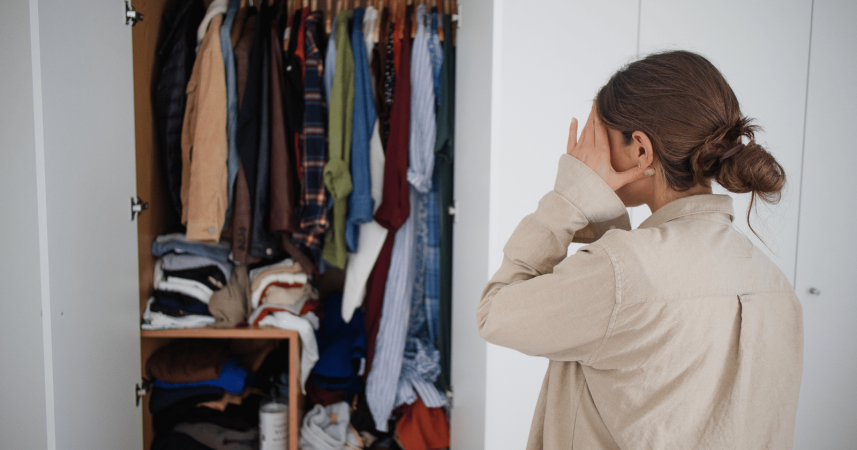
Our closets are full, our minds are restless, and somehow a new outfit still feels like the answer to everything we can’t name.
You know that feeling when you open your closet, stare at the hangers, and still sigh, I have nothing to wear?
It doesn’t matter that the wardrobe is already bursting. Because the moment Zara announces a sale or Shein drops a “limited-time” collection, that inner voice suddenly whispers, Maybe I deserve a little treat.
Fast forward two days, and there’s a new package at your door again.
Gen Z is arguably the most socially conscious generation in history. They talk about sustainability, environmental damage, and ethical shopping more than anyone else. They know fast fashion is problematic. But here’s the paradox: knowing better doesn’t always mean doing better.
It’s not hypocrisy. It’s habit. These habits are woven into culture, emotion, and identity.
And I get it. I’ve been there too, convincing myself that a cheap dress is harmless or that buying “just one more” outfit won’t make a difference.
So let’s unpack this. Here are eight fast fashion habits Gen Z can’t quit, even when they know they should.
1. The “it’s only $10” justification
It always starts small.
That $10 top doesn’t feel like a big deal. You convince yourself it’s affordable, guilt-free, almost like buying coffee or a snack.
But cheap doesn’t mean harmless. That shirt’s real cost is hidden: the low wages of garment workers, the pollution from synthetic fabrics, and the short life cycle that ends in a landfill.
According to the UN Environment Programme, the fashion industry is responsible for 10% of global carbon emissions more than all international flights and shipping combined.
Still, $10 feels emotionally light. It gives you permission to keep scrolling, keep adding to cart, keep pretending it’s not that serious.
That’s how fast fashion wins. Not by being luxurious or exclusive, but by being cheap enough to ignore the consequences.
2. The “new outfit for every event” mindset
When I was in my early twenties, I used to panic before every social outing because I didn’t have a “new” outfit.
There was this unspoken rule that repeating clothes was some kind of fashion sin, especially when photos were involved. I blamed social media at first. But if I’m honest, it was insecurity.
I wanted to look different each time because deep down, I was afraid of being forgettable.
Gen Z has grown up online, where every brunch, concert, or night out becomes potential content. That makes outfit repetition feel like déjà vu.
But here’s the truth: no one remembers what you wore. They remember your vibe, your laugh, your confidence.
The obsession with “new” doesn’t come from others. It comes from the tiny voice inside that says I’m not enough unless I look different.
And the antidote to that isn’t another outfit. It’s self-acceptance.
3. The thrill of the haul
There’s a special kind of excitement that comes from clicking “add to cart.”
The anticipation, the delivery notification, the unboxing, it’s like Christmas morning, every week.
Psychologist Dr. Carolyn Mair, author of The Psychology of Fashion, explains that “buying new clothes releases dopamine, which reinforces the behavior. It’s why we keep going back for more.”
And she’s right. We don’t shop because we need something. We shop to feel something.
I’ve caught myself browsing online stores after a stressful day, not because I needed anything, but because I wanted to escape. Shopping offered a tiny illusion of control, a way to fix a bad mood with a package.
But the truth is, the high fades quickly. And when it does, you’re left with another dress you don’t wear and the same mood you were trying to escape from.
4. The influencer effect
Let’s be honest: influencers are basically the new billboards.
You see someone on TikTok wearing a cute top, and within seconds you’ve clicked the link in their bio. It’s easy, relatable, and you don’t even think twice.
The influencer economy runs on micro-trends that change faster than you can wash your last purchase. They’re not trying to make you waste money, but their job depends on keeping your attention hooked.
And Gen Z, more than any generation before, has grown up in a culture of constant comparison.
You don’t just see someone wearing the outfit. You see them in perfect lighting, living your dream life.
So when you hit “buy,” you’re not just purchasing a shirt. You’re buying a version of who you wish you were.
But that fantasy never lasts. Because once the next creator posts a “haul,” the cycle resets.
5. The convenience trap
Fast fashion thrives because it’s easy.
One tap, free delivery, endless variety, all available while you’re lying in bed.
The convenience is intoxicating. And for a generation juggling work, study, and social lives, it’s a tempting escape hatch.
But that convenience has a cost.
It dulls awareness. You don’t think about the factory worker earning cents per hour, or the energy used to ship clothes halfway around the world.
You just want something quick that makes you feel better now.
And that’s what makes fast fashion dangerous. It doesn’t just exploit labor, it exploits our exhaustion.
When life feels overwhelming, convenience always wins over consciousness.
6. The resale excuse
“Don’t worry, I’ll sell it on Depop.”
I’ve heard this, and said it, more times than I’d like to admit.
It’s the modern moral loophole that makes us feel eco-friendly without changing anything.
Yes, reselling can extend a garment’s life, but it also feeds the overconsumption cycle. You buy more because you believe you can “offset” it later.
But a report from the National Institute of Standards and Technology found that only about 15% of used clothes and textiles in the U.S. get reused or recycled. The other 85% still head for landfill, incineration or down-cycling.
So while resale apps are a step forward, they don’t erase the impact of overproduction.
It’s like trying to mop the floor while the tap’s still running.
7. The illusion of “sustainable” collections
Brands have caught on.
They know Gen Z values ethics and sustainability, so they’ve learned how to speak the language. “Conscious Collection.” “Green Edition.” “Eco Range.”
But most of these lines make up less than 1% of their total inventory.
This isn’t transformation. It’s greenwashing. It’s a marketing strategy designed to soothe guilt, not to solve the problem.
And it works, because we want to believe them. We want to shop guilt-free.
But sustainability isn’t a collection. It’s a behavior.
If the brand is still producing thousands of new styles every week, no amount of “organic cotton” will fix the system.
Sometimes the most sustainable thing you can do is simply not buy.
8. The emotional connection to identity
Fashion has always been tied to self-expression.
But for Gen Z, it’s more than that. It’s identity currency.
Each aesthetic represents belonging. Cottagecore, Y2K, clean girl, grunge revival. Each one is a subtle way of saying, “This is who I am.”
But the problem is, when trends shift, so does that identity.
You end up chasing the next aesthetic like it’s a personality transplant.
I’ve done it too. I once bought a pair of chunky boots because I saw them on someone who looked effortlessly cool. But when I wore them, I felt like a kid playing dress-up.
That’s when I realized something important: the more we rely on fashion to define us, the less stable our sense of self becomes.
Clothes can express who you are, but they shouldn’t decide who you are.
And the most confident people I know? They repeat outfits. They wear what they love. They’re not chasing trends; they’re living in alignment.
Final thoughts
Fast fashion isn’t just an industry problem. It’s a mirror reflecting our emotional patterns.
We shop for comfort. We shop for validation. We shop to distract ourselves from the discomfort of doing nothing.
And knowing the truth doesn’t magically break those patterns. Awareness is just step one.
Real change comes from small, consistent actions:
- Buying only what adds value.
- Repeating outfits proudly.
- Supporting brands that treat people and the planet with respect.
- Taking a pause before hitting “checkout.”
The goal isn’t perfection. It’s mindfulness.
Because every small shift in habit sends a signal. It tells brands, and yourself, that you’re no longer buying into a system designed to keep you empty and consuming.
Growth starts there, in the quiet pause before the next purchase.
So the next time you tell yourself, It’s just $10, maybe ask, What’s it really costing me?