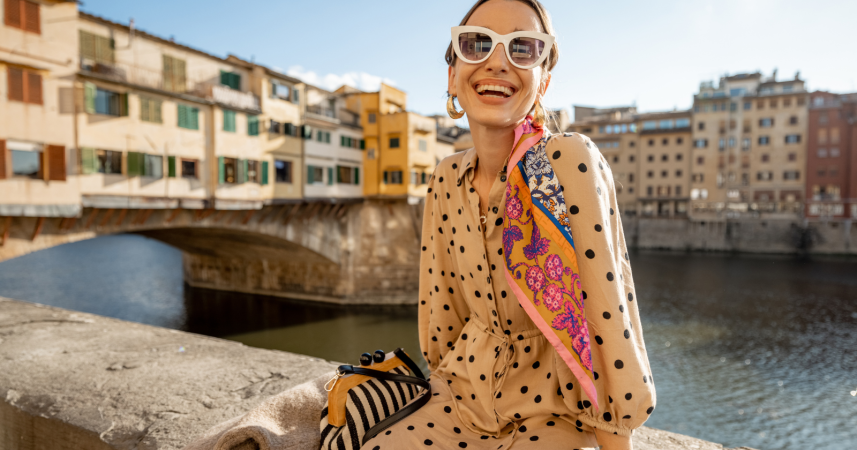
Style slip-ups that make you stand out in Europe—and how to dress so you blend right in.
Europe has a way of making you feel like you’ve stepped onto a film set — cobbled streets, balcony flowers, people who somehow look polished even while juggling a baguette and a bicycle.
On my first trip to Lisbon, I remember standing in a pastelaria with powdered sugar on my lips, watching a woman in loafers, a striped top, and a trench tie her hair with a scarf.
Nothing fancy. Just right.
Meanwhile, I was in zip‑off hiking pants that swished when I moved and neon running shoes that could land an airplane. The pastel de nata was sublime. My outfit? Loud in all the wrong ways.
What I’ve learned, after running around Europe with a carry‑on and a curiosity streak, is that “fitting in” isn’t about erasing your personality. It’s about reading the room.
Local style is a language, and you don’t need to be fluent — you just need a few key phrases.
Below are 7 fashion mistakes travelers make without realizing how they’re being read by locals, plus easy fixes that keep you comfortable, respectful, and still you.
1. Treating city centers like gyms
Athleisure is a global love story, but in many European cities it’s still an off‑duty, on‑the‑way‑to‑Pilates look—not an all‑day uniform.
Head‑to‑toe performance leggings, a slouchy hoodie, and bright running shoes announce “workout in progress,” even when you’re queuing for a museum. To locals, this reads as casual to the point of careless—like wearing slippers to brunch.
You don’t need to ditch comfort — you just need to disguise it.
Swap the technical hoodie for a simple crew or merino sweater. Keep the sleek black leggings but add a long coat, low‑profile sneakers, and a structured crossbody bag. Or trade leggings for straight‑leg jeans with a hint of stretch.
Think “coffee date” more than “cool down.” Athleisure can be part of your look, not the whole sentence.
Pro move: choose sneakers with a minimalist silhouette—leather or canvas in white, navy, or black—so they read “city” rather than “track.”
2. Dressing for the Alps when you’re in Rome
Zip‑off trousers, cargo vests with a hundred pockets, clompy hiking boots, and rain jackets in storm‑alert colors say you’re prepared for a monsoon and a bear encounter—on a boulevard with four gelaterias.
To locals, the message is less “adventurer” and more “expedition cosplay.”
Functional? Absolutely.
Necessary for the Colosseum?
Not most days.
Aim for “quietly weatherproof.” A trench or light parka in beige, navy, or olive handles drizzle without shouting. Dark jeans or chinos pair with everything.
If the forecast calls for rain, wear a compactable shell under your coat and stash a pocket umbrella. Keep one or two technical pieces—like a breathable base layer—under smoother, city‑friendly layers.
And about those daypacks: massive, rigid backpacks turn you into a moving billboard and a hazard on packed transit. Locals often carry compact totes, leather backpacks, or crossbody bags.
Choose something slim that stays close to your body and doesn’t upstage your outfit (or your fellow passengers).
3. Wearing your itinerary on your shirt
I love a cheeky tee, but giant logos, flag prints, team jerseys, and “I ♥ CITYNAME” shirts are basically high‑viz signs that say TOURIST.
Locals may not judge harshly, but they read it as a costume — sweet, but not how grownups here typically present in daily life. There’s also a safety angle: loud branding can telegraph that you’re visiting and possibly distracted.
Try stealth mode style: graphic tees with small, artful prints; knit polos; striped or solid button‑downs; a sweater over the shoulders if you’re channeling Riviera energy.
Keep the souvenir pieces for lounging or game day. If you want a wearable memory, buy a scarf from a local market, a simple signet ring, or a tote from a gallery shop. It nods to place without shouting.
Remember: elegance here often means understatement. Neutrals, one accent color, and an accessory with a story is a formula that works in Paris, Porto, and pretty much anywhere your train rolls.
4. Footwear that fights the cobblestones
Europe is a walking continent. The streets are charming; they are also ankle‑testing.
- Mistake #1: Bringing only pristine fashion sneakers that blister by noon.
- Mistake #2: Heels that catch between stones.
- Mistake #3: Flip‑flops beyond beaches and pools—locals read that as sloppy, plus you’ll be filthy by dinner.
Locals value shoes that look thoughtful and feel broken‑in.
Think loafers with cushioned insoles, low‑heeled ankle boots, leather sneakers, espadrilles with ankle ties, or simple sandals with secure straps.
Test‑drive everything at home for a week before packing. If your soles are thin, add gel inserts. If you’re traveling in shoulder season, waterproof a suede or leather pair.
Two‑pair strategy: bring one smart‑casual shoe (loafers or boots) and one athletic‑adjacent sneaker with a city silhouette. Alternate daily so each pair dries and decompresses. Your feet (and your outfits) will last longer.
5. Missing the quiet dress codes
A lot of European style is about context.
Churches and sacred sites often ask for covered shoulders and knees; some will turn you away otherwise.
Upscale restaurants and cocktail bars expect smart casual at minimum; beach towns shift to resort casual by evening. Locals see adherence as basic respect, not oppression.
Under‑ or over‑shooting the vibe reads as tone‑deaf, the way wearing a ballgown to a picnic would at home.
Pack a “converter kit.”
- For modesty: a lightweight scarf or pashmina, a midi skirt or linen trousers, and a breathable shirt you can button up.
- For polish: a compact blazer or unstructured jacket that dresses up a tee in seconds. For nightlife: dark jeans or tailored trousers, a simple top with jewelry, and shoes nicer than your day sneakers.
Do a one‑minute vibe check when you book reservations or tickets.
If the photos show tablecloths and low light, step it up. If you’re museum‑hopping and then hitting a basilica, plan an outfit that converts with a scarf and a jacket.
Flexibility is chic.
6. Forgetting that fit is the whole outfit
Many travelers choose security and “comfort” pieces that make them look like their clothes borrowed them: baggy cargo shorts, camp shirts two sizes large, money belts worn outside the body, bulky “anti‑theft” vests.
Locals aren’t clocking your pockets. They’re clocking the silhouette.
Even the simplest outfit looks elevated if it skims the body where it should.
Quick tailoring hacks: pack a slender belt to define the waist on dresses or long shirts. Use hem tape to tighten a too‑long trouser. Choose jackets with shoulder seams that meet your actual shoulders and sleeves that hit your wrist bone.
If you love wide‑leg pants, balance them with a fitted top or a tucked tee.
Security can be invisible. A slim crossbody worn under a jacket, a flat pouch that clips inside your bag, or pants with zippers you keep closed—these keep you safe without announcing it.
The local read you want is “put‑together human,” not “walking cupboard.”
7. Ignoring the season and fabric story
Europeans dress to the weather and the calendar.
In July, you’ll see linen, light cotton, open‑weave knits, bare ankles, and straw totes. In November, it’s wool, cashmere, boots, and proper coats. Visitors often misfire by wearing summer gear in chilly shoulder seasons, or by packing heavy synthetics that trap heat in August.
Locals read this as uncomfortable and a little out of sync, like ordering a mulled wine in a heatwave.
Let fabric do the work. In summer: linen shirts, cotton poplin, viscose dresses, and sandals with real soles.
- In spring/fall: merino tees for base layers, trench or wool‑blend coats, and closed‑toe shoes.
- In winter: a real wool coat or puffer, not just a hoodie under a windbreaker. Build a palette of three neutrals (say, navy, tan, black) plus one accent, and everything will mix.
Layering is your passport. A cardigan over a tee, a scarf over a dress, tights under a skirt—these are temperature controls that also read stylish. And yes, scarves have practical magic: warmth, modesty when needed, and instant “I live here” energy.
Conclusion: dress like you’re in the scene, not just on the set
When I think back to that Lisbon pastry shop, I don’t regret my zip‑offs. They’re part of the story I tell—the “before” picture that makes the “after” richer.
Over time, I traded the trail pants for trousers and the neon trainers for loafers I can actually run in (tested during a surprise downpour in Brussels).
I still pack one fun thing—a citrus scarf from Palermo, a red lip for Paris, earrings I found in a Barcelona market—because travel is a conversation and clothes are one way we speak.
If you’re packing right now, do a quick edit: one pair of city sneakers and one smart shoe; a jacket that changes a tee into an outfit; a scarf; pieces that fit your body and the season; a bag that carries what you need without carrying you.
Keep the function, lose the fuss.
Locals aren’t waiting to judge you. They’re just living their lives. But when you read the room—and dress like you’re already in it—you discover a different kind of travel magic.
Doors open, conversations start, you’re invited in.
You stop feeling like a walking packing list and start feeling like a person in a place. And that, in any city, is the point.