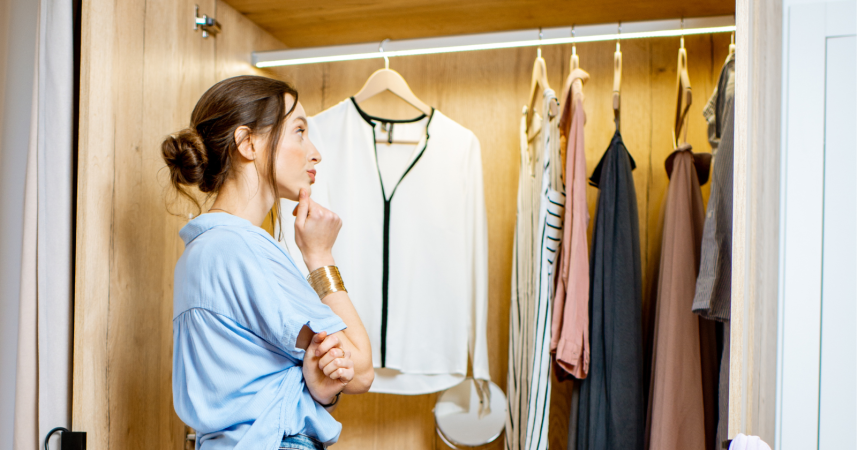
Over time, those tiny choices add up to a quieter mind and a life that feels more aligned every time you get dressed.
Crafting a personal style is a lot like crafting a life.
You think you’re making a bunch of tiny and random decisions, but zoom out and there’s a pattern staring back at you from the closet rail.
Your wardrobe is quiet feedback as it shows you what you reach for when you are tired, stressed, hopeful, or trying to impress someone.
Sometimes that feedback is basically: “Hey, we’ve been doing the same thing for years.”
If you are wondering whether you are stuck in a style rut, your closet already has the answers.
Here are six signs to look for and what to do about each one:
1) Your outfits all look the same
Be honest: Could a friend describe your outfit without seeing you, and be right most days of the week?
If you are always in the same combo (black leggings and big tee, jeans and hoodie, floral dress and cardigan), you might have crossed from “signature look” into “autopilot.”
There is nothing wrong with having a uniform.
In fact, decision science talks a lot about decision fatigue and how simplifying some choices can be helpful.
A healthy uniform is intentional, and a style rut is unconscious.
You did not choose it; it just sort of happened because you were busy making other choices.
I went through a long “black jeans, band tee, same jacket” phase.
At first it felt like my music-writing identity.
But after a while, it was just the easiest thing that stopped me from thinking.
If you are in this zone, try a small pattern interrupt.
Keep your core formula if you want, but change one variable: the color of the top, the shoes, the cut of the pants, or an accessory you never wear.
Tiny experiments are how you remind your brain that you still get a say in how you show up.
2) You own a lot of “okay” clothes and almost nothing you love
Ever stand in front of a packed closet and think, “I have nothing to wear”?
That sentence usually means: “I own a ton of clothes I feel medium about, and almost nothing that actually lights me up.”
Psychologically, this is classic sunk cost; you spent money on those pieces, so they stay.
Even if they itch, pinch, slide, ride up, or quietly annoy you every time you put them on.
I had a drawer of “almost right” shirts once.
Every time I tried one, I tugged at the hem or sleeves all day.
I kept them “for home” or “for painting” or “for workouts” even though I did not want to do any of those activities in them either.
Closet clutter is more than a storage problem because it is a mental load problem.
Every “meh” item is another micro decision your brain has to sift through before it finds something that actually feels like you.
If you want a practical reset, try this: Next time you put something on and immediately feel “eh,” do not put it back on the hanger.
Move it to a clear “out” bag or box.
As a bonus, think about where those pieces go next.
Can they be donated, swapped, or resold so they do not end up in landfill?
As vegans we talk a lot about conscious consumption of food; clothing is the same story in a different aisle.
3) You are “saving” your favorite pieces for someday
There is a weird rule many of us pick up as kids: Nice things are for later.
When you are thinner, when you are going somewhere fancy, and when you are with people who “deserve” to see you in that outfit.
So, your best pieces sit untouched.
Tags on, shoes pristine, and jumpsuit untouched for three summers in a row.
Here is the psychology under that: Scarcity mindset.
If you treat your favorite clothes as rare and fragile, you will hover around them like they are in a museum, not in your life.
I had a jacket I loved so much that I barely wore it because I was afraid of sweat, city grime, and everything dirty.
One day I realized I was basically choosing not to enjoy something I already owned.
So, I started wearing it to the grocery store, to coffee, and on photo walks.
It instantly felt less like a trophy and more like a friend.
Ask yourself: Which pieces are you “saving”? What exactly are you waiting for?
Try choosing one special item and giving it a normal day.
Wear the silk shirt to the farmers’ market, and wear the “fancy” vegan boots to brunch.
Let your life be the occasion.
4) Your clothes belong to a past version of you
Open your closet and ask: Who do these clothes belong to?
The stressed office worker you used to be, the student version of you, or the pre-vegan you who bought leather boots on impulse and then never quite felt right in them again.
Our wardrobes are often timelines.
They hold old jobs, old relationships, old cities, old bodies, old beliefs.
I still had a pair of non-vegan shoes for a long time after going plant based.
They were expensive, and a part of me felt guilty giving them away.
However, every time I saw them, there was this tiny clash between my ethics and my reality.
Eventually I passed them on to someone who would actually use them and made peace with the fact that my values had moved on.
If your closet is full of clothes that belong to old chapters, getting dressed becomes emotional archaeology.
You are constantly bumping into “used to” and “should have” and “almost.”
I have mentioned this before but your environment is one of your loudest coaches.
When your closet keeps shouting about who you were, it is harder to hear who you are becoming.
One simple exercise: Pull out everything that clearly belongs to another life stage, and put it in its own section or box.
Build at least three outfits only from pieces that actually fit your current body, lifestyle, and values.
This is your “present tense” wardrobe; you may be surprised by how much calmer your mornings feel when you start from who you are now.
5) You shop to fix feelings, not fill real gaps
Have you ever opened a shopping app when you were tired, lonely, or stressed, and suddenly there is a new package on the way?
The rush you feel when you hit “buy now” is not an accident.
Behavioral scientists have linked that moment to a quick dopamine spike.
The problem is it fades fast, and the hangers stay crowded.
If most of your recent purchases came from late night scrolling, random ads, or “well it was on sale,” you are self-soothing with fabric.
From a self development standpoint, this matters.
You are outsourcing emotional regulation to the mailman.
For me, this showed up with graphic tees.
Tough day? New tee.
Creative block? New tee.
It was comforting for maybe an hour, then my actual problems were still sitting there next to a growing pile of cotton.
Before you buy the next thing, try a tiny pause: What feeling am I trying to change right now? Do I actually have a functional gap in my wardrobe or just an emotional gap in my day?
If you do see a real gap, make a simple list. “Need black jeans that fit. Need lightweight jacket for travel. Need vegan sneakers for long walks.”
Shop to that list, slowly, from brands that align with your values, instead of whatever the algorithm sends first.
6) Getting dressed feels like work, not play
Last sign: Notice your mood when you stand in front of your closet in the morning.
Do you feel curious, creative—maybe even a little excited—or do you feel tired before you have even chosen a shirt?
When you are in a style rut, getting dressed feels like a chore.
You drag on the same thing because you “have to wear something,” not because you are consciously choosing how you want to show up.
There is a feedback loop here: If your clothes feel flat, your day can start flat.
However, if your day starts flat, you are less likely to experiment or try something new tomorrow and around it goes.
One of my favorite things to do when I travel is watch how people in different cities dress for totally normal days.
The tiny risks they take with color or shape or accessories.
It reminds me that style can be low stakes play, not performance.
You do not need a whole new wardrobe to get that feeling back.
The goal is to remember that you still get to experiment.
The bottom line
If a couple of these signs hit close to home, that is just data.
Your closet is showing you how you have been moving through life on default, and you can thank it for the information and then start editing.
You do not need a dramatic purge or a giant haul.
Start with one “meh” piece moved to the out pile, one special item worn on a regular day, one experiment that feels a little more like who you are now.
Over time, those tiny choices add up.
Not just to a fresher style, but to a quieter mind and a life that feels more aligned every time you get dressed.