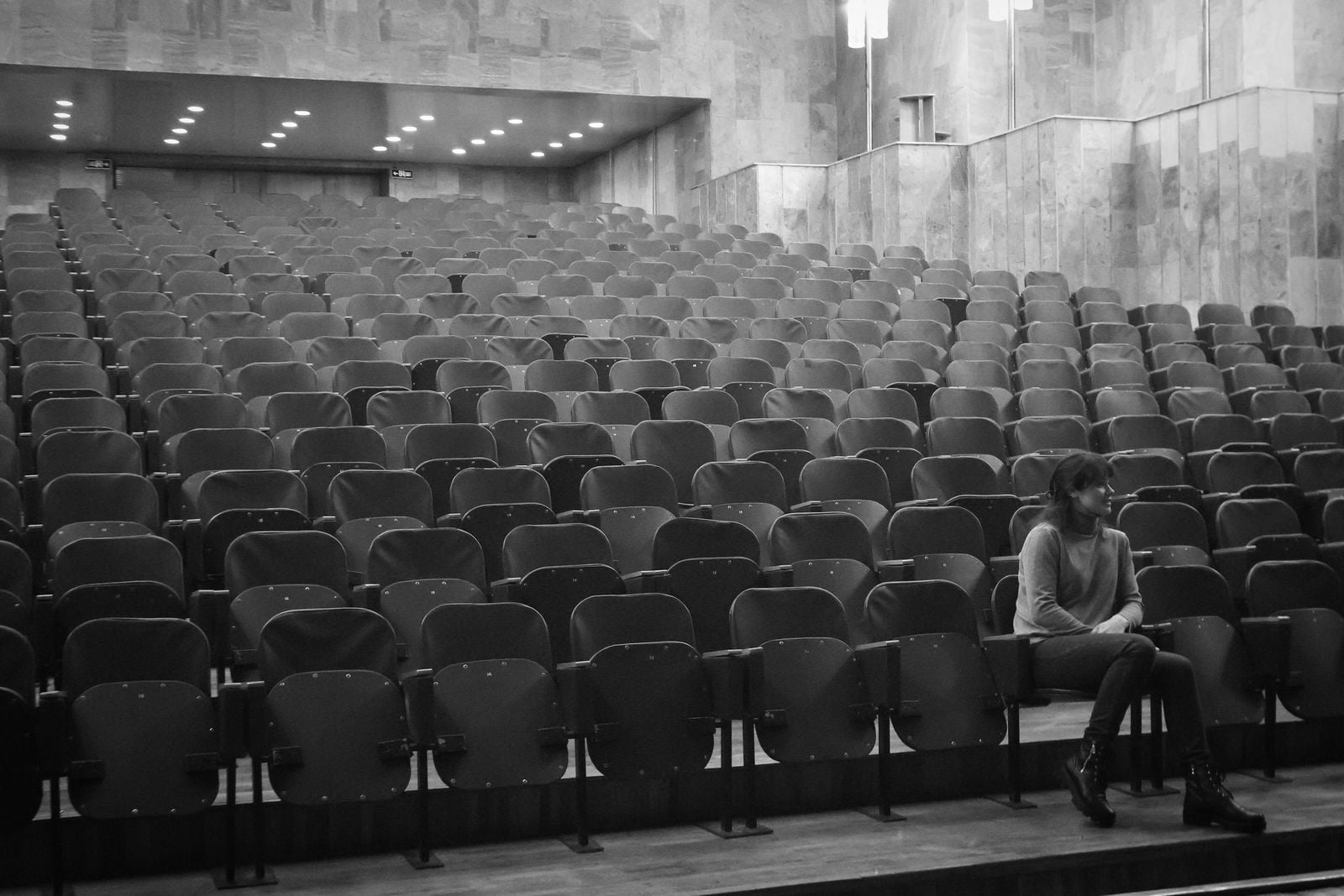
There's a strange territory that opens up when the organising roles of adult life start to recede. The marriage shifts or ends. The active parenting eases. The aging-parent phone calls stop, one way or another. The constant being-needed thins out. And the door you walk through next is the one you walk through when the calendar finally clears and you realise you have no idea who is supposed to walk through it.
This is the grief nobody warned anyone about.
The conventional script says free time is the reward. You grind through the toddler years and the soccer carpools and the parent-teacher nights and the aging-parent phone calls, and somewhere on the other side of all of it, a Tuesday evening opens up. Nothing on the calendar. Nothing owed to anyone.
And then nothing happens. Not in a peaceful way. In a hollow way.
The version of you who wanted this isn't here anymore
The reason the empty evening feels so disorienting is that the person who spent two decades wishing for it is gone. Not metaphorically. Functionally.
The self that fantasised about free time at 38 was a self defined by what she was deprived of. Take away the deprivation and the fantasy loses its scaffolding. What rushes in is not joy. It's a quiet bewilderment about who is even running the show now.
The parts of a person that were dormant for twenty years don't simply re-emerge when the demands lift. They have to be coaxed back, sometimes from quite far away.
The catch is that the coaxing has to be done by a person who has forgotten how she used to coax herself.
The arrival fallacy, but for free time
There's a name for the gap between what we think a milestone will give us and what it actually delivers. The arrival fallacy — the belief that once we reach a long-anticipated destination, lasting satisfaction will follow.
It usually gets discussed in the context of promotions or money or weddings. But the same pattern produces the post-caregiving crash. The reward system seems wired for the chase, not the possession. Anticipation pays its dividend in advance, and once the long-awaited thing arrives, the chemistry quietly moves on.
What this means in practice: the Tuesday evening was never going to feel the way the 38-year-old imagined it. Her brain was producing the anticipation chemicals. Your current brain has to produce something else, and it doesn't yet know what.
This is not a failure of gratitude. It's biology doing what biology does.
What overextension actually costs
Part of why the void hits so hard at 42 or 50 is the sheer volume of role-stacking that preceded it. Midlife adults quietly tend to the health and well-being of millions of younger and older people at once — children, parents, spouses, workplaces, communities. The role inventory is enormous, and most of it is invisible to the people benefiting from it.
When that many roles operate at once, for that long, they don't sit beside the self. They become the self.
So when one or two of them retract — the kids leave, the parent dies, the marriage ends, the project ships — the structural integrity of the whole identity wobbles. There's no off-the-clock self waiting in reserve. The on-the-clock self was the whole person.
The "ugly 40s" aren't ugly, they're disorganised
This period is sometimes characterised by uncertainty — changing bodies, shifting priorities, evolving identities — though the framing often focuses more on cosmetic changes than the deeper transition underneath. The period has been called the "ugly 40s" — one of uncertainty that often precedes growth.
The part that gets less airtime is that the disorganisation isn't only physical. It's existential. The Tuesday evening problem is part of it.
You're not ugly. You're under-narrated.
The story the 38-year-old was telling about her future ended at the point where the kids left and the schedule cleared. There's no chapter after that. The grief is, in part, the grief of being the writer who has to start a new chapter from a blank page after twenty years of working from a tight outline.
What identity diversification actually looks like
The textbook antidote to a single-pillar identity is building multiple anchors of meaning — relationships, craft, service, faith, learning, physical practice — the kind of psychological ballast that single-anchor identities don't have.
This sounds tidy in a research paper. In a lived life it's harder. You can't manufacture an anchor on a Tuesday night because a worksheet told you to.
The work is usually slower than that. It looks like trying things that the deprived 38-year-old self would have rolled her eyes at. A pottery class. A walking group. A weekly dinner with a friend you haven't seen in a decade. A community garden plot. Most of these attempts will feel awkward and slightly performative for months.
That's the price of admission.
Why the small stuff matters more than people think
The Tuesday evening problem doesn't get solved by booking a transformative trip to Portugal. It gets solved, slowly, by the rehabilitation of ordinary attention.
The quietly satisfied adults in their seventies tend not to be the ones with the most exciting hobbies but the ones who learned that a long walk, a good coffee, and a book they actually finish can hold a day. That capacity doesn't appear at 70. It's built decades earlier, often during exactly this kind of restructuring period.
The forty-something who learns to sit with a slow evening is laying down the pattern that the seventy-something will rely on.
Same thing applies to other low-key practices. Adults who garden later in life rarely picked up the practice at retirement. They picked it up in the middle of some other transition and let it ripen.
The thing nobody says out loud
The grief here is also a grief about time. Specifically, about the time the deprived self spent narrating a future that wasn't going to arrive the way she pictured.
Twenty years is a long time to defer. The 38-year-old wasn't wrong to want her evenings back. She just didn't know that the deferral itself was reshaping her — that the version of her capable of using free time fluently was being slowly traded in, day by day, for the version that could survive not having any.
That trade-off is reversible. But it's not free.
This is the part of the conversation that doesn't fit neatly on a podcast or in a self-help book. There is a real loss here. Not the loss of the kids leaving or the role ending. The loss of the self who would have been at home in the new chapter, if she hadn't had to spend twenty years becoming someone else to get there.
Sitting in the disorientation
One of the moves that goes against every instinct at this stage is choosing to sit in the disorientation rather than rush to restore what was familiar. The reflex when the evenings empty out is to fill them — new project, new partner, new house, new diet, new identity bolted onto the gap.
The filling rarely works. The gap was the point.
The gap is where the new self is supposed to assemble herself, and that assembly cannot happen if the space keeps getting filled with stand-ins for the old roles.
This is true for the freshly divorced parent and the just-promoted executive and the recent empty nester and the writer whose last book sold. The texture of the grief differs. The shape of it is the same.
The honest counterargument
There is a version of this argument that's worth taking seriously: maybe the Tuesday evening void isn't a developmental crisis. Maybe it's just rest. Maybe the culture's insistence that every empty hour be metabolised into self-improvement or meaning-making is itself the problem, and the right response is to do nothing on purpose for a while.
Sometimes the empty evening is grief. Sometimes it's just an empty evening. Both are allowed.
The trick is being able to tell the difference. And the way you learn to tell the difference is by spending enough Tuesday evenings in your own company that you stop confusing the silence with an emergency.
The deprived 38-year-old wanted a reward. The 50-year-old gets something more useful — a practice. Different thing. Takes longer. Holds up better.
The version of you who quietly left around your forty-second birthday isn't coming back. The one who's still here is the one writing the next chapter, slowly, in handwriting she's still learning to read.