Exhaustion has a vocabulary problem.
The word covers too much ground: the tiredness of a hard workout, the tiredness of a bad night's sleep, the tiredness of staring at a screen until your eyes ache.
None of those describe what happens to a person who has spent two decades quietly editing themselves out of the grocery list.
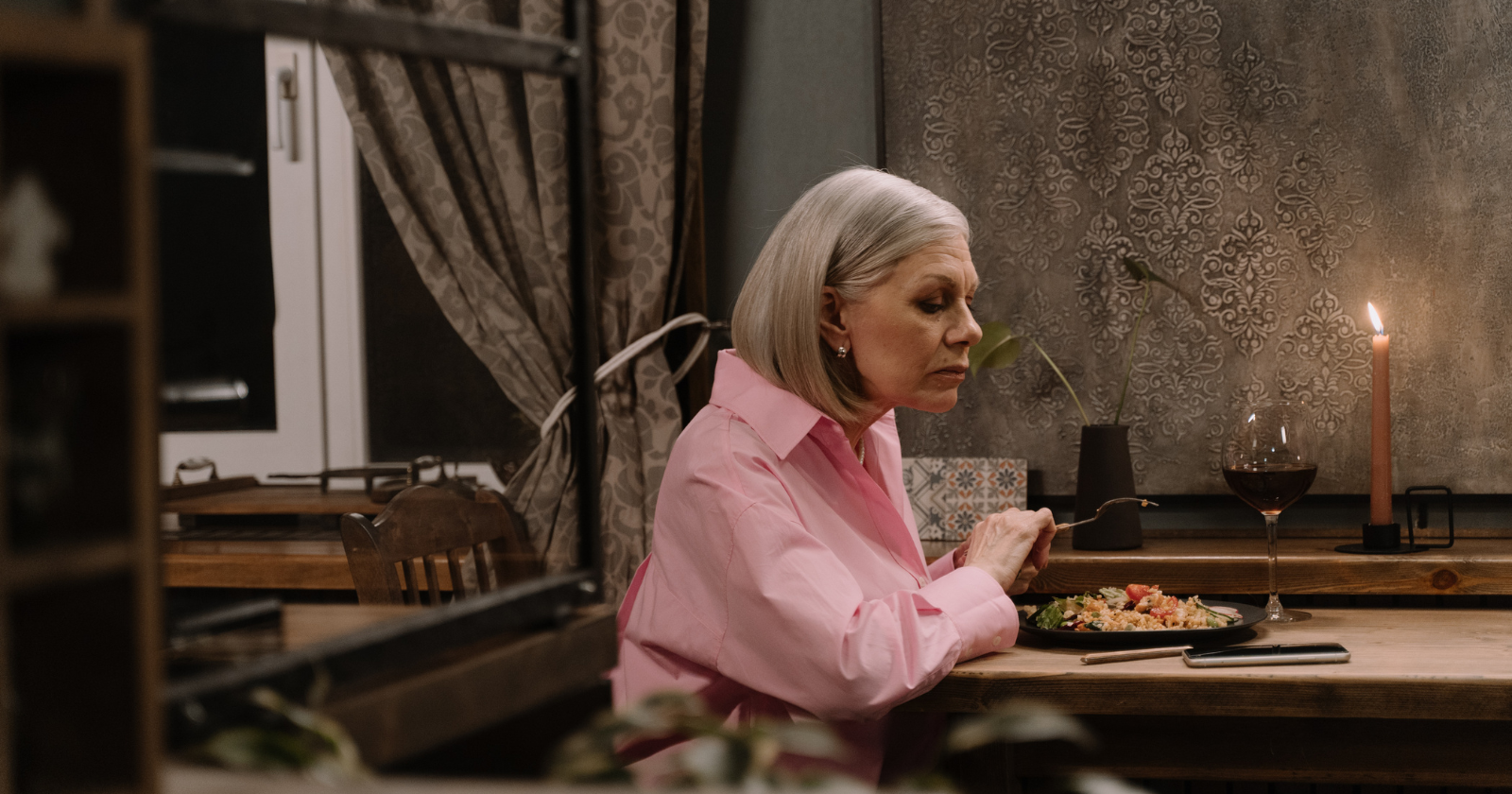
That is a different kind of fatigue, the kind that lives in the body of someone who can recite their kid's texture aversions, their partner's sodium limit, and their mother-in-law's nightshade situation, but who pauses for an uncomfortably long beat when a server asks what they feel like eating.
The conventional wisdom calls this self-sacrifice and treats it as a virtue. The framing has a long shelf life because it flatters the person doing it and benefits everyone around them.
Structurally, it's a slow withdrawal from your own preferences.
And the bill comes due.
The fatigue that doesn't respond to sleep
There's a category of tiredness that rest does not fix.
People notice it most clearly on vacation, when the calendar opens up and the body should, by every reasonable expectation, feel better. Instead, it feels strange, untethered, almost more tired than before.
Clinicians who work with long-term caregivers describe a version of this that maps onto what gets called burnout, but isn't quite the same thing.
Informal caregiving, the unpaid kind woven into family life, carries a distinct risk of physical and emotional exhaustion that doesn't show up on a standard fatigue scale.
It's the tiredness of a person whose nervous system has been on someone else's schedule for years.
Food is where this shows up first, because food is where preference gets practiced three times a day.
The grocery list as autobiography
Look at a household grocery list from a family with kids, or a family with an aging parent, or a couple where one person eats by medical necessity.
The list reads as a portrait, but it is rarely a self-portrait. It is a portrait of everyone else.
The almond milk is for the child who decided dairy was gross at age nine. The low-sodium broth is for the partner's blood pressure.
The specific brand of crackers, the right yogurt, the bread that toasts without crumbling. Every item answers a question someone else asked.
Somewhere on that list, in theory, are the things the shopper actually likes.
In practice, those items are often the first to get crossed off when the budget tightens or the cart gets full.
Care.com's 2026 Cost of Care Report put numbers on the wider pattern: eight in ten parents say they spend almost every waking hour focused on someone else rather than themselves, and more than two-thirds feel guilty taking any time for themselves at all.
Guilt over a sandwich made the way you actually want it is a small thing, but it scales.
Preference suppression has a real cost
The choices get harder to access not because the person doesn't have preferences, but because the muscle that articulates them has atrophied.
A Psychology Today analysis of caregiver burnout frames the issue as something culture quietly engineers, not something individuals fail at.
The piece pushes back on the dominant self-help framing: the suggestion that a bubble bath or a meditation app can offset what is, in reality, an unequal distribution of emotional labor.
You cannot mindfulness your way out of having been the household's sous chef, dietary manager, and short-order cook for twenty years.
The same Care.com data showed 89% of parents describing themselves as burnt out, with 88% saying they had sacrificed other life goals.
Among the goals quietly sacrificed: knowing what you like for dinner.
Why this is structural, not a personal failing
It would be convenient to treat this as a willpower problem, as if the tired parent or partner could simply assert themselves more at the dinner table.
The economics don't support that read.
The same survey found families spend an average of 20% of annual income on child care alone, with sandwich caregivers spending another 17% on top of that for senior care, pet care, or housekeeping.
Broader survey data on American caregivers shows the burden is widespread and recurring, tied to the structure of family life rather than to individual stress episodes.
When a household is running this lean on time, money, and attention, the person doing the feeding optimises for the path of least friction.
The path of least friction is making what other people will eat.
Your own preferences become the line item that gets cut.
Multiply that across a decade.
Multiply it across two.
The identity question that surfaces later
The fatigue described in the title extends beyond food.
Food is the daily, visible version of a wider phenomenon: the slow disappearance of a person from their own life.
A recent piece on caregiver grief in Psychology Today notes that the emotional aftermath of years spent in service roles often includes a kind of identity confusion.
The caregiver realizes they no longer know what they want, only what they were supposed to provide.
The grief isn't only for the people they cared for. It's for the version of themselves who got buried under the caretaking.
This shows up in retirement, in empty nesting, in the months after a parent dies.
It also shows up at restaurants.
Eating alone in public becomes easier not because the person has gotten more confident, but because there's finally no one whose preferences need to be navigated first.
The picky-eater plot twist
One of the more revealing patterns is late-life "pickiness" that family members find baffling.
The parent who suddenly refuses casseroles. The grandparent who, at 68, announces they hate cooked carrots and always have.
From the outside, this looks like aging eccentricity.
From the inside, it is often the first time in decades the person has felt permitted to admit a preference that was never tactically useful to admit.
What reads as fussiness is often a long-deferred honesty.
The interesting question isn't why they're being difficult now.
It's why they spent forty years not being.
How identity gets shaped and reshaped by what you do for others
The mechanism here isn't mysterious.
People become what they repeatedly do, and what they repeatedly do is shaped by what's expected of them.
Research on identity formation shows how powerfully early labelling and repeated role-taking influence who a person believes themselves to be.
The same dynamic runs in reverse with adults.
Spend twenty years being the one who handles dinner and the role becomes the identity.
The preferences inside the person get quieter and quieter, because no one in the household needs them to speak up.
This connects to something we've been investigating on our YouTube channel: the kind of tiredness that doesn't respond to sleep, and that persists even when you're technically well-rested.
We broke down the gut-energy connection and what actually helps in a recent video, because the exhaustion of self-abandonment has a physiological component too.
Then one day the kids move out, the parent passes, the partner retires, and the person is asked what they want for lunch.
The pause is real.
What slowly coming back looks like
The recovery from this kind of fatigue doesn't look like a wellness retreat.
It looks like very small acts of dietary self-advocacy that feel oddly destabilising at first.
Ordering the thing you want at a restaurant instead of the thing that's easiest to split.
Buying the expensive olives.
Making a dinner that no one else in the house would touch, and eating it alone without feeling like you've done something wrong.
Saying out loud, in the kitchen, that you've never actually liked the family recipe everyone praises.
These sound trivial.
They are the rebuilding of a preference architecture that got dismantled one accommodation at a time.
For some people, this rebuilding doesn't begin until a major life transition hands them back the time and quiet to notice what they want.
For others, it begins earlier, usually after a health scare, a breakup, or a quiet morning when the question of what they actually feel like eating produces a longer silence than they expected.
The framing worth dropping
The cultural script that praises self-sacrificial feeding needs to be examined for what it actually produces.
The mother who eats last. The partner who finishes the kids' leftovers instead of plating their own meal. The host who runs themselves into the ground so guests feel taken care of.
It produces good meals for other people.
It also produces a specific population of adults in their fifties and sixties who genuinely do not know what they like.
That outcome is the predictable result of a system that depends on someone in every household quietly absorbing the cost of everyone else's preferences.
It is also the result of a culture that calls that absorption love.
The tiredness in the title is the somatic record of that arrangement.
It eases, slowly, when the person it belongs to is allowed, or allows themselves, to remember that preferences are not a luxury.
They're a basic feature of being a person.
Even at dinner.
Especially at dinner.