The fork hovers over the open laptop, the bowl balances on a stack of mail, the left hand types while the right hand shovels in something that started as lunch and ended up as fuel. The whole thing takes four minutes. The plate goes straight into the sink. By 3 p.m., there's no memory of having eaten at all.
This is how a huge number of adults now eat most of their meals. Standing. Hovering. Half-doing something else.
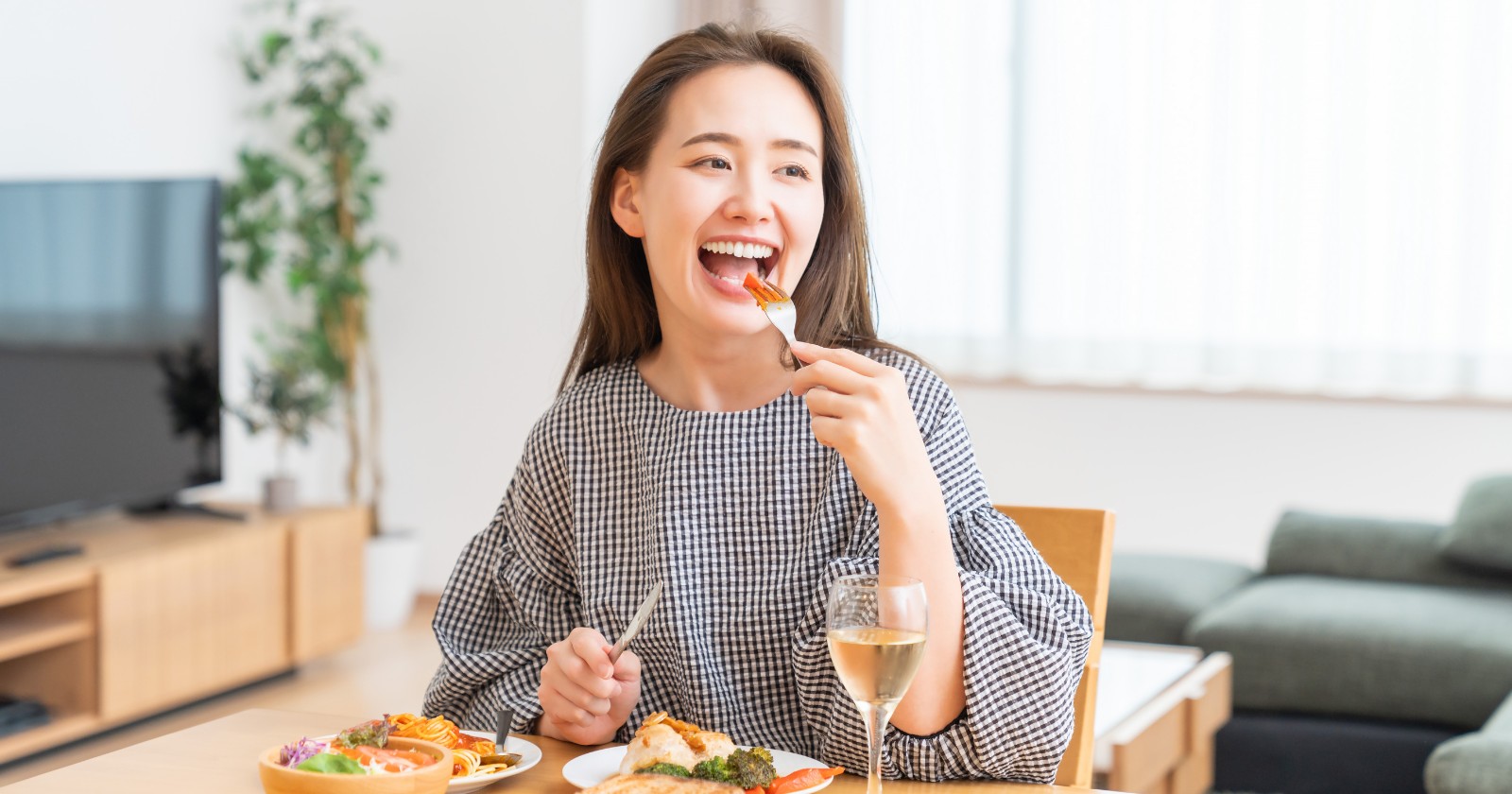
And then there are the other people. The ones who, even when alone, pull out a chair. Set the bowl on the table. Sit down. Eat.
The standing-eaters often read this as performance. As something a little extra, a little theatrical, the domestic equivalent of lighting a candle to take a bath. Who has time for that? they think, finishing the rest of the pasta over the cutting board.
But the people who sit aren't being formal. They're doing something quieter and more deliberate, and the research on why it matters keeps stacking up.
What the counter actually communicates
Standing at the counter to eat sends a specific message to the nervous system, and the message is: this isn't real. This doesn't count. This is logistics. The body is being refueled the way a car is gassed up — efficiently, peripherally, on the way to something more important.
Sitting down sends the opposite message. It says: this is the thing. For the next eleven minutes, eating is what's happening. Nothing else.
The distinction sounds small. It isn't.
The act of sitting down together for family meals — without TVs, without phones — produces measurable benefits for mental health, communication, and emotional stability, even when the meal itself is nothing special. The food matters less than the framing. The chair matters less than what the chair represents.
What it represents is permission. Permission to stop. Permission to register what's happening to you.
The rise of the standing meal
None of this is to suggest that counter-eating is a personal failure. The conditions producing it are structural and they're getting worse.
Solo dining isn't just on the rise. It's becoming the default mode of eating in the United States.
When you eat alone, the social architecture of the meal disappears. There's no one across the table holding the moment in place. No one to wait for. No reason, on the surface, to bother with a chair.
And the economy rewards this. The kitchen island was sold to a generation as the centerpiece of the modern home, but functionally it's a feeding trough designed for people who don't have time to sit. Open-plan layouts dissolve the dining room into the kitchen into the living room into the home office. The table, if it still exists, is buried under mail.
Food brands have followed the design. Single-serve packaging, handheld formats, marketing aimed at office workers eating at their desks, protein bars engineered for one-handed consumption. The supply chain has fully optimized for the standing eater.
Why sitting changes what the meal does to you
The people who sit down aren't being formal. They're protecting something that the standing posture can't deliver, no matter how good the food is.
The first thing they're protecting is the body's ability to register hunger, fullness, satisfaction. When you eat standing up while doing something else, the signals get drowned out. You finish the bowl not because you're full but because the bowl is empty. Then you're hungry again at 4 p.m. and you don't understand why.
The second thing is the shift into a parasympathetic state. Sitting, slowing down, putting the utensil down between bites — these aren't aesthetic choices. They're physiological cues that tell the body it's safe to digest. Eating while on the move, while stressed, while typing, is processed by the body the way any other emergency activity gets processed: poorly.
The third thing is something harder to name. Call it self-witnessing. The act of pulling out a chair is the act of telling yourself you're worth the chair.
The choreography embeds
The clinical literature on disordered eating offers a useful sideways look at this. Research on habit formation in eating behavior consistently shows that the rituals and routines around food — where you eat, how you eat, what posture you eat in — become deeply automatic and resistant to change. The brain encodes the choreography, not just the choice.
This cuts both ways. If standing at the counter becomes the default, it gets harder and harder to do anything else, even when you have the time. The body forgets how to slow down. The reverse is also true. People who sit down for one meal a day, consistently, eventually stop being able to eat standing up without it feeling wrong. What looks like formality from the outside is actually a habit that's been protected so consistently it no longer requires effort.
The table, in other words, is a stand-in for a larger question: whether anything in your day gets to be the main event. For a lot of adults, the answer is no. Work is the main event. Childcare is the main event. The phone is the main event. Eating, sleeping, walking, talking to the person you live with — these get squeezed into the margins. They become background processes.
Sitting down to eat reverses the hierarchy for eleven minutes. It says the meal isn't background. It's foreground. Everything else can wait.
The cooking-eating loop
The people who sit are also, often, the people who cooked. Not always — plenty of people sit down to eat takeout or leftovers or a sandwich. But there's a feedback loop here worth naming.
The act of preparing food can produce absorption, build confidence in one's own capabilities, and contribute to a sense of autonomy. People who cook for themselves are practicing a small form of self-determination several times a week.
If you spent twenty minutes making the thing, you're more likely to spend eleven minutes eating it at a table. The investment justifies the ritual. The ritual justifies the investment.
The standing eater, by contrast, is often eating something they didn't make, in a posture that doesn't honor it, in a window of time too short to register it. The whole sequence trains the brain that eating is a problem to be solved as efficiently as possible.
The stress argument
There's an argument that none of this matters — that the meal is the meal, the calories are the calories, and the rest is wellness-industry theatre.
The counterargument is in the stress data. The most common interventions recommended — slowing down, breathing, creating moments of separation between work and not-work — are exactly what a seated meal builds into the day by accident.
You don't have to think of it as self-care. You don't have to call it mindfulness. You can call it sitting in a chair and eating, which is what humans have done for most of recorded history without making a thing of it.
The thing-making is recent. The standing is recent. The chair is the default the species evolved with.
What the chair actually says
The people who pull out a chair when no one's watching aren't performing for anyone. They're not being formal. They're not trying to recreate a 1950s family dinner. They're not bourgeois, or fussy, or doing it for Instagram.
They've just figured out, somewhere along the way, that the chair is a small piece of architecture for paying attention to your own life. This is connected to a wider pattern of behavior around food — the same instinct that shows up in people who stack their plates before leaving a restaurant. It's a quiet form of respect, directed inward this time. Respect for the food, for the labor that produced it, for the hour of the day, for the body doing the eating.
None of this requires a tablecloth. It requires a chair, a flat surface, and the decision that the next eleven minutes count.
Picture it: the bowl comes off the counter. The laptop closes. The stack of mail gets pushed to one side and the bowl goes down on the cleared patch of table. The chair scrapes back. Someone sits — alone, no audience, nothing on the line. They pick up the fork. They take the first bite, and this time they actually taste it. Eleven minutes later, they'll remember having eaten. That's the whole thing. That's what the standing-eaters are missing.