
The USDA Economic Research Service estimates U.S. food waste at roughly 30 to 40 percent of the food supply — and the USDA's Household Food Security in the United States in 2023 report, released in September 2024, found that 17.9% of households with children experienced food insecurity at some point during the year, with rates running notably higher in low-income urban pediatric populations. Both numbers describe the same broken supply chain from opposite ends. And both numbers tend to live, very quietly, inside the adults who grew up watching them.
Walk into the kitchen of someone who keeps a sparse pantry and a half-empty fridge and the temptation is to read it as a lifestyle choice. Minimalism. Aesthetic. Maybe a TikTok phase.
Sometimes it is. More often, it is a quiet inheritance.
The kitchen as a record of what someone learned about plenty
There is a particular kind of person whose fridge contains four things, all of which will be eaten by Thursday. Their pantry has rice, beans, one good olive oil, and a single jar of something nice. The freezer is not stockpiled. The countertop is clear.
From the outside, this looks like discipline. From the inside, it is often a learned response to having watched food rot in someone else's house — or in their own, before they had any say in the matter.
Children pay close attention to where money goes and where it leaks out. A bag of spinach turning to liquid in the crisper drawer is not a neutral event when you are eight years old and already aware that groceries are a source of tension. The lesson lands early: buying more than you can eat is not abundance. It is waste with a receipt.
What the research actually says about scarcity and sufficiency
The conventional reading of a sparse pantry is that it signals scarcity thinking — the fear-based notion of scarcity that psychologist Robyne Hanley-Dafoe describes in her work on resilience and sufficiency. In that framing, hoarding is the symptom of deprivation and sparseness is its opposite expression: the refusal to accumulate because accumulation itself feels precarious.
But Hanley-Dafoe draws a useful distinction between scarcity and what she calls sufficiency — the belief that there is already enough. Sufficiency is the practice of appreciating what is actually usable, what is actually present, what will actually get eaten.
A half-empty fridge, in that frame, is a sufficiency signal. The contents will be used. Nothing in there is theoretical.
That is a meaningfully different psychological posture than a psychological posture rooted in fear that there will not be enough. It is closer to an understanding that enough may be smaller than commercial messaging suggests.
Why the lesson lands so hard in childhood
Early environmental exposure shapes adult decision-making in powerful ways. The Nature Research summary on consumer behaviour and health decision-making describes how cognitive, emotional and social factors interact to drive choices around diet and consumption — and how patterns formed early tend to override later knowledge of what people believe they should do.
Children absorb what they watch adults do with resources, and they internalise the emotional weather around those actions. A parent visibly stressed about throwing out a leftover roast teaches a more durable lesson than any lecture about money.
That lesson does not require actual food insecurity to take root. It only requires having witnessed waste being framed — explicitly or in body language — as a loss.
The food-insecurity layer underneath
For the children who did grow up food insecure, the imprint is sharper still. The experience is not only psychological — it is biological, and it travels with the person.
It also travels into adult eating behaviour in ways that are not always obvious. The assumption that eating disorders primarily affect wealthy families badly misreads the data. Restriction, hoarding, and complicated relationships with abundance show up across income brackets, and they often trace back to childhood instability around food.
The adult who keeps a sparse fridge is sometimes doing a thing that looks, from the outside, like restraint. From the inside, it can be the only arrangement that does not feel like risk.
Sparse is not the same as deprived
This is where the conventional reading falls apart. A sparse pantry is not, by default, a sign of someone running on empty. Plenty of people with sparse kitchens are financially comfortable, well-fed, and eating extremely well. They are simply buying for the next three days instead of the next three weeks.
They are also, in many cases, much closer to how most of the world eats — small, frequent shops, ingredients chosen for tonight, very little speculative stockpiling. The American household pantry, with its case-pack Costco aesthetic and its three open jars of the same condiment, is a relatively recent invention, sold hard by a retail system that profits from oversupply at the household level.
Which is worth saying plainly: the bulk-buy economy is not a neutral cultural preference. It is the household-facing edge of a food system that produces far more than people can eat, and that has spent decades training consumers to absorb the surplus.
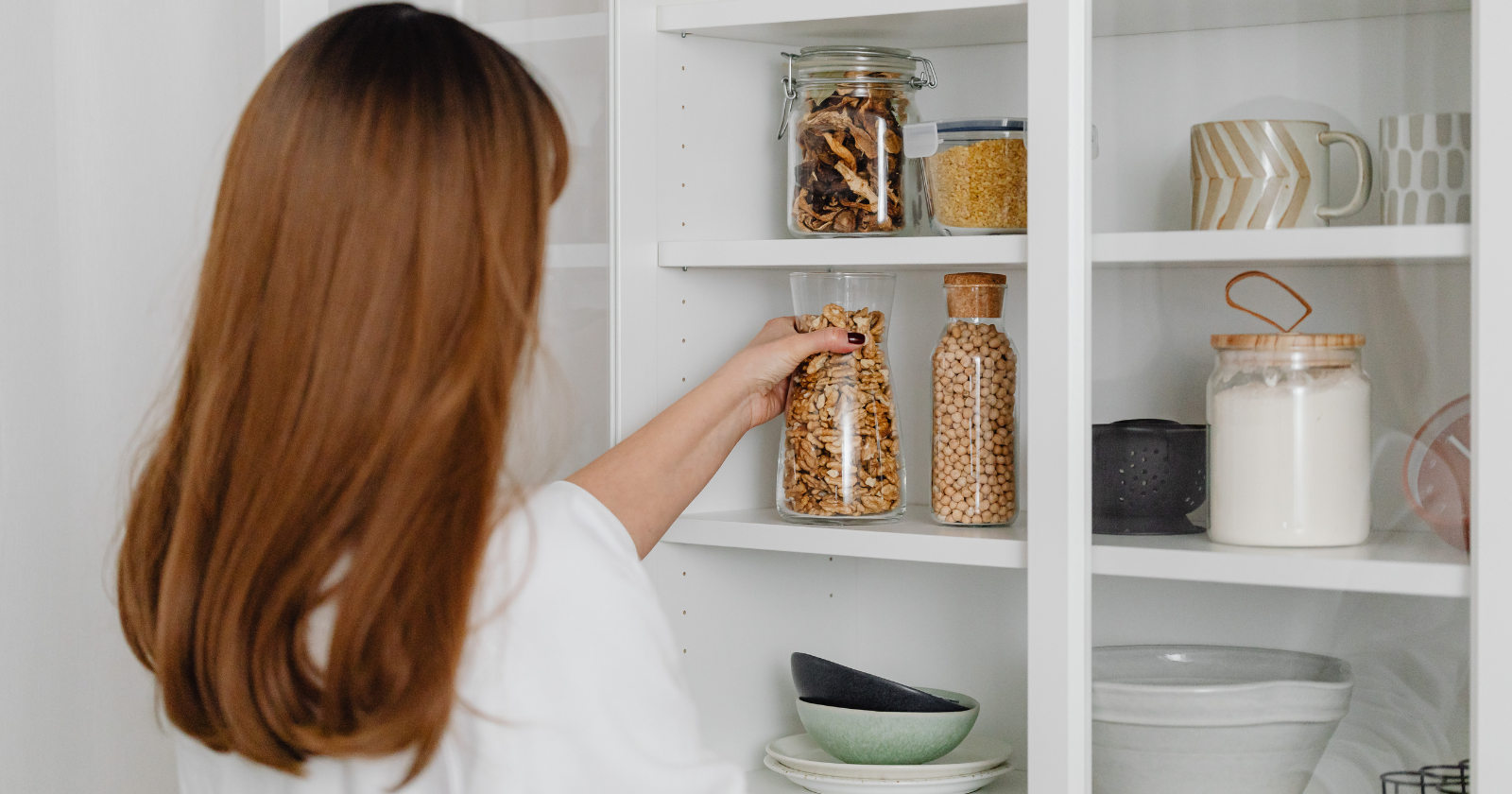
The other extreme — and why this article is not about minimalism
None of this is an argument for performative emptiness. There is a parallel and equally tidy trap, which is the aesthetic of the empty fridge as content. The artisanal lemon. The single bowl of cherries. The implication that virtue lives in the spareness itself.
Psychology Today has written about minimalism and the mental-health appeal of living with less, and the appeal is real — fewer decisions, less visual noise, less waste. But minimalism-as-identity can become its own performance, no more honest than the maximalist pantry it defines itself against.
The people this article is actually about are not performing anything. Their kitchens look the way they look because that is the arrangement that lets them sleep. The point is the relationship to abundance.
What it looks like in adulthood
A few patterns tend to show up together in people whose childhood taught them that excess equals waste.
They buy proteins the day they cook them. They know exactly what is in the fridge at any given moment. They get genuinely uncomfortable when someone over-orders at a restaurant and the leftovers get abandoned. They have a complicated relationship with hosting, because the cultural expectation to prepare excessive amounts of food when hosting scrapes against something old.
They often cook well. Constraint tends to produce skill. When you only have six ingredients in the house, you learn to make six ingredients work.
They also, sometimes, struggle to receive abundance gracefully. A friend showing up with three bags of groceries as a kindness can land as a small panic — where will it go, will it get eaten in time, what happens if it doesn't.
The systemic frame worth holding
It is tempting to pathologise this — to call it a wound that needs healing, a scarcity mindset to be reframed into abundance. Some of that work is real and useful. Hanley-Dafoe's reframing exercises are not nothing.
But the structural read matters too. Household food waste in the United States is the predictable output of a retail system that sells in volumes calibrated to its margins, not to a household's eating capacity. Embedded food outreach specialists in pediatric clinics can move thousands of meals a year through pilot programs — which tells you something about how much food is sitting in the wrong places, waiting to be matched with people who need it.
The person with the sparse pantry is, in a quiet way, opting out of that system at the household level. Whether or not they would describe it that way.
The relationship underneath the kitchen
How a person stocks their fridge is not a small thing. It is a daily, repeated decision about what they trust will be there tomorrow, how much they are willing to commit to in advance, and what they consider waste versus what they consider care.
VegOut has written before about how the way you treat yourself when nobody is watching tends to set the tone for every other relationship in your life. The kitchen is one of the most honest rooms in that respect. It is not curated for guests. It is calibrated for the person who lives there.
If that calibration leans toward sparse, half-empty, and used-by-Thursday, it is worth being slow to read it as a problem. It might be a person who learned, early, what the actual size of their life is. And refused to keep buying past it.
What changes if you stop pathologising it
The most useful reframe is probably the simplest. A sparse kitchen is information about a history, not a verdict on a present.
It can mean someone is still flinching at the memory of waste, in which case the work is gentle — noticing the flinch, asking whether the rule still serves. It can also mean someone has arrived, through whatever route, at a clean working relationship with sufficiency. In which case there is nothing to fix.
The kitchen will tell on a person either way. The question is what story you decide it is telling.