
Bryan Johnson has been hard to stop thinking about. Watch him swallow over a hundred pills in a single morning, monitored by machines, scored by algorithms, optimized to a degree that would make most people feel claustrophobic just imagining it. And one detail sits especially heavy: his fiancée was diagnosed with stage three breast cancer, and he left her during chemotherapy. Then he had her sign a confidentiality agreement. Here is a man who has organized every waking minute around the project of staying alive, and yet something essential about being alive seems to have slipped through the cracks of all that optimization.
The more you sit with his story, the more it reveals something uncomfortable about a cultural obsession many of us share, even if few would ever take it as far as he has. Society treats longevity like a math problem. Add the right inputs, subtract the harmful ones, and the equation yields more years. But the people who actually live the longest on this planet have never done this math. They've been too busy living.
The Most Optimized Life on Earth Looks Eerily Empty
Johnson wakes at 4:30 every morning. He eats 1,950 calories a day, the same meals every day, with his last meal at 11:00 AM. He's in bed by 8:30 every night. Over 70 organ systems are monitored. His blood is drawn regularly. His body fat, bone density, and brain function are scanned and scored. By his own metrics, the results are impressive: biological age scores have dropped, inflammation markers are near zero, cardiovascular fitness is elite.
And yet. He left his faith at 34. His marriage ended. Of his three children, two cut ties with him. His remaining son, Talmage, became part of the protocol itself, with Johnson taking the young man's blood plasma as part of his anti-aging experiments. When Talmage decided to leave for college, Johnson broke down in tears. His son chose to begin his own life, and Johnson couldn't bear it. As he's said publicly: "The human mind is not a reliable source of judgment." So he removed it from command. An algorithm now tells him what to eat, when to sleep, what to take, and how well he did.
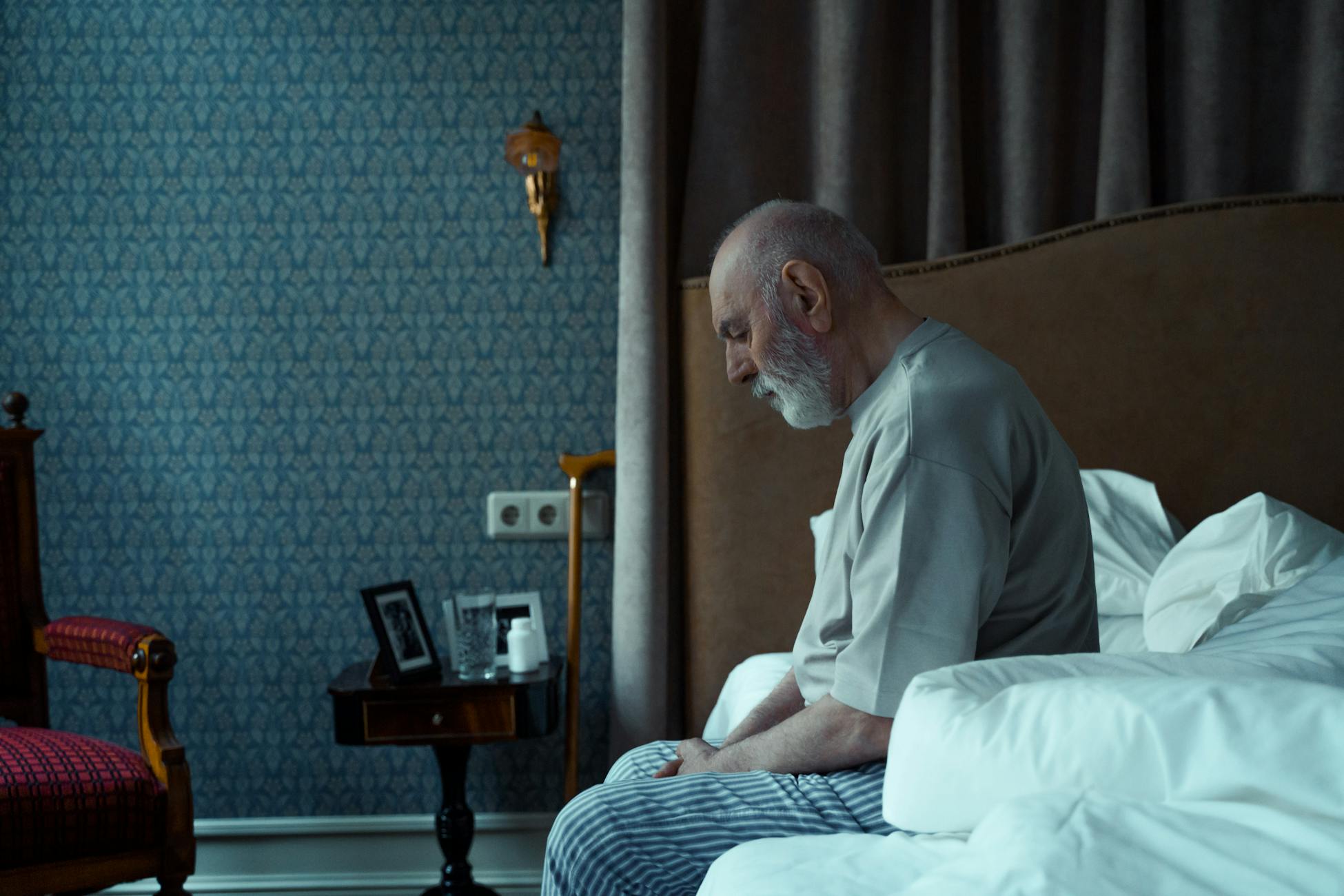
There is something genuinely tragic in this. The man has achieved an extraordinary degree of physical optimization, and the cost has been nearly every relationship that gives a human life its texture. There's a particular kind of regret that settles in around midlife when a person realizes the years spent performing someone else's version of a good life were years that can't be reclaimed. Johnson seems to be building toward a version of this, except the performance is for data itself.
The Billion-Dollar Bet Against Death
Johnson is the most visible face of something much larger. Right now, some of the wealthiest people on the planet are pouring billions into the idea that aging is a disease and death is a problem to be solved. Scientists funded by Jeff Bezos are taking old human cells and reprogramming them back to a younger state in a San Diego lab, with $3 billion behind the premise that aging can be reversed at the cellular level. Sam Altman, the man behind ChatGPT, is backing a team in San Francisco engineering ways to add ten healthy years to the human lifespan. Google is funding a secretive facility where researchers study organisms that barely age at all, with $3.5 billion allocated to a single question: can death be made optional?
The science behind this, cellular reprogramming, works on an elegant principle. Every cell in the human body carries a complete copy of the original genetic code, the version from youth. Over time, cells accumulate damage. Some of them refuse to die, sitting broken and inflamed, leaking toxins into surrounding tissue. Scientists call these senescent cells, and new drugs called senolytics are being designed to hunt them down and clear them out. In animal studies, mice given these drugs physically rejuvenated. Their organs recovered function. Their fur grew back. They ran faster.
AI has accelerated the whole process. Machine learning models now scan millions of molecular combinations, predicting which ones will target specific decay pathways. What used to take a decade and a billion dollars can now happen in months. The promise is enormous: the end of cancer, Alzheimer's, and heart failure, reframed not as separate diseases but as symptoms of one underlying condition, aging itself.
None of this should be dismissed. The science is real, and much of it will likely lead to meaningful medical breakthroughs. What deserves scrutiny is the framework. The assumption running beneath the entire enterprise is that the problem of human mortality is fundamentally a technical one. Fix the machinery, and you've fixed everything. But a growing body of evidence from the places where people actually live the longest suggests the machinery was never the main thing.
What the Blue Zones Keep Trying to Tell Us
The VegOut team traveled to communities around the world where people routinely live past 100, places with no protocols, no supplements, no billion-dollar labs, and found something the data keeps confirming but Silicon Valley keeps ignoring. The full exploration of this contrast, including Johnson's story and the science behind longevity, is worth watching in detail:

More in Think Deeper