
Fourteen boxes of unread books is a surprisingly accurate autobiography. More accurate, honestly, than anything someone could write about themselves on purpose. Each box told a story about ambition and intention and the quiet way a life drifts from its original blueprint without anyone noticing — least of all the person living it.
They went into the car last Saturday. Driven to a donation center. Carried in, box by box, and left without a backward glance. And the strange part, the part that keeps circling back, is how light the whole thing felt afterward. Not sad. Not nostalgic. Light. Like putting down evidence of a crime that was never actually committed.
Most people would call this a decluttering story. A weekend project, a feel-good purge. The conventional wisdom around getting rid of things says you're "making space" or "simplifying your life" or whatever the latest organizational guru is selling this month. But that framing misses what actually happened here. The lightness didn't come from having fewer things. It came from finally stopping a negotiation that had been running for over a decade — a negotiation about who a person was supposed to become.
The library of a person who doesn't exist
Here's what was in those boxes. A three-volume history of the Byzantine Empire. Two books on quantum mechanics written for laypeople. A 900-page biography of Napoleon bought in a London bookshop sometime around 2011. Four novels by authors seen in interviews that inspired the thought, "I should really read their work." A collection of essays on architectural theory. Psychoanalytic philosophy texts from academic years, kept with the idea of revisiting them with fresh eyes.
None of them were bad choices. Every single purchase made sense at the time. The problem was that the person who bought them existed in potential, not in practice. The vision was of a future self with long Sunday afternoons and no screen addiction and the kind of focused attention span that makes 900-page biographies pleasurable rather than punishing.
That person never showed up.
The person who actually showed up built a company, moved across several countries, spent evenings watching YouTube essays about the very topics those books covered, and read maybe thirty pages of the Napoleon biography before setting it on a nightstand where it collected dust for three years.
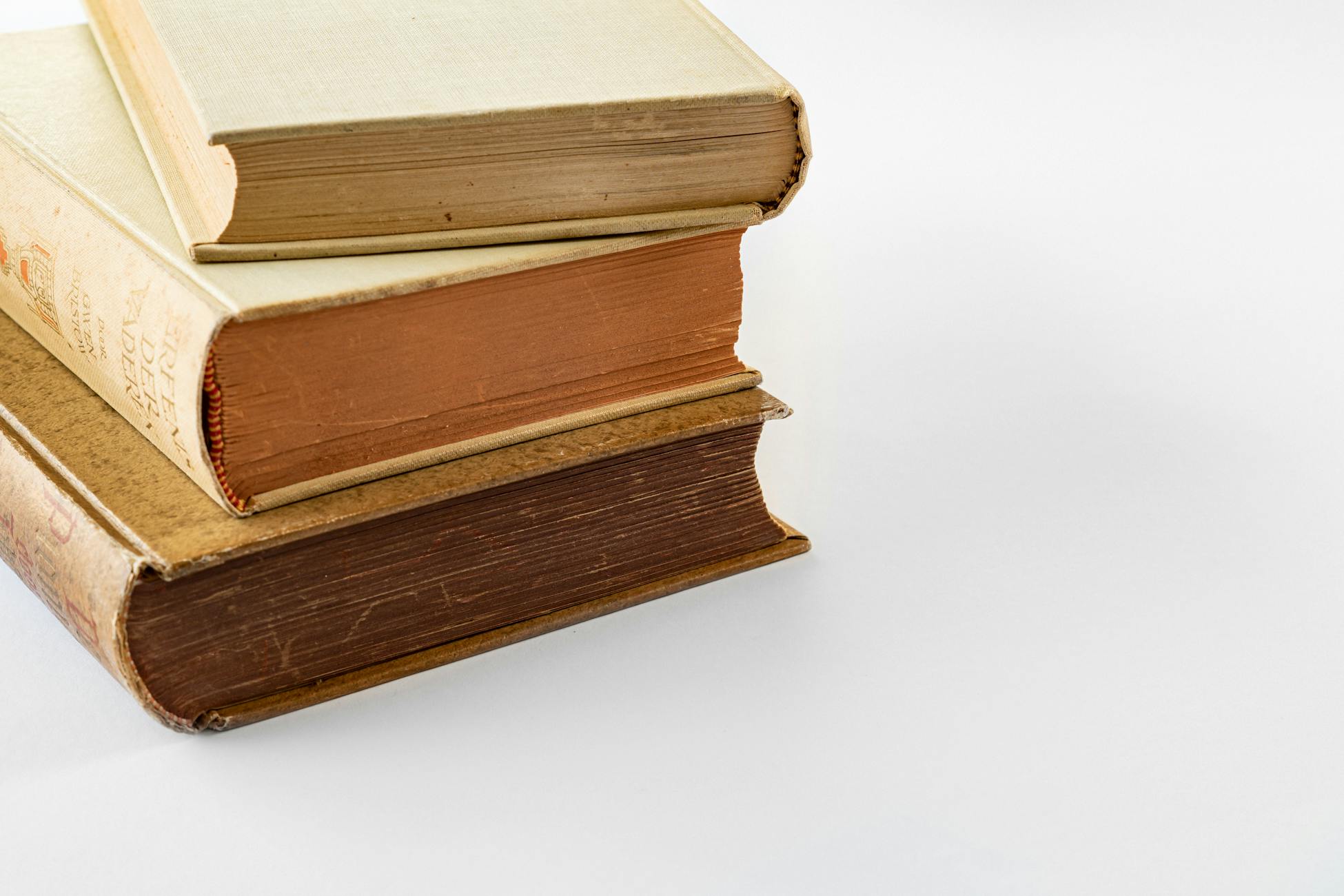
Those boxes moved from apartment to apartment — Melbourne to Bangkok, Bangkok to Singapore — as though transporting them was the same as reading them. As though physical proximity to knowledge counted as absorption. And every time they got packed, the same promise surfaced: "When things slow down."
Things never slow down. You just get used to the speed.
The gap between your actual self and your aspirational one
What made those books so hard to give away wasn't sentimentality, exactly. Nobody has childhood memories attached to a quantum mechanics primer. The difficulty was that each book represented a commitment to a self-concept that wasn't ready to be abandoned. Keeping them meant the door was still open. Donating them meant acknowledging that a different door had been walked through entirely — and it had closed behind.
Psychologists have observed the discrepancy between who you are and who you believe you should be. Studies suggest that the wider that gap grows, the more distress it produces. We tend to think of this in terms of social media and body image, but the principle operates everywhere. Those bookshelves were a monument to the gap between the imagined intellectual and the actual entrepreneur.
And the books weren't even the only artifacts. There was a leather journal from a phase of planning to write longhand every morning. A set of oil paints from a weekend decision to learn to paint. Running shoes in three different styles because of recurring thoughts about becoming the kind of runner who cared about shoe rotation.
Each object was a fossilized intention. A small, physical lie.
Why we hold on to things we never use
The instinct to keep unused possessions runs deeper than laziness or disorganization. There's a psychological architecture underneath it that most people never examine. The objects aren't really objects. They're placeholders for unlived identities.
It's a pattern many people recognize in themselves. Buying a book feels like a micro-commitment to growth. Shelving it feels like progress. The purchase itself delivers a small dopamine hit that mimics the satisfaction of actually learning, and the brain files it under "done" even though nothing has been done at all.
Those who work with sentimental decluttering often observe that the emotional attachment to possessions has more to do with identity than with the object's function. You're not attached to the book. You're attached to the version of yourself who would have read it. And letting go of the object forces you to let go of that version too.
That's the part that stings.

Because admitting you won't read the Byzantine history trilogy means admitting something about your actual interests, your actual attention span, your actual life. And "actual" is a much less flattering word than "potential."
The comfort of planning to become
Many people spend their thirties in a state best described as perpetual becoming. Always about to start the meditation practice. Always about to re