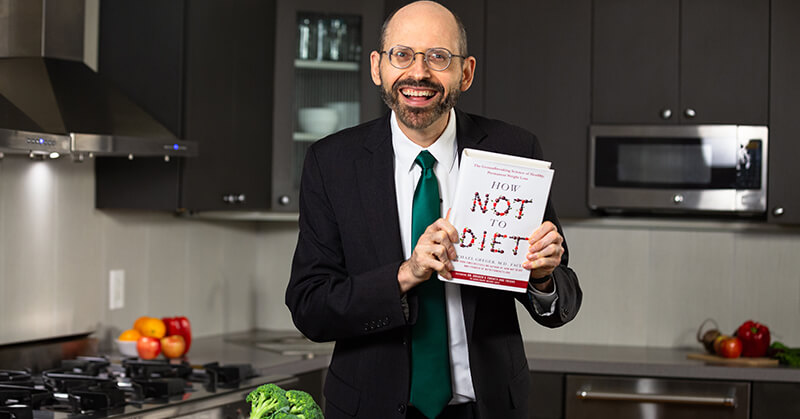
Q: What led you to dive so deeply into plant-based nutrition research and begin NutritionFacts.org?
A: I think what sparks many kids to want to become doctors when they grow up is watching a beloved relative become ill or even die. For me, it was watching my grandma get better.
Q: We love your book, How Not to Diet. Why is the focus of evidence-based weight loss so important in our society?
A: I wanted there to be an evidence-based diet book digging up every possible tip, trick, tweak, and technique proven to accelerate the loss of body fat to give people every advantage and build the optimal weight-loss solution.
Q: Tell us about your Daily Dozen recommended food list.
A: Some foods have special nutrients not found in abundance elsewhere. As the list of foods I tried to fit into my daily diet grew, I made a checklist, which evolved into the Daily Dozen.
Q: Do you have any evidence-based suggestions for keeping our immune systems up during the COVID-19 pandemic?
A: Any disruption of our daily lives is stressful enough, but when that disruption is caused by a global pandemic, we can easily feel overwhelmed. Studies on the emotional health and mood states of those eating plant-based diets suggest that eating less meat may not only be good for us physically, but good for us emotionally as well.
Q: The media has become a saturated source of nutrition information. While there is a lot of accurate nutrition data to be found, not all of it is factual. Which wellness trend or myth would you like to make disappear and why?
A: The notion that a calorie from one source is just as fattening as a calorie from any other source is a trope broadcast by the food industry as a way to absolve itself of culpability. One hundred calories of chickpeas has a different impact than one hundred calories of chicken or Chiclets, based on their different effects on absorption, appetite, or our microbiomes.