Research on food insecurity during pregnancy has found associations with worse maternal mental health, higher rates of gestational diabetes, and lower birth weights — and researchers have argued that the psychological footprint of food scarcity begins forming long before a child can name what is happening to them. That footprint, it turns out, doesn't dissolve when the fridge finally fills up. It just changes shape.
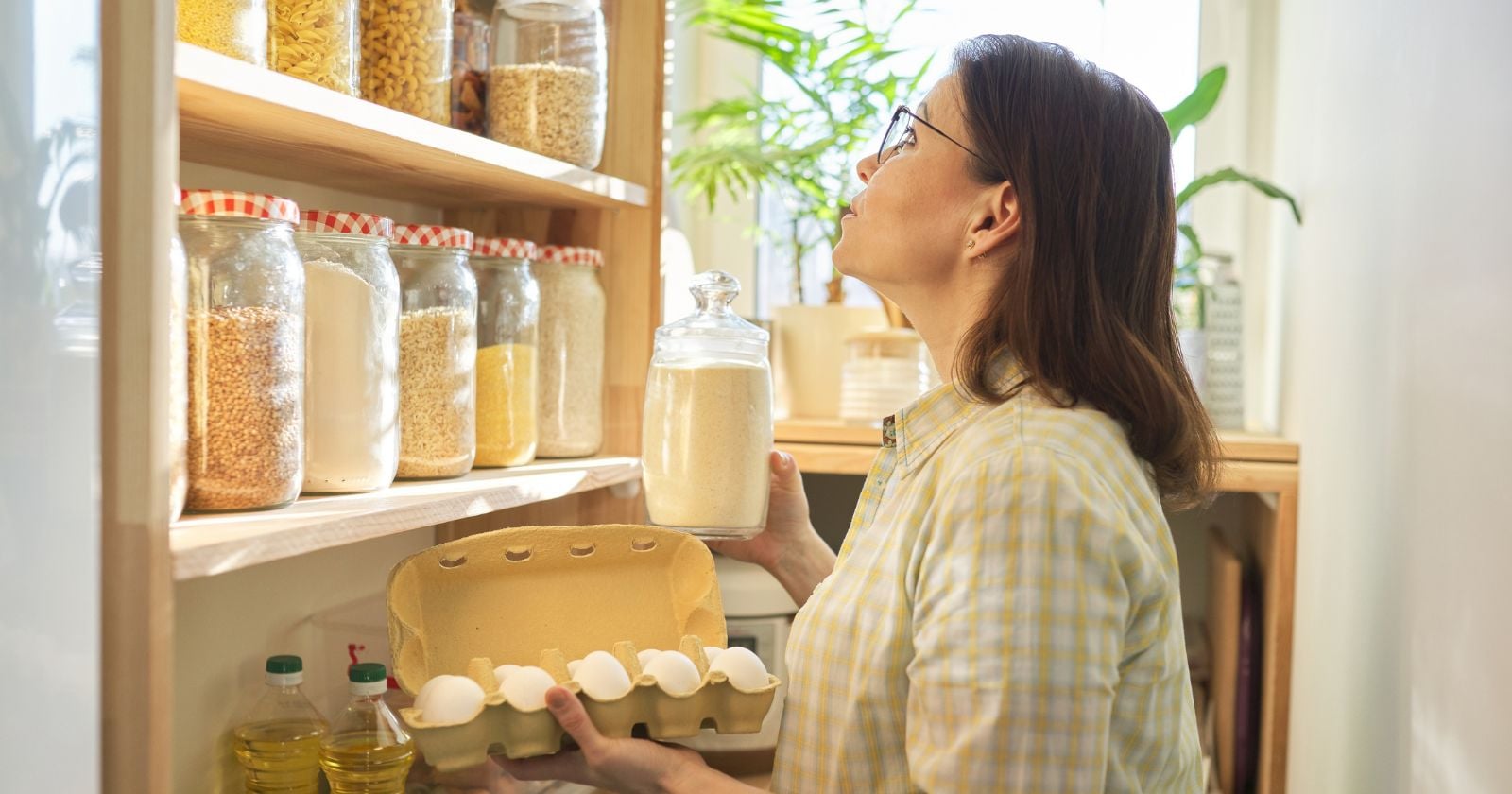
One of the shapes it takes is a pantry that's a little too full.
Not a doomsday bunker. Not a prepper's basement. Just three jars of peanut butter when one would do. Two backup boxes of pasta behind the open one. A drawer that always has batteries, a freezer that always has bread, a cabinet where the olive oil is bought before the current bottle runs out.
The conventional read on this behavior is that it's about control, or anxiety, or maybe just good household management passed down from a grandmother who lived through a war. Some of that is true. But the more honest read — the one that shows up when adults are asked why they actually do it — is quieter and harder to say out loud.
Running out of something, in the household they grew up in, was a small but real shame. And the pantry is the grown-up version of a promise: that the shame won't be coming back.
What food scarcity actually does to a developing brain
The clinical literature on childhood food insecurity has expanded considerably in the past decade, and the picture it draws is not subtle. Children in food-insecure households show higher rates of anxiety and depression, more behavioral issues at school, and measurably worse academic performance. Household food insufficiency has been linked directly to childhood depression and anxiety, even after controlling for income.
The effects don't stop at mood. Early-childhood food insecurity has been tied to worse cardiovascular health markers in young adulthood. And recent microbiome work suggests food-insecure children carry distinct gut microbiome signatures — a biological fingerprint of the experience that persists past the period of scarcity itself.
None of this is the point of a stocked pantry. But it's the soil the pantry grew in.
The shame layer nobody talks about
Hunger is physical. The shame around hunger is social. And for kids, the social part often hits harder than the empty stomach.
In a recent American Hospital Association podcast, Dr. Stormee Williams, chief health equity officer at Children's Health in North Texas, described a case her team encountered: a ten-year-old girl brought into the emergency room after a suicide attempt. When a counselor asked why, the child said she wasn't trying to die — she just thought that if she wasn't there, there would be enough food for her baby brother.
That's an extreme. Most kids who grow up in scarcity-marked households don't end up in an emergency room. But the ambient awareness is the same: that food is a finite resource, that adults are stressed about it, that asking for more might cost something, that the empty bag of bread is a problem with a face on it.
Williams put it plainly. Parents think they're hiding the strain. The kids hear it and feel it anyway.
Shame, in the clinical sense, is the feeling that there is something wrong with you, not just with your situation. A child who opens the fridge and finds it nearly empty doesn't conclude that the grocery system is unjust. They conclude, quietly, that something about their family is lesser. As clinical analysis of childhood deprivation has noted, that shame becomes a template for adult coping — including the coping strategies that look, from the outside, like overpreparation.
How the pantry becomes the antidote
Ask someone with a too-full pantry what would happen if they let it run down. The answers tend to be revealing.
They don't usually say they'd starve or panic. It's more often something like: I'd feel a kind of low-grade dread I don't want to feel. I'd feel like a kid again.
That's the mechanism. The pantry isn't preparing for a hypothetical disaster — it's preventing a specific emotional one. The disaster already happened, somewhere around age seven or nine or eleven, and the adult version of that child has decided, consciously or not, that it isn't allowed to happen again.
Buying the second jar of peanut butter is cheap. The peace it produces — the small, daily, unspoken peace of opening a cabinet and finding what you expected to find — is not cheap at all. It's the resolution of a problem the household has been solving since before the household was an adult.
This is why these adults often also pack their own snacks for flights and long meetings, why they offer food to guests with a particular insistence, why they reflexively ask if you have enough before they've consciously formed the thought. The pantry is one node in a larger system of making sure scarcity doesn't get a foothold again — in their home, in their car, in the moods of people they love.
The intergenerational piece
The reason this pattern matters beyond individual psychology is that it doesn't stay individual. Economic disadvantage moves from one generation to the next — not just through wages and zip codes, but through behavior, expectation, and the small architectures of daily life that parents pass on without meaning to.
A parent who grew up afraid of running out tends to raise children in a house that never runs out. That's mostly a gift. Those children eat reliably, see abundance modeled, develop a different relationship to food than the parent had. But they also absorb the unspoken anxiety underneath the abundance — the parent's quick scan of the cupboard before guests arrive, the third trip to the store this week, the particular tone of voice when the milk is almost gone.
Work on the intergenerational transmission of childhood trauma has shown that adaptive behaviors developed in response to early hardship often persist in the next generation even when the original conditions are gone. The cupboard fills up. The vigilance stays.
This isn't a flaw to be corrected. It's a load-bearing adaptation. But it's worth seeing clearly, because what's invisible can't be edited, and a behavior whose origin you can name is one you get to keep on purpose rather than by reflex.
What the pantry has in common with the clean kitchen and the noticed haircut
Pattern-recognition is the part of the conversation that often surprises people. The full pantry rarely travels alone. It shows up alongside other quiet habits that look unrelated and aren't.
The adult who keeps a clean kitchen even when nobody's coming over often grew up in a house where mess signaled that something was off. The adult who notices a friend's haircut or a slight shift in mood often learned early that small changes in people mattered. The full pantry is part of the same family of habits — the daily, small-stakes work of making sure the floor stays under your feet because once, briefly, it didn't.
These are the habits of people who learned that the environment was something you actively maintained, not something you could trust to maintain itself.
The honest counterargument
It's worth saying that not every stocked pantry has this story behind it. Some people just like Costco. Some people cook in big batches because they cook for a family of six. Some people grew up perfectly fed and simply prefer not to run out of olive oil on a Tuesday night.
The behavior isn't a diagnosis. It's a frequent pattern with a recognizable origin, and the value of naming the pattern isn't to pathologize a kitchen cabinet — it's to give people who do recognize themselves in it a more accurate story about why the cabinet matters to them.
Most adult behavior is overdetermined. The pantry can be about anxiety and good planning and the price of pasta and a memory from 1987. All of it can be true at once.
Why this matters beyond the cabinet
The economic story underneath this pattern is not small. Tens of millions of American children currently live in food-insecure households, and policy shifts in 2025 and 2026 around SNAP eligibility have widened that number sharply. Every one of those children is forming, right now, the relationship to food that they'll be living with at forty. Some will become the adults with the too-full pantry. Some will become the adults who can't keep one stocked at all because the sight of it brings up too much. The variance is wide and not yet well understood.
What is well understood is that the early experience leaves a mark. The pantry is one of the visible places where you can see the mark, decades later, still doing its quiet work.
There's something tender in that, if you're willing to look at it. A grown adult, with their own income and their own keys and their own grocery list, walking through the kitchen and noticing the peanut butter is getting low — and buying the next jar a week early, just to be sure.
Not because they're afraid of the apocalypse. Because some part of them is still seven years old, and that part deserves to open the cabinet and find what it's looking for.