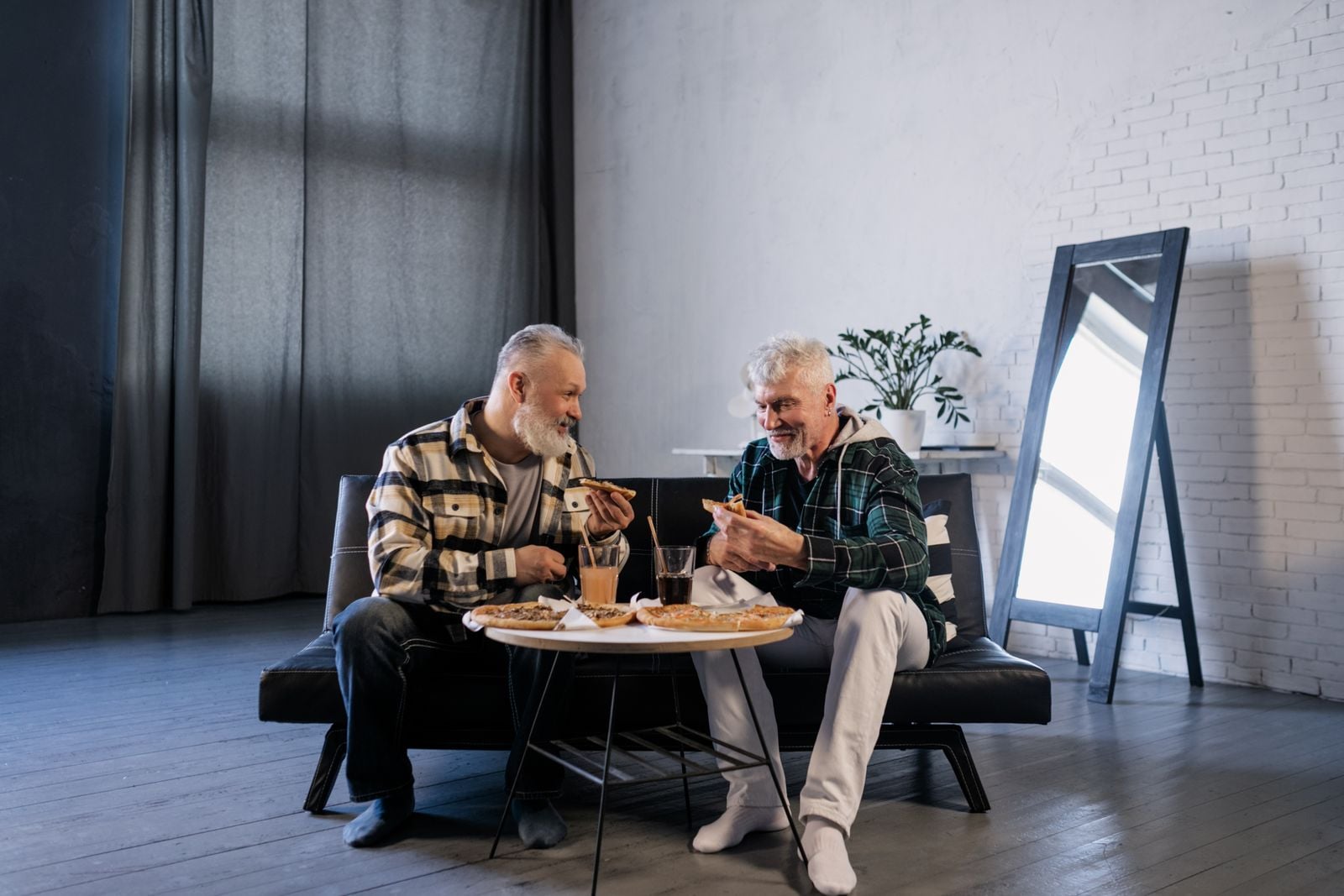
Adults who grew up before snacking was a category often arrive at their sixties with a relationship to hunger that doesn't require an app, a schedule, or a moral framework to feel like a normal part of being alive
Hunger isn't a test of willpower—it's a biological conversation you can't fully control. Yet modern culture has turned eating into a moral performance, complete with apps, schedules, and influencer-approved rules.
Hunger and fullness aren't voluntary experiences. They're shaped by a conversation between the gut, hormones, the brain, and the surrounding environment, most of which operates outside conscious control. People often try to manage appetite through willpower, then discover that willpower is not really what's in the driver's seat.
Which makes it strange that the dominant cultural script around eating treats hunger as a kind of moral test.
People are told to track it, time it, schedule it, override it, or honour it depending on which influencer happens to be shaping the conversation that month. There is an app for it. There is a fast for it. There is a snack designed by a food scientist to interrupt it before it fully forms.
And then there are adults in their sixties who simply eat when they are hungry and stop when they are not.
The generation that never learned to snack
For many people who grew up in the 1950s or 60s, "snack" was not really a category in the modern sense. There were meals. There was sometimes a biscuit with a cup of tea. The kitchen was closed between proper sit-down events, not because anyone had read a book about intermittent fasting, but because that was simply the architecture of the day.
Three meals. A kettle. A tin in the cupboard that was not supposed to be raided.
The snack industry as it exists today, a distinct commercial category aimed at filling the hours between meals, emerged primarily in the latter decades of the twentieth century. Before that, food companies sold ingredients and meal components. After that, they sold a new behavioural pattern: graze, all day, on engineered products.
Which means an entire cohort of adults now in their sixties spent their formative eating years before the snack economy had fully reorganised the day around continuous consumption. They learned hunger as a signal that came and went on its own clock, not as a thing to be intercepted every ninety minutes.
What the gut is actually doing
The biology here is more interesting than the diet industry lets on. Appetite is not a single switch. It is shaped by stomach stretch, gut hormones, blood glucose, learned cues, reward circuits, past eating patterns, and the environment around the person eating.
In other words, the body has a built-in messaging system running between the stomach and the brain, signalling when to start, when to stop, and when the kitchen can be left alone.
The problem is that the message does not arrive in a vacuum. Highly available, highly palatable foods can keep cueing desire even when the body is not asking for energy. The signal can still be there, but the noise around it gets louder.
This is the part the willpower framing misses. People raised inside a forty-year experiment in continuous snacking are not morally weaker than their parents or grandparents. They are living in a food environment that asks them to listen to internal cues while constantly shouting over them.
Hedonic hunger versus the real thing
There is a useful distinction to hold onto: hunger driven by actual energy need versus hunger driven by the brain's reward circuits, triggered by hyper-palatable foods engineered to combine sugar, fat, and salt in ways that can override normal satiety.
A neuroscience study covered by News-Medical found that food cues may keep activating learned reward responses even after people feel full. The body may have had enough, but the cue can still keep talking.
Which is to say: a sixty-five-year-old who looks at a packet of chips on the counter and feels nothing is not necessarily unusually disciplined. They may simply have spent fewer decades training their attention to fire at the sight of a branded wrapper.
Cris E. Haltom, Ph.D., CEDS, writing for Psychology Today, describes this as "food noise": persistent thoughts about food that sit beyond ordinary hunger and fullness cues. The modern environment has gone from sparse to saturated within a single lifetime, and for some people, the background hum has become hard to switch off.
Why the apps don't fix it
Here is a question worth asking. If hunger is biological and the gut-brain conversation is doing its job, why do so many people need an app to tell them when to eat?
Partly because the food system has made the signal harder to hear. Partly because a wellness industry has emerged whose revenue model depends on selling people back the ability to listen to their own bodies. Coaches, hunger-tracking apps, macro calculators, fasting timers: these are products. They have shareholders. The premise of each one is that the individual, alone, cannot be trusted to know when hunger is real.
The conventional wisdom says people in their sixties eat less because their metabolism has slowed and their appetite is dimming. There is some truth to that, but it misses the more interesting variable. Some of them eat less, and more peacefully, because they were never recruited into the cognitive overhead of monitoring it.
They do not have a hunger app. They have a kitchen that closes at eight.
The pre-snack relationship to appetite
Watch someone who grew up before snacking became a category and certain patterns become noticeable. They may be a bit hungry for an hour before lunch and not say anything about it. They may finish dinner and experience the kitchen as effectively closed in their head. If they want something sweet at three in the afternoon, they may have it, then not think about food again until the next meal.
There is no narrative around any of it. No identity attached.
In many older households, meals happen with a similar matter-of-factness. People sit. They eat what is there. Between meals, the question of food simply does not arise as a topic. Hunger is treated as weather: it shows up, it passes, and it does not need a paragraph written about it in someone's head.
Contrast that with the version of eating many adults under fifty now live inside, where every meal is a small ethical and aesthetic decision. Is this organic. Is this enough protein. Is this aligned with personal values. Was this earned. Was this tracked. How does this fit the macros, the window, the plan, the brand.
A lot of what looks like rigidity in older generations is sometimes better understood as peace. The structure is not always a cage. Sometimes it is the absence of having to decide.
The moral framework problem
The newer wrinkle is that eating has been colonised by morality. Clean eating. Cheat days. Earning dinner. Being good. Falling off the wagon. These are confessional categories, dressed up as nutrition.
A Psychology Today essay by Hamid Zand, Ph.D., recently explored whether hunger and sexual desire may be among the most ancient subjective experiences: biological needs translated into felt motivation. Hunger is older than language. It is older than dieting discourse.
And modern culture has made it into a personality trait.
The people who eat most peacefully tend to be the ones who never fully accepted that frame in the first place. They do not think of food as a moral test. They do not think of themselves as good for skipping the bread or bad for having it. They think of themselves as hungry, or not.
What this isn't
This is not a romanticised "wisdom of the elders" pitch. Plenty of people in their sixties have disordered eating, hidden food anxiety, and decades-old shame. The cohort being described is not everyone over sixty. It is a slice of people whose formative food years happened before continuous snacking, restrictive dieting, and wellness-as-identity converged.
This connects to something explored on the publication's YouTube channel: how the modern food supply has interfered with the same GLP-1 signaling system that drugs like Ozempic are now prescribed to influence. The video "Ozempic: The Drug Your Gut Used to Make for Free" walks through the science of what has happened to a biological process that used to work more quietly.
Some of them are also lucky. They grew up in households where food was stable, where there was enough but not too much, where meals were uneventful in the way that lets a person relax around eating.
The counterargument worth taking seriously is that this generation also grew up before the food environment got truly hostile. They were not tested the way younger people are tested. If a fourteen-year-old today were placed into a 1962 pantry, they might well eat in a similar way. The variable is not only the person. It is the room.
What's actually transferable
The interesting question, then, is what can be transferred. Nobody can time-travel back to a kitchen with three meals and a biscuit tin. But some of the architecture can be borrowed.
The research summary on responsive infant feeding describes the value of recognising and responding to hunger and satiety signals rather than relying only on imposed schedules or fixed volumes. The adult version is not identical, but the underlying idea is familiar: cues matter. Signals can be noticed, respected, or overridden.
What older adults who eat peacefully tend to share is a few simple things. The kitchen has hours. Snacks are not an architectural feature of the day. Meals are events with beginnings and endings. There is no running commentary about whether the eating was earned, deserved, or aligned.
And there is no app.
The quiet competence
What stands out when watching this kind of older eating pattern is not discipline. It is the absence of effort. These adults are not fighting their appetite or honouring it or processing it. They are just having lunch.
The wellness industry would like people to believe that arriving at this kind of relationship with food requires a course, a coach, a protocol, and ideally a subscription. The people who actually have it did not pay for any of those things. They had it because the surrounding culture, for a few decades, did not make eating into a project.
That culture cannot be recreated by one person alone. But the architecture can still be noticed. A kitchen can occasionally close at eight. Hunger can be allowed to come and go. A body signal does not always need to be outsourced, tracked, moralised, or turned into a story.
That is most of what these older adults are doing. It is not a system. It is just a lighter relationship with a very old feeling.