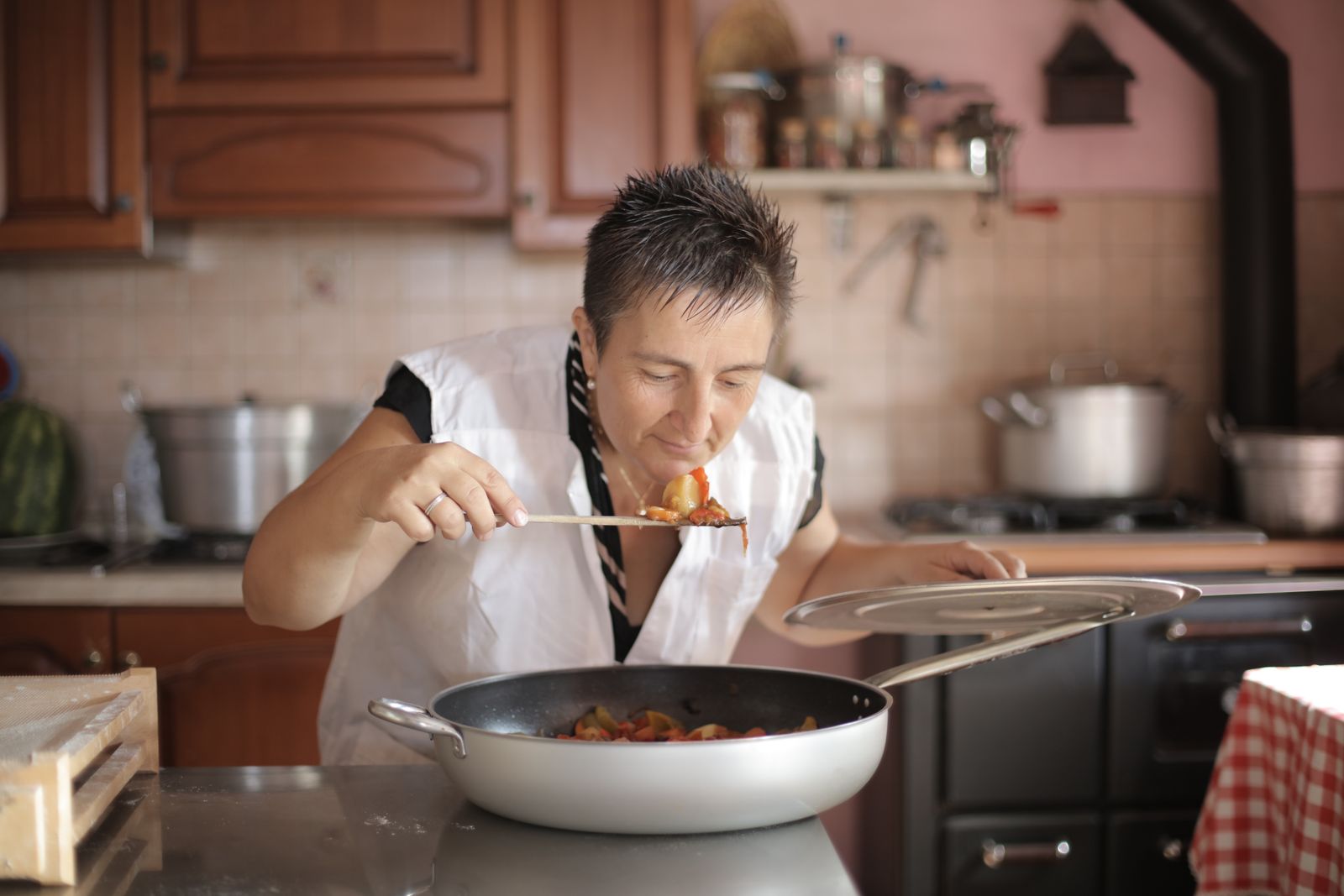
Research suggests that intrinsic motivation predicts quality of performance, while extrinsic motivation predicts quantity. The same pattern shows up in kitchens. People who genuinely enjoy cooking tend to produce food that tastes like it was cooked by someone who wanted to be there. People performing the role of "home cook" tend to produce food that looks correct.
The conventional wisdom is that the difference comes down to skill. Better knife work, better recipes, better pans.
It almost never does.
The difference is closer to motivation architecture — whether the person standing at the stove is doing it for the activity itself or for an audience that may not even be in the room. Watch closely enough and the tells are physical. They live in tiny habits that take three seconds and reveal everything.
1. They taste before they season, not after
Performers reach for salt the moment the pan heats. It's a ritual gesture borrowed from cooking shows, where seasoning early is dramaturgically satisfying.
People who enjoy cooking taste first. They want to know what the food is doing before they intervene. The behavior is small but it signals a different relationship with the ingredients — curiosity instead of choreography.
2. They don't narrate what they're doing
Performative cooks often talk through the steps mentally, even when alone, narrating actions like deglazing with wine as if following a script picked up from cooking shows.
Enjoyers fall quiet. In mindful present-moment awareness, attention turns toward the actual sensory experience rather than the narration of it. The pan hisses. The garlic shifts color. There's nothing to say about it because they're inside it.
3. Their mise en place is messy on purpose
The food-media version of mise en place — every ingredient in its own glass ramekin — is a television convention designed for cameras. It looks beautiful. It also doubles prep time and creates a small mountain of dishes.
People who actually cook a lot keep loose piles on a single board, group things by when they go into the pan, and reuse the same bowl four times. Efficiency is a sign of repetition. Repetition is a sign of enjoyment.
4. They clean as a rhythm, not a punishment
Performers cook in a burst and then face a destroyed kitchen at the end, which they treat as the price of the activity. This is one of the clearest tells of someone who finds the cooking part rewarding only in retrospect.
Enjoyers wash the cutting board while the onions soften. They wipe the counter between steps. The cleaning is folded into the cooking because the cooking isn't a sprint toward a finished plate — it's the thing they're doing.
5. They buy the same olive oil every time
Performative cooks chase newness. A different finishing oil every month, a new fish sauce because someone on Instagram said so, three half-empty bottles of vinegar.
People who cook for love tend to settle into a small set of staples and stay there for years. As VegOut explored in a piece on why people stick with the same brand of olive oil, the staples become a kind of muscle memory. You don't need to think about the oil. You can think about the dish.
6. They taste with a spoon and don't react theatrically
The performance tell here is dramatic — the eyes-closed swoon, the "mmm," the small nod that signals to an imagined viewer that things are going well.
The enjoyer takes a tiny taste and either adjusts something or doesn't. The face barely moves. They're gathering information, not auditioning for it. Genuine present-moment focus tends to look like nothing from the outside. The performance of mindfulness is louder than mindfulness itself.
7. They cook past the recipe
Recipes are scaffolding. Performers treat them as scripture, scrolling back to verify each measurement, anxious about deviation. Cooking this way is essentially a test, and tests are not enjoyable.
Enjoyers read a recipe once, get the rough architecture, and then start improvising within it. Building on Self-Determination Theory, autonomy is one of three core ingredients of intrinsic motivation. A recipe followed to the letter removes autonomy. A recipe used as a starting point restores it.
8. They don't photograph the result
The phone tell is the most modern one and the most diagnostic. Performative cooks plate the food and then photograph it before eating, often making small adjustments to the plate for the shot.
People who genuinely enjoy cooking tend to eat the food while it's hot. The plating is functional. The pleasure was already absorbed during the chopping and the simmering, so the photograph doesn't carry the weight of being the only reward.
9. They keep a pantry that looks lived-in
Performance pantries are curated — matching jars, hand-labeled containers, three types of flour the household uses twice a year. They look like the inside of a magazine spread.
Enjoyer pantries look like someone has been cooking out of them. Half-used bags of lentils. A jar of preserved lemons that was opened in March. The pantry is sized to actual cooking patterns. VegOut has written about how oversized pantries often carry an emotional history — but the everyday cook's pantry is sized for use, not display.
10. They cook the same dish more often than they admit
The performance economy rewards novelty. New cuisines, new techniques, new ingredients. People who post about cooking online almost never repeat a meal publicly, because repetition is bad for the algorithm.
People who love cooking eat the same lentil soup forty times a year and consider it one of the small good things about being alive. Repeated behaviors become more efficient and less cognitively demanding over time — which is partly why the hundredth pot of soup is more pleasurable than the first. The hands know what to do. The mind is free.
Why the performance version is so common
None of this is a moral failing. The performance pattern is a structural outcome of what people have been shown.
Most adults under fifty learned cooking from screens — first the Food Network, then YouTube, then TikTok. Every model they absorbed was, by definition, someone cooking for an audience. The narration, the dramatic seasoning, the clean ramekins, the closing shot of the plated dish — these are all camera conventions, not cooking conventions. People learned the choreography of being watched without ever being told that's what they were learning.
Building on Self-Determination Theory, behaviors can be driven by genuine interest or by external pressure and reward. Habit formation adds another layer: a behavior can become automatic without becoming enjoyable, especially when it was learned under conditions of self-evaluation or performance anxiety. You can cook three times a week for a decade and still be performing every time.
How the shift actually happens
The move from performing to enjoying isn't a willpower problem. It's an attention problem.
Most people who cross over describe a similar small shift: they stop imagining how the dish will be received and start noticing what's actually happening in the pan. The garlic smells different at minute two than at minute three. The water sounds different right before it boils. The knife is sharper than they remembered.
VegOut covered this turn in a piece on people who become curious about cooking later in life — often after decades of cooking for families. The shift, when it comes, isn't about technique. It's about finally being allowed to pay attention to the activity instead of the audience.
The honest limit of this framing
The performer/enjoyer split isn't a clean binary, and it shouldn't be used as a way to feel superior to anyone still finding their way around a stove. Plenty of people cook three nights a week, hate every minute of it, and feed their families well. That counts for a great deal. Impact over identity is the rule.
The point isn't to judge the performance. The point is that the performance is exhausting, and the people stuck inside it usually don't realize there's another way to stand at the stove.
The small habits above are not techniques to copy. Copying them would just be a new performance. They're symptoms of an internal shift that, when it happens, makes cooking feel less like a task with an audience and more like a quiet thing the body already knows how to do.
That shift is available to anyone. It mostly requires turning the imaginary camera off.