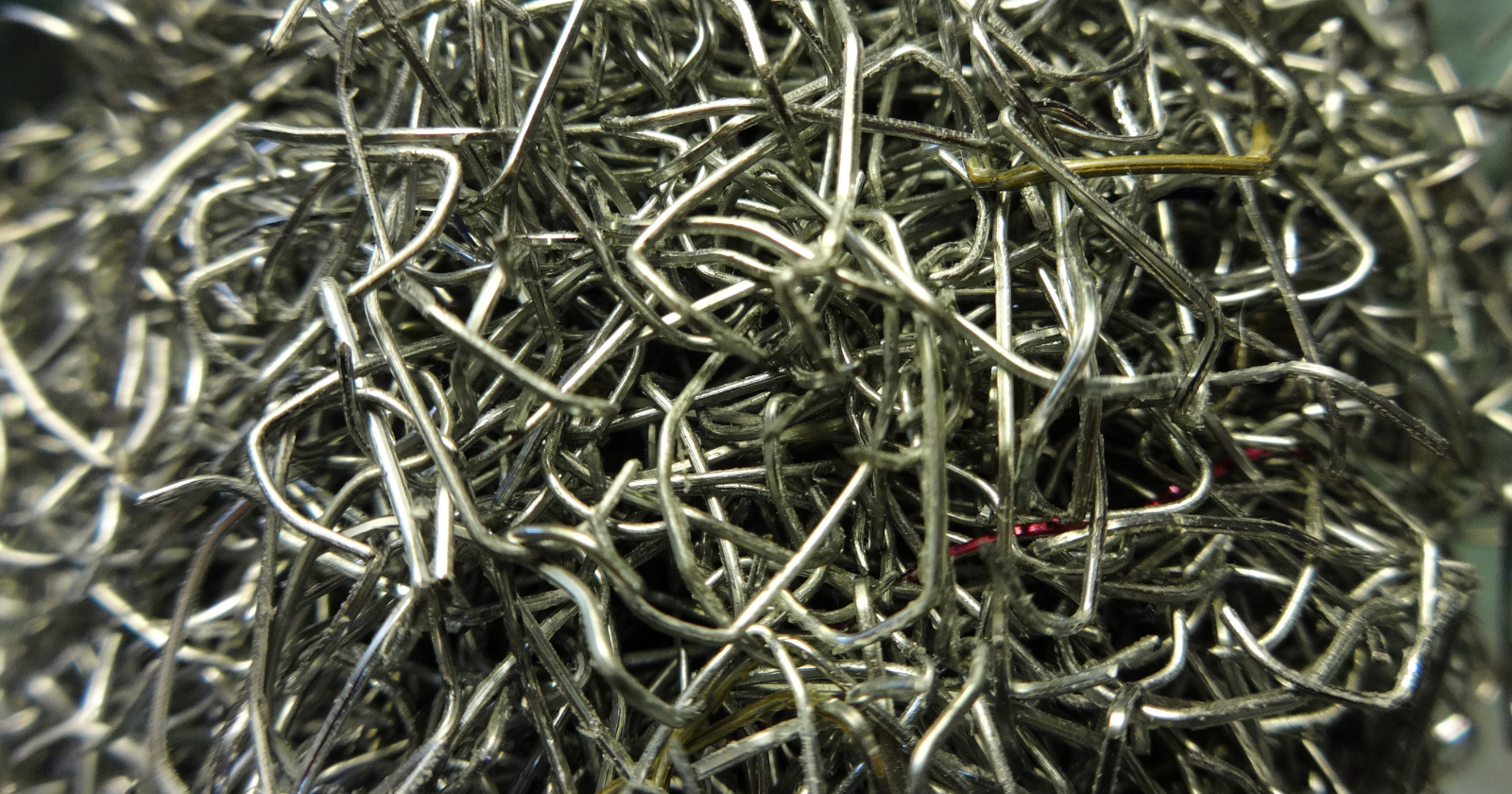
Materials that can hold their shape under load, then collapse into loose particles when shaken, represent an intriguing direction in granular mechanics. The underlying principle relies not on chemistry, but on geometry.
The particles are shaped like tiny office staples. When piled together, their two-legged forms hook into each other and refuse to let go. Apply gentle vibration and they grip harder. Crank the vibration up and the whole structure unravels into a pourable heap.
That is the finding from a team at the Paul M. Rady Department of Mechanical Engineering at CU Boulder, led by Professor Francois Barthelat. In work published in the Journal of Applied Physics, Barthelat and his colleagues — including PhD students Saeed Pezeshki and Youhan Sohn — show that staple-shaped particles tangle into a structure that is both strong and flexible, and that the level of entanglement can be tuned on demand with vibration.
The conventional assumption in materials science is that strength and reversibility sit at opposite ends of a spectrum. Concrete is strong but permanent. Sand is reconfigurable but weak. The new findings suggest that trade-off may have been a failure of imagination about particle shape rather than a hard physical limit.
Why shape matters more than substance
Sand grains are smooth and convex. They slide past one another. That's why a sandcastle holds together only when wet — water bridges the gaps that the grains themselves can't.
Staple-shaped particles don't have that problem. Each one has two bent legs that can thread through the legs of its neighbors. The result is a tangled network held together by mechanical entanglement, not glue, not friction, not chemistry.
Natural structures where tangled fibers create unexpected strength — bird nests that survive storms, the collagen scaffolding inside bone — follow a similar pattern: hook-shaped components, randomly oriented, holding load through interlocking rather than bonding. Barthelat's team draws on those analogues directly.
In testing across a range of particle geometries via Monte Carlo simulations and physical pickup experiments, the two-legged staple form produced the highest degree of entanglement. Add or subtract a leg and the numbers fall off. The shape isn't arbitrary — it's an optimum.
The strength-toughness problem
Engineers usually have to choose between two properties. Strength is the ability to resist force without deforming. Toughness is the ability to absorb energy without shattering. Steel cables are strong. Rubber is tough. Materials that are both — silk, bone, certain composites — are rare and expensive to manufacture.
"Our entangled granular material using the staple-like particle demonstrates both high strength and toughness at the same time," Pezeshki said. The interlocking network distributes load across many particles. When stress concentrates in one area, the local tangle shifts rather than fractures.
The behavior sits in an ambiguous category: the material is obviously not a liquid, but it's also not quite solid. That ambiguity opens engineering possibilities that conventional categories foreclose.
What you could actually build with it
The most immediate application is construction. A building assembled from interlocking particles could, in principle, be vibrated apart at the end of its useful life and the particles reused. No demolition waste. No crushed concrete sent to landfill. No new raw material for the next structure.
The scale of that potential is hard to overstate. Construction and demolition waste accounts for more than a third of all waste generated in the EU, according to the European Commission, and the picture is broadly similar across much of the developed world. Most of it is not recyclable in any meaningful sense — concrete, drywall, and bonded composites are downcycled at best. A reversible structural material would change the math on what a building actually is over time.
The second application is reconfigurable architecture. Temporary shelters that can be reshaped on site. Disaster relief structures that arrive as a sack of particles and assemble into walls. Stage sets, exhibition spaces, modular labs — anything that needs to be solid for a while and then something else entirely.
The third is stranger. Swarm robotics researchers have been looking for materials that can self-assemble and self-disassemble on command — small robots that entangle, perform a task, then disentangle when they're done. A pile of staple particles that locks into a rigid platform when vibrated one way and releases when vibrated another is, functionally, programmable matter at a primitive level.
What's missing from the story
The work has been done at small scale, with manufactured particles in laboratory conditions. Scaling to anything resembling a building means producing those particles by the ton, in materials that can bear real structural loads, and engineering the vibration systems that lock and unlock them on demand. None of that is solved.
There's also a thermal and acoustic question that hasn't been addressed publicly. A wall made of interlocking particles is, by definition, full of gaps. How it performs in heat, cold, wind, and rain is a separate engineering problem from how it performs in a load test.
The CU Boulder group's next step is testing more aggressive geometries — particles with additional protruding "legs," which the researchers compare to the spiky plant burrs that cling stubbornly to shoes and clothing outdoors. They believe these shapes may entangle even more aggressively than staples.
The bigger pattern
What's interesting about this approach to materials design, from a sustainability standpoint, is the design philosophy underneath it. Most materials innovation in the last fifty years has been about making bonds stronger — better adhesives, better polymers, better composites. Stronger bonds mean longer-lasting products, and also products that cannot be taken apart.
Barthelat's group goes the other direction. It asks whether the bond itself is the problem. If you can get strength from geometry alone, you don't need the bond. And if you don't need the bond, the whole question of end-of-life waste changes shape.
That's a different mental model for how physical things should work. Reversibility as a feature, not a failure. Disassembly as a design goal, not an afterthought.
Whether staple particles ever end up in a real building is almost beside the point. The principle — that the way something comes apart is as important as the way it holds together — is the kind of idea that quietly reshapes industries once it takes hold.