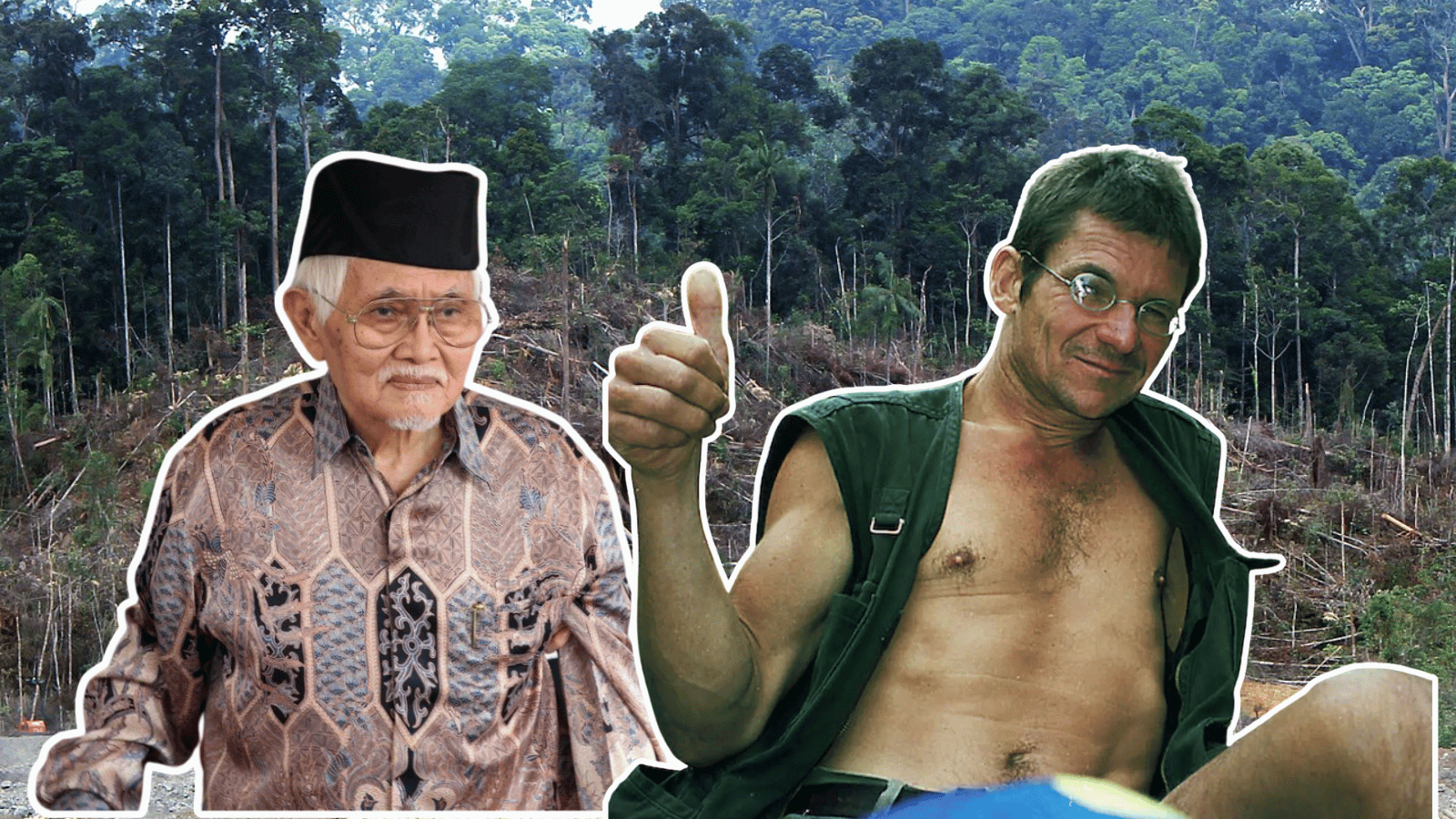
After weeks of investigation into one of the greatest environmental crimes most people have never heard of, a disturbing picture emerged. In the Malaysian state of Sarawak, on the island of Borneo, a single politician named Abdul Taib Mahmud had orchestrated the destruction of one of Earth's oldest rainforests — turning trees that had stood for centuries into $21 billion of personal wealth.
The numbers were staggering: an area of forest the size of England, gone. 2.5 million indigenous people driven from their ancestral lands. Between 2019 and 2023 alone, another 423,500 hectares destroyed — that's a football field every two minutes, around the clock, for four straight years.
Mapping how Taib built his corruption machine — appointing himself both finance minister and natural resources minister, dissolving environmental protections, granting logging licenses to relatives — reveals a system that seemed unstoppable. Perfect, even, in its total fusion of political power and environmental destruction.
But beyond the spreadsheets of devastation, there was a human story. Someone who had tried to stop it.
That story lives inside Carl Hoffman's The Last Wild Men of Borneo.
The book tells two stories, but the more compelling one belongs to Bruno Manser, a Swiss shepherd who in 1984 walked into the same Malaysian rainforest Taib was destroying. What happened next is one of the most extraordinary — and heartbreaking — environmental stories of our time. It's a story most people have never heard, about a man who gave everything to save a forest and a people, only to vanish without a trace.
But it's also a story about what his sacrifice taught the environmental movement — lessons we're still learning today.
Bruno Manser grew up middle-class in Basel, Switzerland, but he'd always been different. In the 1970s, while his peers chased careers, he chose to become a shepherd in the Swiss Alps, living without electricity or running water, making his own tools, seeking a simpler existence. By 1984, at age 30, he wanted to go deeper — to find people still living in harmony with nature, untouched by modern civilization.
He found the Penan.
The Penan were one of the last nomadic tribes on Earth, roughly 10,000 people living in Borneo's interior rainforest as their ancestors had for thousands of years. They owned nothing and everything — no permanent homes, but an entire forest. They hunted wild boar with blowpipes and poison darts, gathered sago palm to make flour, moved when the resources thinned, leaving the forest to regenerate behind them.
Hoffman brings this world alive through Bruno's journals and sketches. Here's Bruno learning to read the forest like a book — which trees fruit in which season, which vines hold drinking water, how to build a shelter from palm fronds that would keep you dry through torrential rain. The Penan taught him their language word by word: kayeu for tree, ba for water. They gave him a name: Laki Penan. The Penan man.
For two years, it was paradise. Then the chainsaws arrived.
What Bruno didn't know when he entered the forest was that Sarawak's new Chief Minister, Abdul Taib Mahmud, had just launched one of the most audacious resource grabs in history. While previous leaders had merely taken bribes from logging companies, Taib revolutionized corruption. He appointed himself minister of both finance and natural resources, giving him control over both the forests and the money they generated. He dissolved the forestry department entirely in 1985, eliminating environmental assessments and oversight. Then he handed out logging concessions covering millions of hectares — not through competitive bidding, but to his relatives, friends, and political allies.
These weren't small operations. Companies like Rimbunan Hijau and Samling were given territories larger than some European countries. In return, they kicked back millions through elaborate schemes — "consulting fees" paid to Taib's family members, shares in companies registered to his relatives, property deals that enriched his children. One Japanese investigation found timber companies paid $9.7 million in kickbacks through Hong Kong shell companies controlled by Taib's brother. The genius was its circularity: timber money bought political power, which granted more timber licenses, which generated more money.
While Bruno was learning to hunt with blowpipes, Taib's companies were pushing deeper into Penan territory each day. Clear blue streams turned brown with erosion. The wild boar fled. Sago palms were bulldozed. Sacred burial sites were destroyed.
The Penan didn't understand what was happening. They had no concept of land ownership — the forest had always been there, like the air. Now men with chainsaws were telling them it belonged to companies in faraway cities.
This is where Bruno transformed from observer to activist. He helped organize the first blockades in 1987 — entire communities standing across logging roads, armed with nothing but their presence. Old women, young children, hunters who had never protested anything, linking arms in front of bulldozers.
The image was so powerful it went global. Hoffman describes how international media descended on Sarawak. Al Gore, then a US Senator, condemned the logging. Prince Charles called the treatment of the Penan "genocide." The BBC, National Geographic, and major newspapers sent crews. For a moment, it seemed like international pressure might actually work.
But Taib was smarter than that. While Bruno was teaching the Penan to blockade roads, Taib was building something far more sophisticated — a machine that turned trees into money and money into power. He controlled which companies got logging licenses. Those companies kicked back millions to his