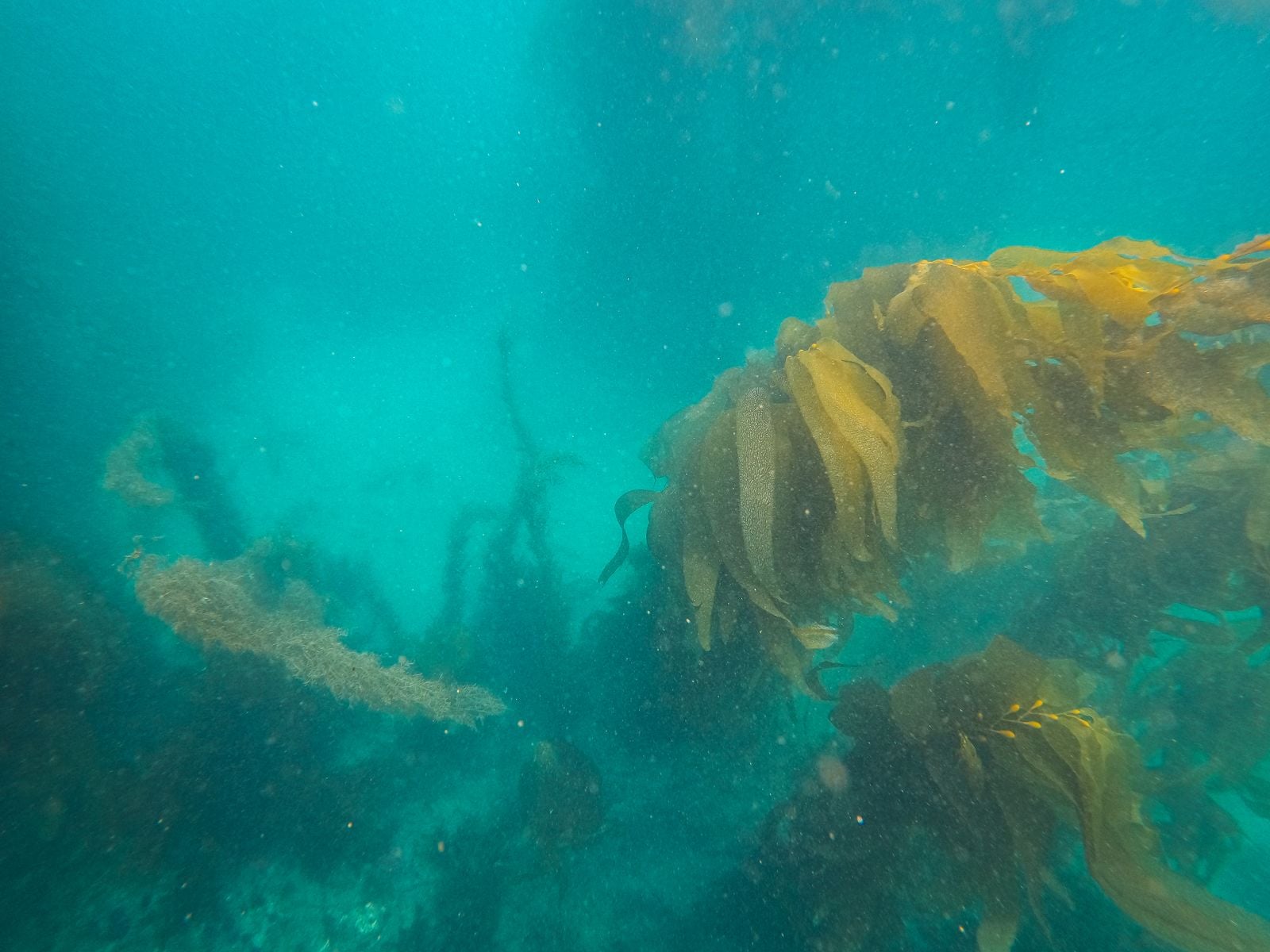
Kelp forests are disappearing from warming coastal waters, and the fight to bring them back is becoming one of the quieter conservation stories of the climate era.
They are easy to underestimate. To most people, kelp is either a backdrop for sea otters and divers, a strip of kombu in a broth, or something that washes up on the beach after a storm.
But the science tells a bigger story. A 2024 paper in Nature Geoscience estimated that, on average, 15% of seaweed production is exported across the continental shelf, equal to about 56 TgC per year. In plain English, kelp and other seaweed forests are not just coastal habitat. They are part of the ocean’s carbon machinery.
That matters because kelp forests are under pressure in many parts of the world. Warm water can weaken them directly. Urchins can finish the job by grazing down what remains. Once a kelp forest tips into an urchin barren or low-productivity turf algae, restoring it becomes much harder than simply letting nature bounce back.
California shows how quickly the damage can become visible. AP reported that purple urchins largely destroyed 96% of California’s iconic bull kelp forests between 2014 and 2020, harming red abalone and other marine life that depended on them.
The response has been hands-on and experimental. Divers remove or crush urchins. Scientists test lab-grown kelp. Restoration teams try to identify which patches can recover and which ones are likely to keep failing as the water warms.
The problem is scale. Clearing a stretch of reef is possible. Rebuilding whole coastal ecosystems in a warming ocean is something else.
That is where the food economy becomes interesting. In places where seaweed is already part of daily life, kelp is not only a conservation symbol. It is an ingredient, a crop, a coastal livelihood, and a cultural habit.
Japan’s relationship with kombu is the obvious example. South Korea’s seaweed economy is another. In both cases, the argument for protecting marine forests does not have to rely only on abstract carbon storage or underwater biodiversity. It can also point to food, jobs, coastal identity, and the value of keeping a living resource alive.
That does not make restoration simple. A seaweed-eating culture cannot cancel out marine heatwaves, overgrazing, pollution, or emissions. But it can change the politics of care. A forest that feeds people has a more immediate constituency than one that only stores carbon out of sight.
This may be kelp’s strongest argument for survival. The ecosystems most likely to be restored are not always the ones with the cleanest scientific case on paper. They may be the ones tied most directly to what people eat, sell, cook, and recognize as worth saving.
None of that removes the larger condition. Kelp restoration cannot succeed indefinitely in seas that keep warming. Without serious emissions cuts, more kelp beds will keep giving way to simpler, poorer underwater landscapes.
But the lesson is still useful. Conservation tends to move faster when an ecosystem becomes visible in everyday life. For kelp forests, the path back may run not only through the lab or the dive boat, but through the pantry.