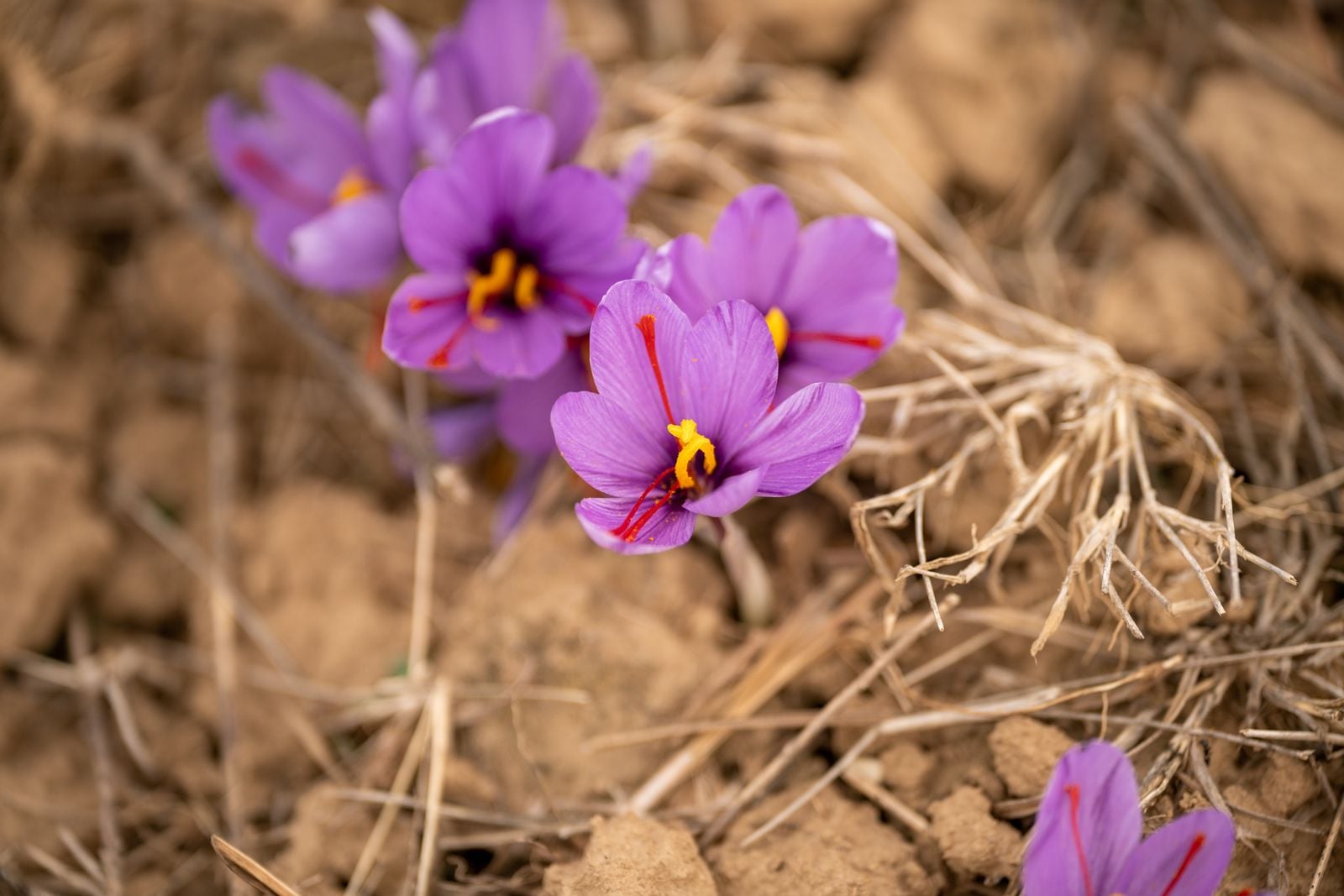
In the Navelli highlands of Abruzzo, saffron pickers head into the fields before dawn each October morning, moving between rows of low purple flowers with baskets tucked against their hips. They pick the whole bloom, not the threads — that comes later, at a table, indoors, in the slow afternoon hours when the light is good and the eyes are still fresh. The flowers must come out of the ground while they're still closed, because once the sun opens them, the crimson stigmas inside start losing the volatile compounds that give saffron its price.
Everything about the spice is a rebuke to industrial farming.
Roughly 75,000 crocus blooms are needed to produce a single pound of dried saffron. In Abruzzo, it takes 200 blooms to produce a single gram, which works out to around 90,000 flowers per pound of the local Zafferano dell'Aquila DOP. The math is not a marketing flourish. It is arithmetic that has held steady for a thousand years because no machine has figured out how to do the job.
The conventional story about expensive food is that it's expensive because it's rare, or because someone has managed to build a good scarcity narrative around it. Saffron is expensive for a plainer reason. The bottleneck is human fingers.
The three threads inside every flower
The Crocus sativus is a small autumn-flowering bulb, purple-petaled, low to the ground. Inside each flower are three thin crimson stigmas — the female part of the plant — and these are what become saffron. Three per flower. That's the whole yield.
You cannot mechanise this. The stigmas are delicate, tangled among yellow stamens that must be discarded, and any damage to them affects both aroma and colour. So the flowers go into baskets in the field, and then a second workforce — often the same workers, sometimes their grandmothers, sometimes their kids — sits at a long table separating the red threads from everything else by hand.
Then the threads are dried, traditionally over a low wood-burning grill, until they've lost most of their moisture and gained the deep, almost metallic aroma that survives the trip into a pot of rice.
Why the picking has to happen before sunrise
The window is narrow. Crocus flowers bloom overnight and open with the sun. Once open, the stigmas are exposed to light and heat, which degrade the crocin, picrocrocin, and safranal — the three compounds responsible for saffron's colour, taste, and smell, in that order.
Pickers work in the cold. It's late October in the Apennines. Fingers stiffen, backs ache from bending, and the flowers have to be collected quickly enough to beat the sun but gently enough not to bruise the petals. The whole operation is a race against a natural clock that has never negotiated with anyone.
Abruzzo produces only about 20 kilograms of saffron each year across the entire region — roughly 44 pounds — and it sells for around €30 per gram. That's €30,000 a kilogram, or close to $15,000 a pound at current exchange rates. The price is a direct reflection of how many human hours went into it.
The monk, the umbrella, and a thousand years of trade
Saffron didn't originate in Italy. It's believed to have started in Iran around the 10th century BC, then travelled the Silk Road, showing up in Ovid's poetry, in the Bible, in Egyptian cosmetics.
The Abruzzo story starts in the 14th century with a Dominican monk who, according to local legend, was so struck by the purple crocus fields in Spain that he brought bulbs back to his home village of Navelli hidden inside an umbrella. The soil turned out to be almost identical to what the crocus wants: high altitude, low rainfall, well-draining limestone, plenty of sun.
For centuries, saffron was L'Aquila's export crop. The 15th-century Basilica di San Bernardino, one of the city's churches, was largely funded by profits from locally-harvested saffron during the Middle Ages. Saffron, like wool, helped build the buildings.
What the spice actually does in the body
The pigment that makes saffron look like it does — that startling, almost radioactive red-orange when it hits warm liquid — is a carotenoid called crocin. Carotenoids are the same family of compounds that make carrots orange and tomatoes red, and they act as antioxidants in the human body.
Saffron has drawn a lot of research interest in the last decade, most of it small-scale but consistent enough to be interesting. Saffron extracts showed measurable effects on prostate cancer cell lines in vitro, with researchers pointing to crocin and safranal as the likely active compounds. Trials have also looked at saffron for mild depression, PMS symptoms, and age-related macular degeneration, with results generally described as promising but preliminary.
None of this makes saffron a medicine. It makes it an ingredient that's slightly more than an ingredient, which is roughly what every culture that has used it for a thousand years has intuited.
What happens when the industrial model tries to muscle in
Here's where the story gets interesting for anyone who thinks about food systems. Because saffron is so expensive by weight, and because global demand keeps climbing, there are constant efforts to scale it up — to find a place where labour is cheaper, or a technique that eliminates some of the human input.
Most of these efforts fail in instructive ways.
In India, the Regional Agricultural Research Station in Visakhapatnam has been testing saffron as an alternative high-value crop for tribal farmers in Andhra Pradesh's Agency areas. The trials worked — but only under protected conditions like glasshouses and shade nets. Plants grown in open fields didn't flower at all. A private company has proposed cultivating saffron on 30 acres in the first phase, with plans to reach 3,000 acres over the next decade, aimed largely at export markets in the US, Australia, and the Middle East.
The picking still has to happen by hand. The threading still has to happen by hand. What changes with scale isn't the process — it's the number of people needed to do it, and the wages they can be paid.
The premium isn't a marketing trick
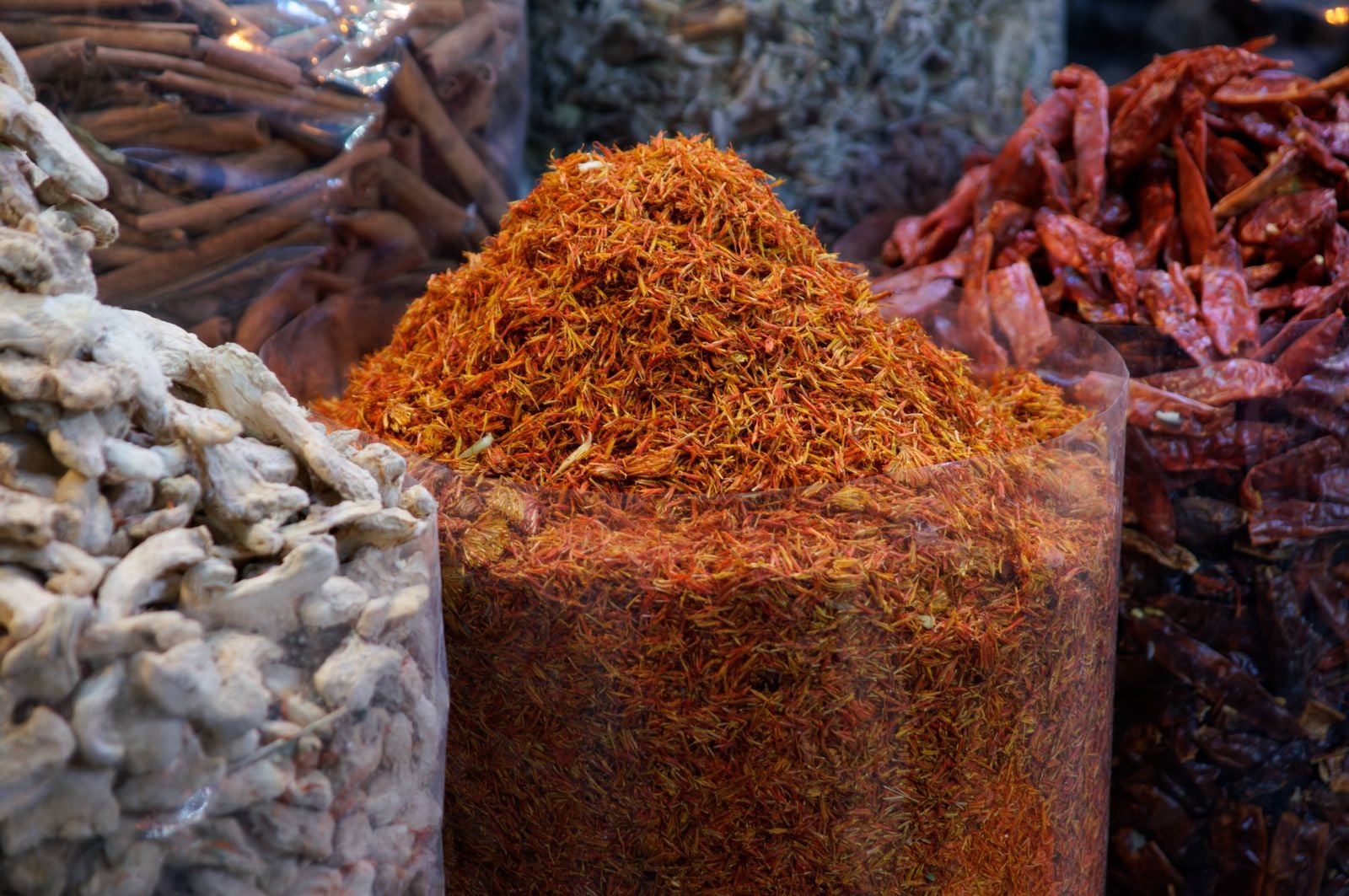
You can get cheap saffron. It'll be adulterated with safflower, marigold petals, or turmeric-dyed corn silk. It'll be old. It'll be from a supply chain where someone shaved the labour costs by paying pickers less than the flowers were worth to their hands.
Real saffron is expensive because 75,000 flowers is 75,000 flowers, and there's no version of the math that makes that cheap. When a spice tin at a specialty shop costs $12 for half a gram, the price is honest. It's the €5 jar at a tourist stall in Marrakech that's lying.
This is one of those cases where the market signal is doing what it's supposed to do, which is unusual enough to be worth noticing.
How a spice holds a community together
L'Aquila has had a difficult recent history. The 2009 earthquake killed 309 people and injured more than 1,600, and reconstruction is still visible — or its absence is — throughout the historic centre. The economy is largely agricultural: wine, olive oil, wheat, maize.
Saffron is a small part of the picture in volume terms, but a large part in narrative terms. The cultural association Le Vie dello Zafferano — the Paths of Saffron — safeguards the DOP designation, which about 50 producers across 13 villages must comply with. Every year on the last weekend of October, the association hosts a harvest festival where children and adults go into the fields to pick flowers, attend workshops, and eat saffron-flavoured gelato. Local producers make a saffron-infused blonde beer called D'Oro Rosso — "Red Gold."
Michelin-starred chefs in L'Aquila serve as ambassadors of Zafferano dell'Aquila DOP, using the spice in ways that go well past risotto.
This is what a food system looks like when it hasn't been optimised for scale. It's a spice that stays in the town that grows it, that funds a bakery here and a beer there, that pulls people out of bed at 4am in October and gives them something to sell in November.
What saffron teaches you about food economics
Most of what we eat is cheap because someone, somewhere, figured out how to remove humans from the process. Wheat gets combined. Tomatoes get picked by machine. Even avocados — which still require ladders and human hands — have been squeezed into a supply chain that keeps the price at a supermarket-friendly level by keeping picker wages low.
Saffron sits outside all of that. It's the same spice it was in Cleopatra's Egypt. The same process. The same crimson threads pulled out of the same purple flowers by fingertips that will be stained yellow by evening.
When you dissolve a small pinch of it in warm water and watch the colour bloom outward — that fast, that gold — you're watching about 500 flowers do their one job at once. Someone bent down 500 times in the dark for that pinch.
It's a useful thing to know before dinner.