The famous 227 figure sounds like a precise count of everything people decide about food without noticing. It was not.
The number came from estimates supplied by participants in a 2007 Cornell study, not from researchers observing hundreds of decisions unfold across an ordinary day. More recent researchers have argued that the method inflated the total, while still recognizing that the way food is arranged can make some choices easier than others.
That leaves a less dramatic but more useful idea. A kitchen counter cannot be shown to matter more than every diet, but what remains visible and convenient can support choices a person already wants to make.
What the 227 figure actually measured
Brian Wansink and Jeffery Sobal asked participants to estimate how many decisions they made each day about eating and drinking. The initial average was 14.4.
Participants were then asked separate questions about when, what, how much, where, and with whom they ate. Those estimates were multiplied by the reported number of meals, snacks, and drinks before being added together. That calculation produced the much larger average of 226.7.
Wansink and Sobal interpreted the gap as evidence that people overlook most of their food decisions. But the study did not directly observe 226.7 separate decisions, nor did it establish that the difference represented 212 unconscious choices caused by the environment.
Why researchers now question the number
In 2025, Maria Almudena Claassen, Jutta Mata, and Ralph Hertwig examined the calculation in Appetite. The Max Planck Institute for Human Development explains that they identified a problem known as the subadditivity effect.
People tend to produce a higher total when one broad estimation question is divided into numerous smaller questions. In this case, adding estimates for several categories can create a large number without demonstrating that every item represents a distinct real-world decision.
The researchers therefore concluded that the high number of supposedly mindless decisions was not an empirically observed reality. They also warned that presenting food choices as overwhelmingly unconscious could leave people with an unnecessarily diminished sense of control.
The journal has since added another reason for caution. In 2026, Sage issued an expression of concern for the 2007 article, stating that concerns had been raised about its data and that an investigation was underway.
An expression of concern is not the same as a retraction. It does mean the 227 figure should not be presented as settled evidence, especially when the paper’s measurement method has also received a direct scholarly critique.
What kitchen layout can still do
Questioning the number does not require pretending that surroundings are irrelevant. Claassen and her colleagues discuss self-nudging, which means arranging an environment so that choices aligned with a person’s goals are easier to make.
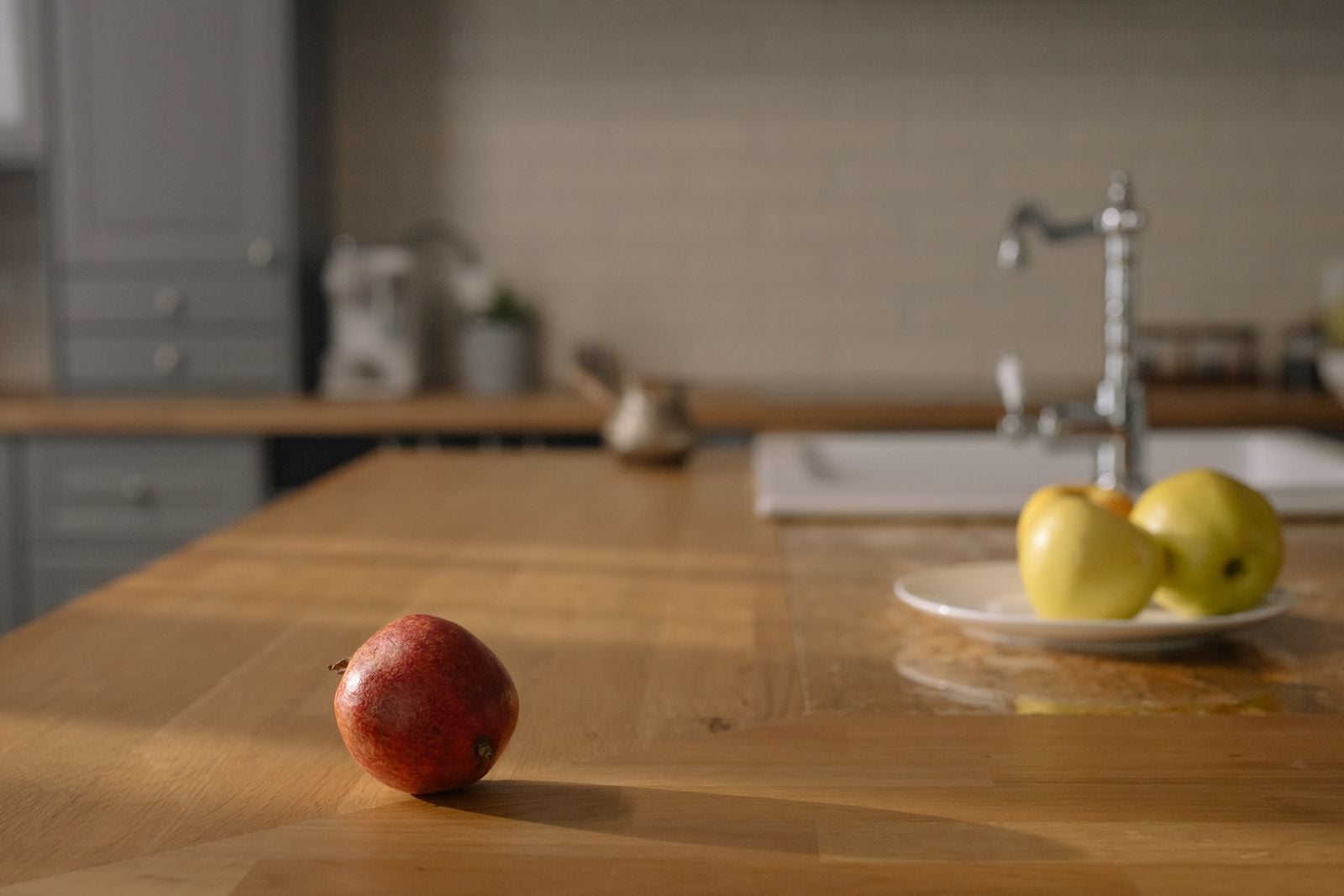
Pre-cut fruit placed within easy reach requires less effort than fruit hidden at the back of a refrigerator. Sweets kept out of sight provide fewer visual reminders. A visible water pitcher can make water the most convenient option when someone walks into the kitchen thirsty.
These changes do not prove that a counter overpowers every diet or determines what someone will eat. They alter visibility, convenience, and friction. Those smaller effects are more credible than the claim that an unseen collection of 212 daily decisions has been handed over to the room.
Research from Aston University adds another layer, although it does not specifically test kitchen counters. A 2024 study reported associations between parents’ and children’s eating styles, as well as links involving parental feeding practices.
The findings support the ordinary observation that children learn within a broader family food environment. They do not establish that countertop placement independently determines a child’s eating or matters more than direct feeding practices, preferences, access, or other influences.
Why awareness and environment can work together
The choice is not between monitoring every bite and surrendering control to the kitchen. Awareness can help someone identify the few situations that matter most, while environmental changes can reduce the effort required when those situations recur.
If fruit is part of someone’s goal, washing it in advance and placing it where it will be seen may help. If an open packet encourages distracted snacking, putting it away after serving a portion creates a natural pause. These are practical arrangements, not evidence that willpower is useless.
The counter works best as support for an intention, not as a substitute for one.
The separate Cornell study about purpose
Anthony Burrow’s Contribution Project at Cornell offers an interesting parallel, but it should not be treated as evidence about food decisions. Beginning in 2019, the project randomly selected participating high school and college students to receive $400 for a contribution benefiting themselves, their families, or their communities.
According to reporting on Burrow’s preliminary results, recipients scored higher than non-recipients on measures including purpose, belonging, and well-being six to eight weeks later. At the time of that reporting, the findings had not been peer-reviewed or published.
Kendall Cotton Bronk, a professor of psychology at Claremont Graduate University whose research focuses on purpose in young people, told the publication that popular discussions often emphasize personal needs while overlooking meaningful contribution to others.
The project suggests that giving young people resources and an opportunity to act may support a sense of purpose. It does not show that environmental shifts generally outperform intentional ones, and it cannot validate the disputed 227 figure.
What belongs on the counter
The strongest conclusion is also the most modest. The exact number of food decisions people make remains uncertain, and the gap between 14.4 and 226.7 should not be treated as a measurement of unconscious behavior.
Still, kitchens contain repeated cues. What is visible, prepared, and easy to reach may influence which option gets considered first. Arranging those cues around a real goal can make an ordinary Tuesday evening require a little less effort.
The counter is not stronger than every diet. It is simply one place where intention can be turned into convenience before the tired version of a person walks into the room.