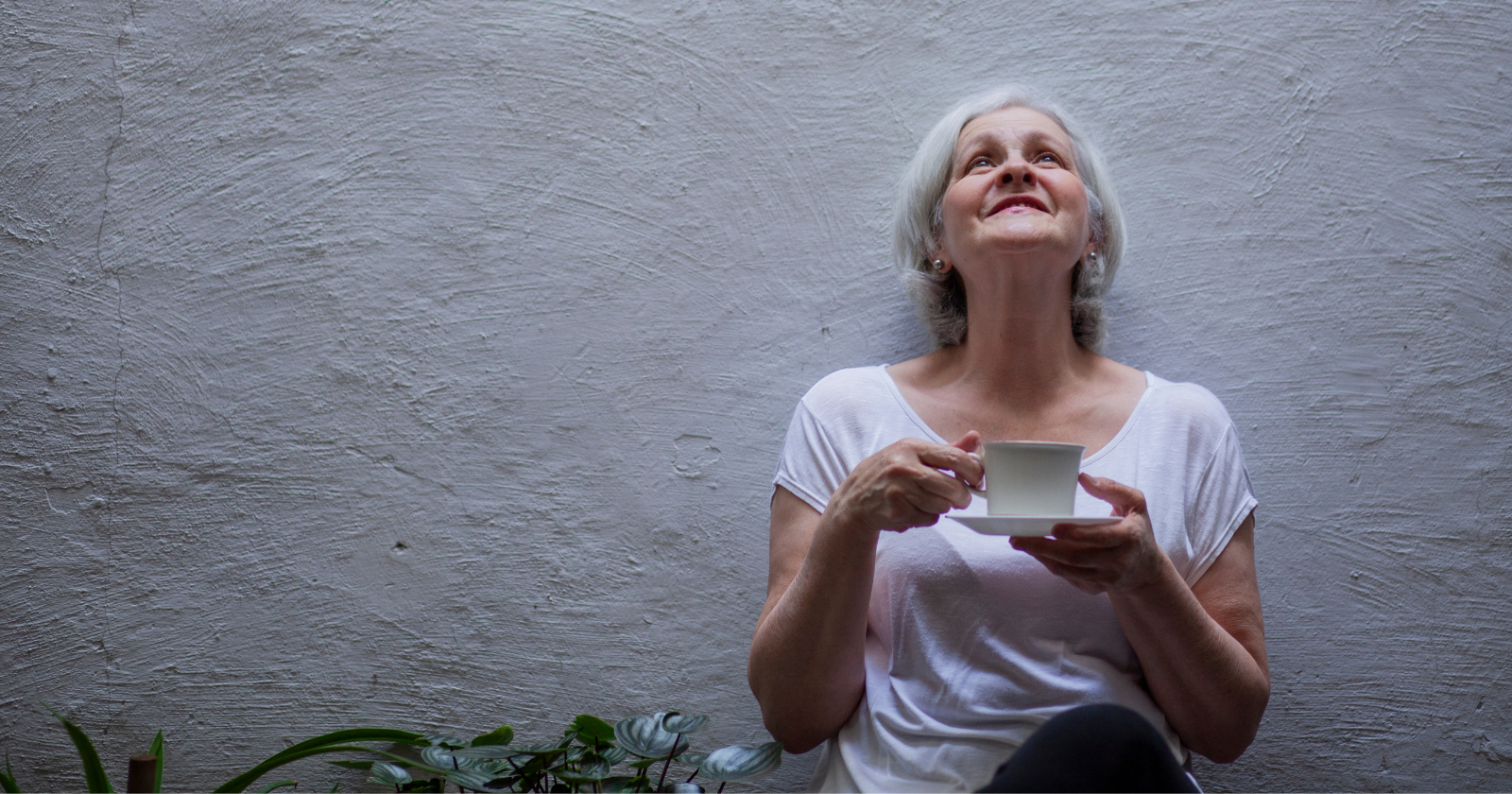
Something shifts in the sixties that doesn't announce itself. The rituals get smaller, more particular, and almost stubbornly private: a chair that nobody else sits in, a window that has to be open by 7 a.m., a long route home from the pharmacy that adds eleven minutes and saves something harder to name.
The conventional reading of this is decline. People slowing down. Getting set in their ways. Becoming, as the cliché goes, a little eccentric.
The pattern tells a different story. Nearly one in four adults over 60 who begin in poor well-being can regain optimal well-being within three years, and the people who make it there aren't usually doing one dramatic thing. They're often the ones with stable sleep, daily movement, social ties, and small structures that hold their days in place.
The rituals aren't eccentricity. They're scaffolding.
1. Eating breakfast outside, even when it's a little too cold
People in their sixties start taking the first meal of the day outdoors with surprising consistency: on a balcony, a back step, a patio chair that's been there for years and only now gets used every morning.
It looks like a weather preference. It can function as a soft transition from sleep to day, all stacked into twenty minutes of coffee, daylight, air, and quiet. For some people, the point is less about health optimization than about letting the day begin at a human pace.
It also accomplishes something the kitchen table can't: it makes the day feel chosen rather than entered.
2. Keeping one room nobody else is allowed to redecorate
Ask people in their sixties about their house and a particular room tends to come up: a study, a sewing room, a corner of the basement, a small bedroom that used to belong to a child and has been quietly annexed.
The furniture is whatever they like. The walls are whatever color survived the last family vote. Nobody is allowed to suggest improvements.
This isn't territorialism. It's the architectural version of what happens after decades of compromise: a small physical space that reflects one person's actual taste, unfiltered through anyone else's opinion. The self that's been on standby for years powers back on slowly, and it tends to want a room.
3. Taking the long way home from every errand
The pharmacy is six minutes away. The route home takes seventeen. This is on purpose.
The detour usually involves a particular tree, a view of water, a street with good gardens, or simply roads with fewer left turns. It's the deliberate insertion of slack into a day that used to be measured in efficiencies.
The wellness frame would call this mindfulness. The honest frame is that decades of optimizing every minute for other people's schedules eventually produces a craving for the opposite: time that doesn't have to earn its keep. The long way home is doing more than it looks like it's doing because it gives the day back a margin.
4. Refusing to eat standing up
The countertop meal, the handful of crackers, the half sandwich eaten while reading mail, quietly disappears in the sixties. Plates come back out. Napkins, even cloth ones, reappear.
It looks formal. It's actually the opposite of formal. It's the recognition that sitting down to eat is one of the few decisions in a day that says, without speaking, that the person doing it is worth the chair.
5. The 4 p.m. walk that doesn't go anywhere
Not exercise. Not errands. A loop around the block, sometimes twice, sometimes with a podcast and sometimes with nothing.
Physical activity is one of the factors linked with regained well-being later in life, but something more specific emerges in ordinary routines: it's not always intensity that matters most. It's consistency, and the social and psychological scaffolding that habitual movement creates.
A loop walk at 4 p.m. is a meeting with yourself that you keep.
6. Reading the physical newspaper in a specific chair
The chair matters. The paper matters. The order, local section first, then opinion, then the crossword, matters in a way that would have seemed absurd at forty.
What's happening here isn't only nostalgia. It's sustained attention in a fixed location, at a fixed time, in a world that keeps trying to break attention into smaller pieces. People in their sixties often seem to understand that this kind of focus is worth protecting before it disappears entirely.
7. Keeping a single drawer that's only theirs
Not a desk. Not a room. A drawer.
It contains items that don't go together by any logic: a letter from 1987, a small notebook, a piece of sea glass, a watch that doesn't work, a photograph of someone who's been gone twelve years. Nobody else opens it.
The drawer is a small museum of self. It exists because the rest of the house is shared, and a person needs at least one square foot of unshared space to remember which parts of their life were just theirs.
8. Cooking the same meal on the same night every week
Soup on Sunday. Pasta on Thursday. Whatever the rotation, it stops being negotiable.
The conventional reading is rigidity. The actual function is cognitive offloading: one decision permanently removed from the week so the energy can go somewhere else. It's also, for people who spent decades cooking around other people's preferences, often the first meal that's purely theirs.
There's a particular kind of loneliness that arrives the first time someone cooks a full meal for themselves after years of feeding a family, and the standing weekly meal is one way people answer it. The repetition is the comfort.
9. The 9 p.m. hard stop on news and screens
Not 10. Not whenever. Nine.
The phone goes on the kitchen counter. The television goes off. What replaces it is sometimes reading, sometimes music, sometimes just sitting in a room with another person and not saying much.
The mental health field has been making an increasingly sharp distinction between the absence of distress and the active presence of well-being: positive mental well-being existing on its own continuum, not simply as the inverse of illness. The 9 p.m. stop isn't only avoiding harm. It's protecting the conditions in which something quieter can grow.
10. The unstructured Saturday morning
Nothing scheduled. Nothing required. The day starts when it starts, and the first three hours belong to whatever wants them: a book, a garden, a phone call to one person, a recipe pulled out of a drawer.
This is the ritual that takes the longest to develop because it requires the most undoing. People who spent thirty years with Saturday mornings claimed by other people's needs don't reclaim them in a week.
But the people who get there describe it the same way: it's the part of the week where the rest of the week makes sense.
What the rituals actually do
None of these are dramatic. None of them would show up neatly on a wellness checklist or a longevity podcast. They're too small, too specific, too embarrassing to explain to anyone who hasn't lived long enough to need them.
But the pattern underneath them is consistent with what well-being research keeps finding. The people who recover well-being after a difficult period aren't necessarily the ones who optimize any single domain. They're often the ones who build small, daily, mostly invisible structures that touch several at once.
Eating breakfast outside is light, air, and unhurried time. The long way home is movement, contemplation, and refusal of urgency. The drawer is identity. The chair is attention. The Saturday morning is autonomy.
Even social factors, which consistently flag as protective, show up in the rituals in surprising ways. Solitary rituals aren't always the opposite of connection; sometimes they're what makes connection sustainable. The person who eats breakfast alone outside is frequently the same person who shows up most fully at dinner.
There's a version of late midlife where the appetite for bigger experiences gets replaced by an appetite for longer ones: the same walk, the same chair, the same window, repeated until the ordinary finally feels earned.
The rituals are how that appetite gets fed.
And the quiet thing nobody tells you about your sixties is that the people who seem most at peace aren't the ones who simplified everything. They're the ones who kept ten small, specific, slightly inconvenient rituals and stopped explaining them to anyone.