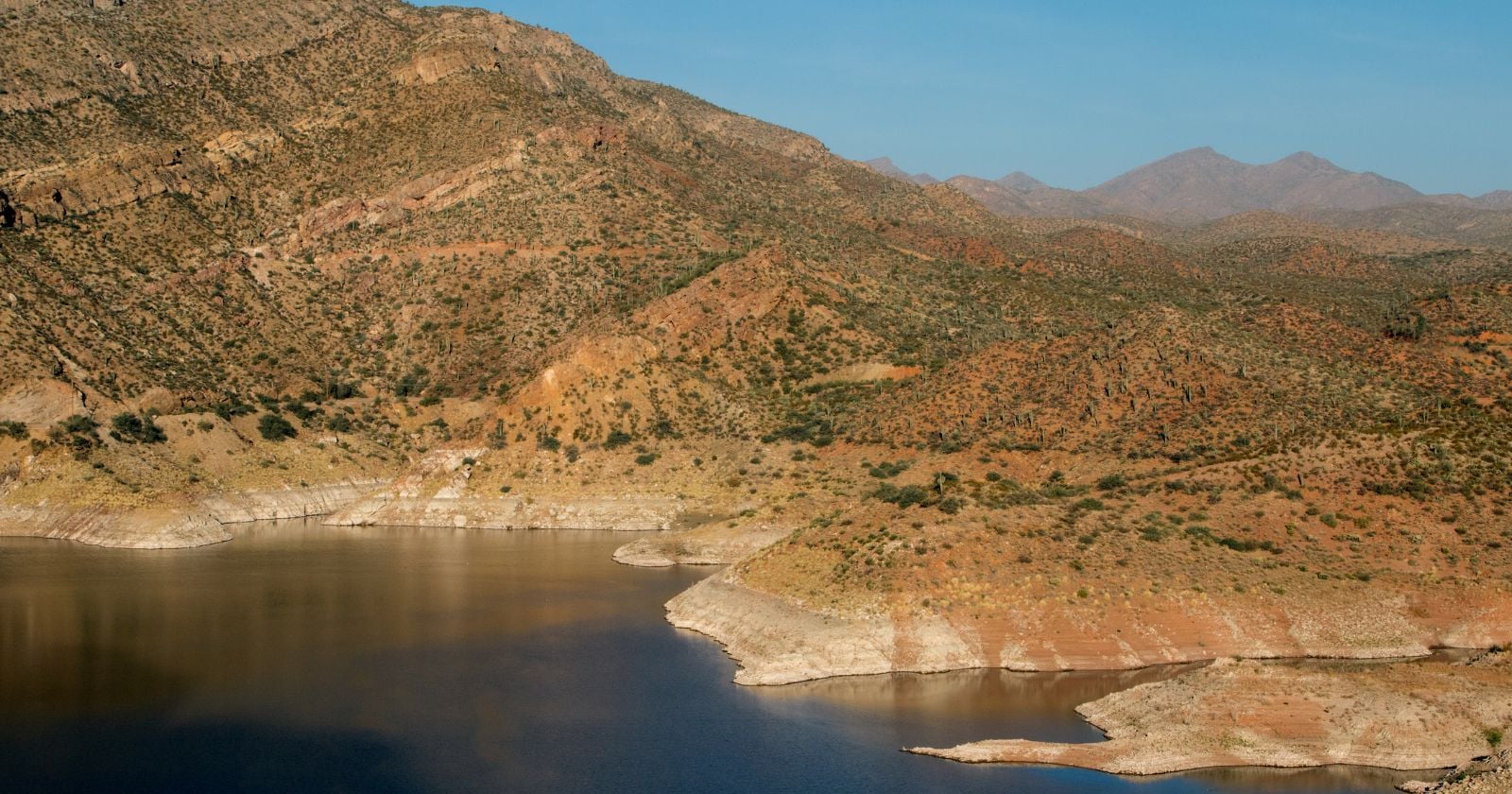
Arizona's San Carlos Reservoir, once one of the state's largest bodies of water, is now a cracked basin holding less than 1% of its capacity — and the fish that lived there are mostly dead. By late May 2026, the reservoir behind Coolidge Dam had collapsed to critically low levels, the result of a snowpack collapse so severe that mountain snow in the Gila River watershed was virtually absent. State officials closed the reservoir indefinitely on June 5, 2026 after decomposing fish raised public health concerns.
The conventional reading of a story like this is that it's another isolated drought event in a region that has always been dry. That framing isn't wrong — the reservoir has experienced numerous dry periods since it filled in 1930 — but it misses the harder question. The frequency, severity, and ecological cost of these cycles are shifting, and the buffers that used to absorb them are thinning out.
What actually happened at San Carlos
The Gila River runs from the mountains of southwestern New Mexico into the desert lowlands of Arizona, and in good years, snowmelt off the Mogollon Mountains and Black Range refills San Carlos through spring. In 2026, that didn't happen. According to NASA Earth Observatory analysis of Landsat imagery, the watershed's mountain snowpack registered at just 2 percent of the 1991-2020 March median, and April streamflow into the reservoir was 39 percent of normal.
Mandatory water releases for downstream agriculture finished the job. By June, the reservoir was a shallow puddle ringed by tamarisk, willow, cottonwood, and sedge. The May 22, 2026 Landsat image shows the stark contrast with three years earlier in June 2023, when the reservoir held roughly 60% of capacity. Same lens, same angle, different planet.
The fish kill followed the physics. Shallow, warm water holds less dissolved oxygen, and when a reservoir collapses to a fraction of its volume, hypoxia sets in fast. Largemouth bass, black crappie, bluegill, channel catfish, flathead catfish, and stocked brown and rainbow trout died together. The San Carlos Recreation and Wildlife Department warned that decomposing fish posed risks to anyone attempting to boat or fish, which is why the closure is indefinite rather than seasonal.
The historical pattern, and what's different now
San Carlos has done this before. When President Calvin Coolidge dedicated the dam in 1930, humorist Will Rogers reportedly looked out at the dry, grassy lakebed and quipped, "If this were my lake, I'd mow it". The reservoir has experienced numerous similar low periods in its 96-year history.
The pattern of fish kills at San Carlos shows a compressing timeline. Major events have occurred with increasing frequency — a legendary 1976-1977 drought killed an estimated 5 million fish and required a five-year recovery period, with another major die-off in 2018 — and each recovery is happening against a worsening regional baseline. The Gila River's headwaters in New Mexico are experiencing severe drought conditions.
A recovery from a fish kill means rebuilding invertebrate populations, restoring spawning conditions, and giving water chemistry time to stabilize. Historical recovery windows have stretched over years. Whether the system has that kind of recovery time before the next collapse is the question worth sitting with.
The downstream economics nobody talks about
The release schedule that drained the last of San Carlos wasn't bureaucratic carelessness. It was contractual. The reservoir exists primarily to deliver water to downstream agriculture, and those obligations don't pause for a bad snow year. When the choice is between holding back water to protect an aquatic ecosystem and releasing it to keep cotton, alfalfa, and pecan operations viable, the legal framework decides — and the framework was written when snowpack collapse at these levels was inconceivable.
This is where the story stops being about weather and starts being about systems. Western U.S. water allocation was built on hydrological assumptions from a wetter century. Each drought cycle exposes that gap, and each gap gets papered over with emergency measures rather than redesigned. The fish in San Carlos are a downstream cost of an upstream policy that hasn't caught up to its inputs.
The broader pressure on biodiversity from a warming, drying climate is something VegOut has covered before in a piece on accelerating species loss, and the San Carlos event is a small, local instance of the same pattern: ecosystems collapsing faster than the institutions managing them can adapt.
What the next few months will tell us
There is a plausible recovery path. A NOAA seasonal monsoon outlook issued in May 2026 estimated a 33 to 50 percent chance of above-average rainfall across the region during summer, with strengthening El Niño conditions in the Pacific that can increase the likelihood of heavy rainfall across the Southwest. If the monsoon delivers, San Carlos could refill substantially before winter.
But a refilled reservoir isn't a restored one. Even generous summer rains won't reseed the fishery overnight. Restocking programs will need to wait for water chemistry to stabilize and oxygen levels to hold. The reservoir's recreational economy — fishing licenses, boat rentals, the people in the surrounding community whose income depends on a functioning lake — is offline for an indefinite period regardless of how much it rains in July.
The harder analytical point is this: hoping for above-average rain is not a plan. It's a hope. The communities and ecosystems downstream of Coolidge Dam need infrastructure and allocation rules that work in scenarios where rain doesn't arrive on schedule. The fish kill at San Carlos is what happens when the buffer between hope and policy runs out.
The pattern worth watching
San Carlos is a small reservoir in a remote part of Arizona, and its closure won't make most national news cycles for long. What makes it worth paying attention to is the compression of the cycle. The lake has always been a marginal proposition — Will Rogers saw that in 1930 — but the gap between dry years used to be wide enough for recovery. The current dry period is multi-year, the snowpack baseline is shifting downward, and the agricultural draws that empty the reservoir are locked in.
For anyone tracking how climate stress translates into actual losses — species, jobs, food systems, recreational economies — these are the case studies that matter. San Carlos matters because similar pressures are building on reservoirs across the Colorado River basin, the Rio Grande system, and inland lakes from California to Utah. The Coolidge Dam story is a preview, not an outlier.
The fish kill will be cleaned up. The reservoir may refill. The harder question — whether the systems managing Western water are prepared for a future where extreme snowpack failures aren't statistical anomalies — remains open.